IdeaJones

Tag: writing

  • NaNoWriMo Is Almost Here!

    NaNoWriMo Is Almost Here!

    If you’ve ever uttered the words, “I’d like to write a book some day,” then it’s time to take a chance on your dream. National Novel Writing Month is almost here (starts November 1), and if you go to https://nanowrimo.org , you can sign up (it’s free) and join other writers working on their books. Lots of budding novelists bloom in November by taking part in this.

    It holds you accountable. You log in every day in November and submit your word count for the day, and it tracks your progress. You’d be surprised how far you can get with just a little every day. Sure, some weeks you can come up with hours to write, but other days you may have only 30 minutes. Thirty days hath November, which means that by the end of the month, with just 30 minutes a day, you’ll have put in at least 15 hours on your book!

    Our NaNoWriMo book for 2018: East-West Crazy

    Our NaNoWriMo book is “East-West Crazy,” which is a Women’s Fiction novel with dark humor. It’s already started, but I plan to make real progress in November, and I’m looking forward to it.

    My mom used to say that time is a gift so precious, we rarely give it to anyone. For many of us, this is especially true of ourselves. But even if it’s only 15 minutes a day, that’s one whole work day you invested in yourself and your dreams by the end of the month. You’re worth that… and no matter how tight your budget may be, you can afford 15 minutes a day.

    By the end of the month, your “some day” will be a lot closer.

  • Gatekeeper Secrets: 5 Ways To Start Off Ahead

    Continuing my online writer conference (since I had to miss the PNWA con this year). Day 5 — Gatekeeper Secrets

    Because I interviewed a bunch of “gatekeepers,” people who look over submissions and decide if they merit consideration, I have some advice to pass along. Also, I’ve been a gatekeeper (I was once an Editor for a magazine). So I’ve had to climb Mt. Slushmore in search of gold nuggets myself.

    Some of this may sound obvious. Most of it sounds obvious once you’ve heard it. But an agent at a recent conference talked about some of this stuff and it reminded me that it’s still the place most hopeful beginners fall on their climb to “published.” It also applies to other arts as well, fine art, music, acting, etc.

    Even for people who have been published, it’s good to be reminded that The Basics still count. I’m trying to go from “published in newspapers and magazines” to “published book author,” so I’m climbing Mt. Slushmore again myself. Since we’re trying to climb Mt. Slushmore and reach the peak, let’s start at the bottom:

    5) Don’t bother anyone until you’re ready to go. This is at the bottom not because it’s unimportant, but because it’s the first step, and you shouldn’t even attack the mountain until you complete it.  Agents want to know you have AT LEAST one book COMPLETED (or, if you’re an actor, have actually acted in something, taken classes, etc.).  You have a great idea? Good for you!

    Now make it. Write the songs, paint the painting, write the screenplay, etc.  If you’re trying to get an assignment to write an article (say for a magazine), and you haven’t had anything else published, be ready to work “on spec” and get paid only after you’ve written the article and the editor has decided to buy it and run it.

    I keep meeting nice people who have ideas for books, articles, radio stories, etc. that they “just need someone to write up,” or that they are writing and have yet to finish, who expect to find buyers for their uncompleted (or in some cases, unstarted) debut projects. You are up against people who are working at their craft. Taking it seriously. Developing their chops.  Be a professional.  Respect your idea by taking it seriously.

    After you’ve created it… edit, revise, polish. You’re trying to convince people you are a producer of diamonds. Have at least one polished diamond to show them.

    4) Get your supplies in order. Your book, your article, needs to be as good as you can make it. Professionally edited, if you aren’t an editor (and even if you are, have someone else check it, proofreading, notes, etc.).

    Workshop your novel, and pay attention to audience reaction. The best advice I’ve gotten so far (regarding improving my work) was, “Read it aloud.” Mark and I started participating in an open mic night for writers, in a book store, reading our work and paying attention to the reactions, both from the other writers, and the people in the book store. If attention is wandering, make a note where it starts to drift. I have to tell you, watching people linger in the stacks, taking a book off the shelf, putting it back, repeat, repeat, to hear the end of your story is a high.

    If you’re only writing for  yourself, great, you don’t need to know what people think. If you’re writing for an audience, you do.

    3) Research the mountain. No matter what professional mountain you want to climb, someone has climbed it before. Never in the history of humanity has information been so easy to come by. Sure, you have to look at the source and figure out how reliable that information is… but that’s doable. And you can average. If 25 people with professional credentials tell you that you need a certain sort of rope to climb that sort of mountain, you need to look closely into getting that sort of rope.

    For writers, you can go to professional conferences, join writing organizations, and yes, read. I mean, if you don’t like to read, why do you want to write? Take writing classes. Do writing exercises. In California, the California Writers Club, for example, has chapters all over the state, with workshops, speakers and sometimes even those open mic nights.

    If you were an acrobat, you would stretch a lot and do muscle-strengthening exercises (or you’d plunge to your death. At least writing isn’t that dangerous).  Whatever profession you’re trying to break into has its own series of stretches and exercises. Expect to do them.

    2) Don’t Be An Asshole. Good advice generally, but in the arts? Crucial. Plus, in the internet age, everything lives forever and comes back to haunt you. Be polite to the Receptionist. Don’t argue with people and get defensive (especially the people you’re trying to get to consider you. Have you ever been argued into liking someone? No, and neither have they). And every career has its ups and downs. You meet the same people going both directions, and sometimes they can give you enough of a boost to stop you from falling off the mountain entirely. It’s good ethics, good karma. Don’t fawn (don’t lick boots unless you’re addicted to the taste of shoe polish). Just be polite.

    This includes other people in your field. Again, both for professional reasons, and so you can like yourself. It’s not like there are only so many cookies, and if someone gets a cookie, you get none, so don’t run down other people.  It makes you look insecure. And it’s nice to be able to talk to people who get what you’re trying to do and think it’s worth doing (because they are, too). In radio, I’ve referred other engineers and field producers when I couldn’t take a gig — and they’ve referred me when they couldn’t.

    1) Follow. The. Guidelines. The most obvious advice is still the advice most people don’t bother to follow. If you’re submitting to agents or editors (or whatever is the equivalent in your art form), look at the website. Read the Submission Guidelines. Treat them like gospel.

    Every publication, every agent, has The Way We Do Things Here. By not reading and following those guidelines, you come off as an arrogant amateur. It’s basic courtesy, really. If you rang on someone’s doorbell and asked to come in, and he said, “Well, okay, but we have a white carpet, so you have to take your shoes off,” would you say, “I paid a lot for these shoes and matched my outfit to them, so even though everyone else takes his shoes off, I’m special?”  If you did, you should expect to feel the door slamming shut on your snout. It’s rude. It’s inconsiderate. And it’s dumb.

    It doesn’t matter how you like to do things. You are approaching that publication, that editor, that agent, and asking to be considered. You are ringing their doorbells. They aren’t ringing yours. Don’t cheese them off by swanning about, expecting them to bend the rules for very special  you.

    Some agents, for example, want the first ten pages. Others want the first  two chapters. Some want a bio and a synopsis of the book. Others don’t care about that unless they like the first chapter. Some want a letter. Others don’t.  Whatever they want to see, that’s what they feel they need to see in order to get a feel for whether or not they’re interested in you.

    As the agent at the workshop said, “By following the guidelines, you lift yourself above 50% of the people who submit from the start. And I’m not kidding. It might even be more than that.”

    Why start climbing by stepping on your own toes?

    Whatever mountain you’re trying to climb, be it Mt. Slushmore, the Hollywood Hills, or your mountain of choice, climb smart and you might just make it. I hope we both do. Good luck!


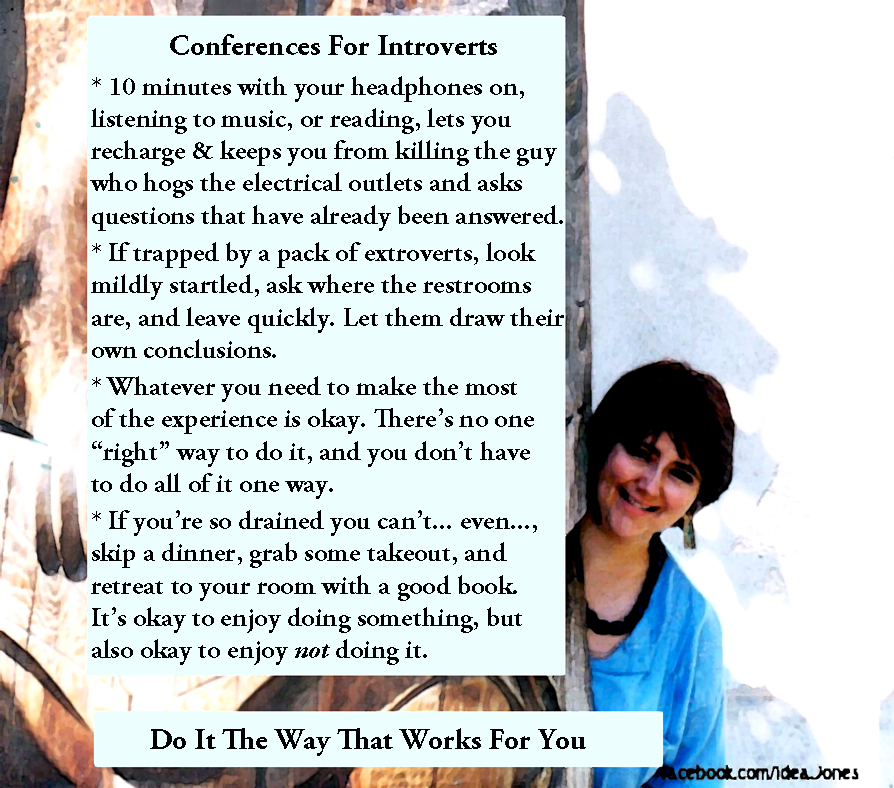
  • Conferences for Introverts: Big Events for People Who Like People In Small Doses

    Conferences for Introverts: Big Events for People Who Like People In Small Doses

    Huge groups of people! Yay?

    Often, extroverts (and there are far more of them than introverts, which makes sense — who is more likely to get out and find people to mate with?) think introverts don’t like people, or don’t like to go out.  They don’t understand that being an introvert has nothing to do with liking (or not liking) people. It’s about energy — what charges you, and what drains you.

    Extroverts are energized by being around people. They need to be around people as much as possible. This doesn’t mean they never like to be alone, but they don’t need to be alone.

    Introverts? We like being around people, but it drains our batteries. To recharge, we need to be alone. I can’t tell you how many times I’ve been running on fumes and really needed some alone time, only to be asked what was wrong or who made me mad. Nothing. Nobody. I just need to fill that battery — and being an introvert, that means some alone time.

    So how to cope with crowded events, like conferences and conventions? I’ve been going to more conferences lately, and having to think about how to get the most out of them (they’re expensive and you want to feel you got your money’s worth, which means identifying what take-away would be satisfying).  How to not drain my batteries to the point where I can’t take in any more input, or worse, Dr. Bruce Banner becomes The Incredible Hulk.

    The first step sounds obvious, but when you try it, you realize it isn’t. Accepting that you are an introvert, what you need to be at your best, and that it’s okay not to be an extrovert. Extroverts make up more of the population. The world is thus geared toward them. Like being left-handed in a right-handed world, introverts bump up against expectations that they want and need what extroverts do, and operate the way extroverts do. Nope.

    Where extroverts might look see, “6:30 PM: Cocktail Mixer” and think, “Hey! People! Fun! Drinks!,” your average introvert thinks, “Ooh. More people after a whole day of people. Trying to make conversation with strangers. Standing around feeling awkward. Meh.” This is because extroverts will get charged up and introverts will get more drained.  And if you say you just want to go to your room and watch tv, prepare to be asked if you’re okay. Several times.  It takes self-knowledge and self-acceptance to withstand well-meaning pressure to conform.  If you want to go and it sounds good, go and enjoy, and leave whenever you feel like it. If not? Don’t go, and enjoy, and hear the stories about what went on the next day.

    If you’ve met a few interesting people, you can also see if anyone wants to have dinner together, just a few of you. Then see them off to the mixer with your blessings. Best of both worlds. You get to really talk to a few people instead of making small talk with a lot of people, and then get your alone on.  Getting coffee is also good.

    Personally, I’d rather really enjoy and make a connection with a few people than try to paper a crowd with my business cards. The people I do chat with remember me, and I remember them.  Introverts tend to be good listeners.  I can’t give 50 people my full attention at the same time — but I can give 50 people my full attention one, two or three at a time.

    The next step is to plan a bit. Have those ear buds available. Have a book on you. Look at the schedule for a few minutes you can retreat from the crowd. The classes are usually too close together to give you a break. Get the feel of the event. Is it okay to be a few minutes late for something? Is there one you really can skip? It’s often not necessary to do every single thing available to you — and better to be really present for what you do attend.

    Really, the secret seems to be doing it  your own way, in whatever way works for you and most promises that you’ll be able to get the most from the event. My mom and I had a saying, “Better to be a really good donkey than a sub-par fake horse.” We’re all weird. Be weird in your own way and rather than trying to be a fake extrovert, be a really good introvert.

  • A Dog’s Guide To Humans: Piddle & Doody

    A Dog’s Guide To Humans: Piddle & Doody

    A word about wiz.

    You might want to go relieve yourself before you start reading this dispatch.

    Of all the things I’ve observed about humans, the most perplexing is their attitude toward their own bodies and natural processes. Honest to Dog, it’s confounding. I’ll see if I can make even minimal sense of it, but some of this you will just have to accept on faith. I swear on my favorite squeaky toy, what I’m about to tell you is true.

    • They are embarrassed by the fact that they poop.

    I’m not talking about someone seeing them poop. When someone watches you go, it’s awkward and weird, no doubt about it. I’m talking about simply acknowledging that you do poop, or pee, at some point in your day.

    I think it’s some sort of sacred ritual for them. They even have special rooms in which to relieve themselves. They also wash themselves in that same room, which is odd unless you consider it as part of a ritual. You have the shameful elimination, then the ritual cleansing. This might explain why it’s considered such a private event.

    Outside of the Altar of Elimination, though, they try hard to pretend they don’t have to go. Some humans use special code words for elimination. Piddle, which sounds like an endearment for a puppy, is actually a code word for peeing. There are many others. One is “tinkle.” I met a dog named Tinkerbelle and she said her name was very confusing as nobody ever rang a bell when she tinkled. I theorized that maybe they were saying it sounded like a bell when she tinkled. Human hearing is quite limited, after all. This seemed to satisfy her and make her far more happy with the situation.

    There are also many words for defecation, including “doody.” My humans like to watch historic recordings of the stories that appear on the glowing boxes. One featured a man in a cowboy suit who talked to a wooden toy he called “Howdy Doody.” I do not believe he would have greeted even a toy by saying, “Hello, Turd,” but “Howdy, Doody” seemed to be not only acceptable but much admired, to judge by the humans slapping their front paws together (known as “applause,” the equivalent of a happy tail wag).

    They have a great many words for peeing and for pooping, from those supposed to be rebellious (“shit”) to those meant to be euphemisms (“do your business,” for example. This one confused me quite a bit at first as it seems an odd business to be in).  A species only exhibits this behavior in regards to things seen as taboo.

    • Some of them are driven insane by elimination.

    Not their own, I hasten to add. They might be uncomfortable with their own elimination, but they are downright neurotic about ours. My own humans will not let me eliminate in their Altar of Elimination, although they do allow human visitors to do so, so I must go in the back yard. Strange as this is, it is nothing to the behavior of some humans.

    I have been told of dogs who are swatted with objects when they eliminate inside the dwelling. It has even entered their language. To be “hit with a rolled-up newspaper” is a general term for being corrected. It is uncertain what the thinking is, but I’m inclined to accept the explanation given to me by Runs With Nose Lifted (aka “Wowzer”), a Great Dane I met. He theorizes that as uncomfortable as humans are with elimination in general, some are driven mad in the presence of it. Wowzer said he solved the problem by going behind the sofa to eliminate.

    Another dog, Steps High And Walks Fast (aka “Charlie”), said she tried designating her own altar — the tiny room in which the humans store their clothing — but this proved displeasing to her human companions, so as of that morning, she had started going under their bed, which seems reasonable.

    There is more to write on this subject, but I am still compiling my notes, and will send another dispatch as soon as I can.


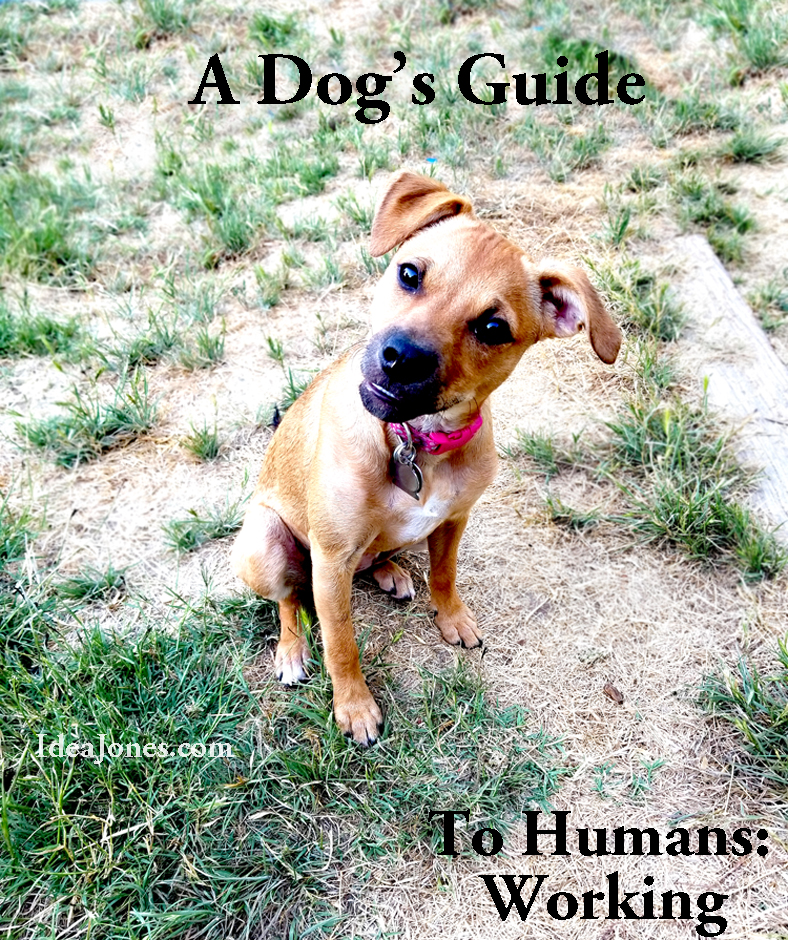
  • A Dog’s Guide To Working With Humans

    A Dog’s Guide To Working With Humans

    Humans are both fascinating and confusing.

    If you want to work with humans, there are a few important things you need to know.  I’ve been working with these humans for a couple of months now, and I can already tell that working with humans isn’t as easy as working with dogs:

    • Humans talk about cooperating a lot more than they cooperate.  Sometimes this is because they really don’t want to cooperate.  I overheard someone saying “This shit has too many captains.”  He pronounced it “ship,” but I’m not going to make fun of him for a speech impediment.

    As you know, among dogs, we all sort out who does what and do what we do best.  I have the best sense of smell in our pack, but Reo is better at spotting squirrels in trees. I’m little and fast, but Moby is big and strong. Humans can use can openers. We all have our role to play.

    Humans have an “all or nothing” approach to control. They don’t want to give up any, or they pretend they gave up all of it.  And nobody listens to anybody just because she’s good at that particular thing. They think listening to someone who knows what she’s talking about means giving her some sort of power over them… How do humans get anything done? They overcomplicate things so much.

    • Humans have the awareness of rocks.  Okay, their senses are, to be kind about it, very limited.  They stare, baffled, at the tree you’re barking at, because they can’t hear or see the squirrel right over their heads. They step in things because they can’t smell them.

    This lack of awareness of who or what is around them causes them endless problems. When a pack works together, we pay attention to where the other members of the pack are and what they’re doing. If Moby flushes a rat, Reo and I need to be able to help him catch it. If we don’t pay attention to each other, the rat gets away. Which means we’ll probably have to chase that same rat another day — plus a bunch of baby rats.  If I flush a rat, I need Reo and Moby to help me, because I’m a baby and the rat is probably almost as big as I am. If they aren’t aware of me, the rat gets away, or I’m rat chow.

    Humans engage in things far more complicated than chasing rats, but usually they don’t seem to be aware of the other people involved. If Reo chases a rat and it runs my way, I have to chase it toward Moby so he can take care of it. Moby needs me to do my part, so he can do his. But humans take on projects where each person  has to chase his rat, so to speak, on time, so the next person can chase her rat.  But they ignore all of the other people waiting for them and do whatever they feel like, whenever they feel like it, so the next person waiting for the rat to come his way misses it, or gives up and goes home.

    No wonder there are so many rats in the world.

    The humans are interesting animals with many bizarre habits, and the ones I have adopted are very nice, even if they are, as all humans seem to be, somewhat limited.  My studies continue, and I will send more dispatches as I can.