IdeaJones

Tag: writer life

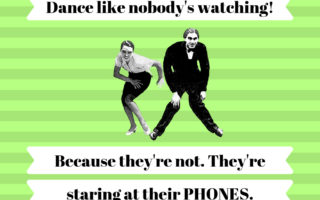
  • Dance Like Nobody’s Watching

    Dance Like Nobody’s Watching

    My mom used to say, “We’re on each other’s minds a lot less often than we think we are. While you’re worried about what people think of you, they’re worried about what other people think of THEM.”

    Mom was so right. Especially in this social media, selfie-driven age. Where you used to go through the world trying to figure out what the people in your immediate vicinity thought of you, now we wake up and check our phones for thumbs up or thumbs down from an entire world.

    Think about that symbolism for a moment. We’re taught that the thumbs up or down was used by Roman emperors to declare whether someone lived or died (not sure if it’s accurate, but for sure it’s what I was taught). Having incorporated those symbols into social media means that we’re not just saying, “I like this,” or, “I don’t like this.” We’re passing judgement on each other. Letting other people declare whether or not we are worthy. Which is why involvement with social media isn’t a good predictor of happiness.

    Increasingly, we’re not even bothering to hit “like.” It takes less than a second to do, but now even that often seems like too much trouble. I can’t tell you how many times someone has told me in person they really like what I do — and yet they don’t bother to literally “like” it online, or share it. Which can make creating feel like yelling into the abyss — you’re shocked when you hear a response. And yet, there is good news in this, for creators.

    Take Twitter. Writers are constantly told we must “build platforms” and increase our “social media presence.” Which can lead to having 2,000 followers, most of whom don’t actually follow what you do, in the sense of paying attention to it. They’re other writers or artists following you so you’ll follow them so it’ll look like you have a lot of followers, yet how many of those followers are truly engaged? One really engaged follower beats 100 (or more) courtesy followers.

    Where’s the good news? In creative freedom. You can stop reading tea leaves, casting chicken bones, and otherwise trying to figure out what other people think of you, or what you do. The idea that you actually know, based on numbers of followers, etc., is an illusion.

    Do what you do. Create the best version of what you do that you can. Experiment. Learn your craft. Try things, get some wrong, learn from the process. Edit, refine, examine and re-examine. Show the world as much or as little of all that as you choose. Be brave. Wallow, flail, find and develop your stroke, and learn to swim.

    In time, you may find your tribe, the people who get what you’re doing and enjoy it. Meantime, at least you’ll be enjoying it.

    And if you really want to be a Patron of the Arts, bother to hit “like” occasionally. Comment now and then. Share the stuff you like. Don’t just flood feeds with automatic retweets… make your opinion count by sharing what speaks to you and saying that it does (and even why). Be engaged.

    That, by the way, really is a good predictor of happiness — how engaged you are with people and the world around you.
  • Into the Twitter(pitch)verse: The Basics

    Into the Twitter(pitch)verse: The Basics

    There are opportunities to get your project in front of agents and editors, and, I’m learning, ways to do it (and not do it).

    An intro to Twitter pitch events for writers.

    Twitter pitch contests — I’m no expert. I’m experimenting and figuring it out. But it’s a chance to get your work in front of agents and editors, so it’s worth exploring. Here’s what I’ve learned so far (my opinion. If you disagree, fine, do what makes sense to you):

    1) How to find them — I searched “Twitter pitch contest” and then did the legwork, reading up on the various pitch contests, who runs them, who participates, articles by writers and agents who’ve participated to find the ones I wanted to participate in. There are contests for novels, scripts, etc. There are contests by genre.

    2) Crafting your pitch… You’re pitching your project in 140-280 characters. It has to be a complete pitch in itself as the agent/editor might not see your other pitches.

    You’ll find articles by agents on what they want to see, and by writers on their experiences pitching, but basically, you include your protagonist, maybe antagonist, and the stakes. I’m still experimenting. Our novel is contemporary fiction (mainstream/women’s fiction), with humor, so the pitches have a humorous tone.

    If you had to boil down your project for its essence, like distilling vanilla beans for extract, what is the essential heart of your story?

    3) Space out your pitches. you’re usually allowed 3-6 pitches across the day. Remember they’re usually EST (not always, so check), so don’t post your last pitch after 3 pm PST.

    4) There are no guarantees. Getting a request depends on the right agent seeing the right tweet at the right time. It’s just an increased chance you’ll be seen. You get between 3-6 tweets across one day.

    I’ve done a couple of them so far. First one? Three chances, zero requests. Second? Six chances, six requests. Don’t think that getting no requests means your project isn’t good — it can just mean the right person didn’t happen to see your pitch.

    5) If you get a request, do your homework on the requester — just like cold querying an agent. There are hoaxsters and even some legit pitch events don’t vet participants. It’s on you to find out if this person seems legit.

    6 If you do get a request? Check out the requester. If s/he seems legit and a good fit, check submission guidelines. Go for it.

    7) If you get no requests? Look over your pitches. Look at other pitches. Which stand out? Which are interesting? Learn from the competition. If your pitches are sound, then maybe your person didn’t see them (there can be a LOT of pitches). Get back to querying and be prepared for the next event. This is a marathon, not a sprint.

    Hope something here is helpful to you. Any legit chance to get your work out there is worth pursuing, in my book. Show the industry you’re trying to get into that you have what it takes!

    #writing #writingcommunity #writingtips

  • Into The Twitter(pitch)verse

    Into The Twitter(pitch)verse

    More on Twitter pitch events… Da Etiquette

    Into the Twitter Pitchverse. An introduction to Twitter pitch events for writers.
    Navigating the world of Twitter pitching.

    I’m not an expert, just another writer trying to navigate the jungle of getting and agent and getting published. In that quest, I’ve been finding my way through Twitter Pitch Valley, and in the interests of #WritingCommunity, I’m offering what I’m figuring out in the hopes it might be helpful to someone else. First, because it’s that important, Da Etiquette.

    As mom used to say, “Manners matter.” There is etiquette to Twitter pitch events. If you don’t follow it, you will probably get chastised, and may find yourself banned, so it’s worth noting.

    1) Be thou not a jerk. Criticize not the pitches of other participants.

    2) Follow thou the rules. If allowed three pitches, confine yourself to three. If allowed six, whoopee! Do six. Not seven. Read Da Rules and follow same.

    3) Seriously, be thou not a jerk. Don’t criticize the worthiness of other participants, or their right to participate.

    For example, one pitchfest for books is #DVpit. For writers from marginalized groups, such as the disabled. It’s on the honor system and if someone cheats they will be found out, but it’s not for you to make that call. If you personally know this participant and have concerns you can politely DM, I suppose, but otherwise? Leave ya nose outta it.

    4) Only “like” a pitch if you are a legit agent or editor and wish to see the manuscript. That’s how this works. If not, some allow you to retweet pitches you like. Some ask you not to. Read and follow Da Rules.

    If allowed to RT pitches you like, it’s a nice way to show support.

    So it follows that you do NOT “like” your own pitches, as you are not an agent looking to see your own manuscript.

    5) Be not a daft twit. Check Da Rules. If it’s a genre thing, be sure you legit fit somewhere in that genre before you participate. If you don’t know what the genres are and where you fit, for crying out loud, do some research.

    If it’s for left-handed writers and you can’t even brush your hair left-handed, stay out of it. If it’s for Women’s Fiction and your book is about a guy who hates women and kills people with a dinner fork, stay out of it.

    6) Time marches on — and you need to know which way. Most of those I’ve seen are Eastern Standard Time. If you live otherwhere than the east coast of the United States, plan accordingly. If it ends at 8 pm EST and you post your pitch at 8 pm PST, It’s 11 pm where the organizers are and nobody will see your post.

    7) Don’t take any of this too seriously. Just seriously enough. Do your homework. Follow the rules. Set up your pitch event calendar so you don’t forget when the next one is coming. Get your pitches ready and polished. Be ready to tweet when the time comes… then relax. You may or may not get requests. The requests may or may not pan out. It’s a chance, not a guarantee. You can still query agents traditionally whether they request you through the event or not. Enjoy life. Don’t let your happiness hang on this. Take the chance because it’s a chance, then take the next one, until one pans out.

    Good luck!

    #writing #writingcommunity #writingtips #writerlife

  • A Cinematic Book

    A Cinematic Book

    We made the quarterfinals of the ScreenCraft Cinematic Book Competition! (Update… we made the semifinals!)

    Just got the word that we made the semifinals of ScreenCraft’s competition for “cinematic” books, which means script readers could see this as a movie.

    There are a lot of great books that wouldn’t make good movies. To be made into a movie, a book needs a visual language. Long ago, we took a series of classes from Dale Wasserman, who wrote the play “Man of La Mancha.” He wrote the “book” of the play (as opposed to the music and lyrics — although he maintained some of the lyrics were lifted from his text). He also wrote for film and tv as well as theater.

    He said that books are the most literate art form, then plays, then film, then tv. It wasn’t an insult — it’s just that film and tv are more dependent on visuals than language. Language matters in film and tv, but first, you have to have pictures.

    Mark and I have placed in screenwriting contests, and Mark writes in pictures. He’s good about prodding me to look at what I’m writing and think about what it looks like. “It’s a movie in the reader’s head,” he told me one time. “When I read, I see it and hear it.” Plus, he trained me in producing for radio, where creating mental pictures is what it’s all about. It’s something I still work on… as you can tell, I tend to be verbal.

    Lots of writing is you alone with your thoughts and your computer (or notebook, or…). I talk to myself when I’m writing, wondering if anyone but me will understand what I’m trying to convey. There’s no way to tell until someone reads it. First we had beta readers, then did live readings, then got feedback from a reviewer, and at every stage, examined what was working and what wasn’t. Every time a reader says they enjoyed it, and tells me what connected with them, I want to cheer. Now we’re querying it. It’s a terrifying process.

    I overwrite, then have to cut like the villain in a slasher film. There’s always a struggle to cut what is “extra” without taking all the juice out of it.

    To know that the ScreenCraft readers, who have never met me and don’t know what I sound like, “hear” and “see” this novel is a joy. Congratulations to my fellow semifinalists, and to everyone who completed a novel they were proud enough of to enter it in a competition — that’s a big achievement right there.

  • A Dog’s Guide To Humans: Piddle & Doody

    A Dog’s Guide To Humans: Piddle & Doody

    A word about wiz.

    You might want to go relieve yourself before you start reading this dispatch.

    Of all the things I’ve observed about humans, the most perplexing is their attitude toward their own bodies and natural processes. Honest to Dog, it’s confounding. I’ll see if I can make even minimal sense of it, but some of this you will just have to accept on faith. I swear on my favorite squeaky toy, what I’m about to tell you is true.

    • They are embarrassed by the fact that they poop.

    I’m not talking about someone seeing them poop. When someone watches you go, it’s awkward and weird, no doubt about it. I’m talking about simply acknowledging that you do poop, or pee, at some point in your day.

    I think it’s some sort of sacred ritual for them. They even have special rooms in which to relieve themselves. They also wash themselves in that same room, which is odd unless you consider it as part of a ritual. You have the shameful elimination, then the ritual cleansing. This might explain why it’s considered such a private event.

    Outside of the Altar of Elimination, though, they try hard to pretend they don’t have to go. Some humans use special code words for elimination. Piddle, which sounds like an endearment for a puppy, is actually a code word for peeing. There are many others. One is “tinkle.” I met a dog named Tinkerbelle and she said her name was very confusing as nobody ever rang a bell when she tinkled. I theorized that maybe they were saying it sounded like a bell when she tinkled. Human hearing is quite limited, after all. This seemed to satisfy her and make her far more happy with the situation.

    There are also many words for defecation, including “doody.” My humans like to watch historic recordings of the stories that appear on the glowing boxes. One featured a man in a cowboy suit who talked to a wooden toy he called “Howdy Doody.” I do not believe he would have greeted even a toy by saying, “Hello, Turd,” but “Howdy, Doody” seemed to be not only acceptable but much admired, to judge by the humans slapping their front paws together (known as “applause,” the equivalent of a happy tail wag).

    They have a great many words for peeing and for pooping, from those supposed to be rebellious (“shit”) to those meant to be euphemisms (“do your business,” for example. This one confused me quite a bit at first as it seems an odd business to be in).  A species only exhibits this behavior in regards to things seen as taboo.

    • Some of them are driven insane by elimination.

    Not their own, I hasten to add. They might be uncomfortable with their own elimination, but they are downright neurotic about ours. My own humans will not let me eliminate in their Altar of Elimination, although they do allow human visitors to do so, so I must go in the back yard. Strange as this is, it is nothing to the behavior of some humans.

    I have been told of dogs who are swatted with objects when they eliminate inside the dwelling. It has even entered their language. To be “hit with a rolled-up newspaper” is a general term for being corrected. It is uncertain what the thinking is, but I’m inclined to accept the explanation given to me by Runs With Nose Lifted (aka “Wowzer”), a Great Dane I met. He theorizes that as uncomfortable as humans are with elimination in general, some are driven mad in the presence of it. Wowzer said he solved the problem by going behind the sofa to eliminate.

    Another dog, Steps High And Walks Fast (aka “Charlie”), said she tried designating her own altar — the tiny room in which the humans store their clothing — but this proved displeasing to her human companions, so as of that morning, she had started going under their bed, which seems reasonable.

    There is more to write on this subject, but I am still compiling my notes, and will send another dispatch as soon as I can.