IdeaJones

Tag: Joey

Joey Jones is co-owner of IdeaJones

  • A Dog’s Guide To Humans: Piddle & Doody

    A Dog’s Guide To Humans: Piddle & Doody

    A word about wiz.

    You might want to go relieve yourself before you start reading this dispatch.

    Of all the things I’ve observed about humans, the most perplexing is their attitude toward their own bodies and natural processes. Honest to Dog, it’s confounding. I’ll see if I can make even minimal sense of it, but some of this you will just have to accept on faith. I swear on my favorite squeaky toy, what I’m about to tell you is true.

    • They are embarrassed by the fact that they poop.

    I’m not talking about someone seeing them poop. When someone watches you go, it’s awkward and weird, no doubt about it. I’m talking about simply acknowledging that you do poop, or pee, at some point in your day.

    I think it’s some sort of sacred ritual for them. They even have special rooms in which to relieve themselves. They also wash themselves in that same room, which is odd unless you consider it as part of a ritual. You have the shameful elimination, then the ritual cleansing. This might explain why it’s considered such a private event.

    Outside of the Altar of Elimination, though, they try hard to pretend they don’t have to go. Some humans use special code words for elimination. Piddle, which sounds like an endearment for a puppy, is actually a code word for peeing. There are many others. One is “tinkle.” I met a dog named Tinkerbelle and she said her name was very confusing as nobody ever rang a bell when she tinkled. I theorized that maybe they were saying it sounded like a bell when she tinkled. Human hearing is quite limited, after all. This seemed to satisfy her and make her far more happy with the situation.

    There are also many words for defecation, including “doody.” My humans like to watch historic recordings of the stories that appear on the glowing boxes. One featured a man in a cowboy suit who talked to a wooden toy he called “Howdy Doody.” I do not believe he would have greeted even a toy by saying, “Hello, Turd,” but “Howdy, Doody” seemed to be not only acceptable but much admired, to judge by the humans slapping their front paws together (known as “applause,” the equivalent of a happy tail wag).

    They have a great many words for peeing and for pooping, from those supposed to be rebellious (“shit”) to those meant to be euphemisms (“do your business,” for example. This one confused me quite a bit at first as it seems an odd business to be in).  A species only exhibits this behavior in regards to things seen as taboo.

    • Some of them are driven insane by elimination.

    Not their own, I hasten to add. They might be uncomfortable with their own elimination, but they are downright neurotic about ours. My own humans will not let me eliminate in their Altar of Elimination, although they do allow human visitors to do so, so I must go in the back yard. Strange as this is, it is nothing to the behavior of some humans.

    I have been told of dogs who are swatted with objects when they eliminate inside the dwelling. It has even entered their language. To be “hit with a rolled-up newspaper” is a general term for being corrected. It is uncertain what the thinking is, but I’m inclined to accept the explanation given to me by Runs With Nose Lifted (aka “Wowzer”), a Great Dane I met. He theorizes that as uncomfortable as humans are with elimination in general, some are driven mad in the presence of it. Wowzer said he solved the problem by going behind the sofa to eliminate.

    Another dog, Steps High And Walks Fast (aka “Charlie”), said she tried designating her own altar — the tiny room in which the humans store their clothing — but this proved displeasing to her human companions, so as of that morning, she had started going under their bed, which seems reasonable.

    There is more to write on this subject, but I am still compiling my notes, and will send another dispatch as soon as I can.
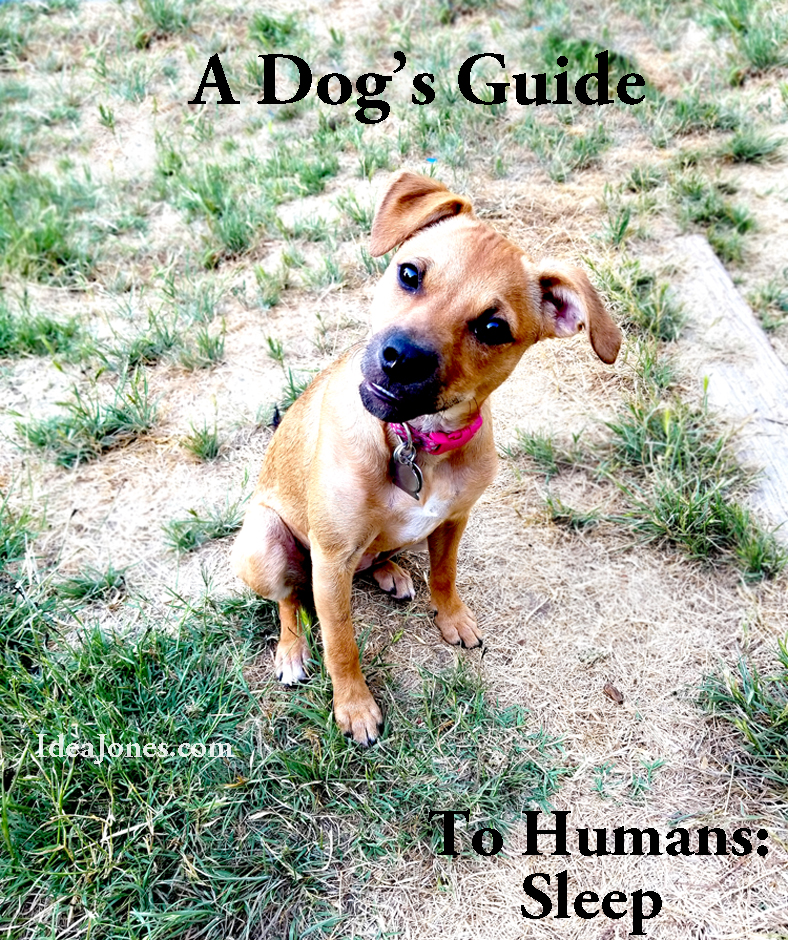
     

  • A Dog’s Guide To Humans: Sleep

    A Dog’s Guide To Humans: Sleep

    Humans are always tired.

    As with so many things, humans have a strange relationship with their own bodies (just wait until I get to humans and elimination. Oh my dog, that’s a whole subject in itself).  They are so uncomfortable in their own skins that they do things to themselves that can only be described as straight-up freaky. One of the things they really can’t figure out is sleeping.

    How, when, where or with whom, humans can screw all of that up beyond any dog’s ability to understand, but I’ll do my best to explain it.

    • Humans don’t understand sleep.

    I mean, quite literally, they don’t grasp the concept. Not really. They seem to do all right as puppies, but once they can walk unassisted, they start experimenting with it.  Their puppies, called “babies,” are the most sensible stage of their development. They eat when they’re hungry (well, they demand food), poop when they need to, and sleep when they’re tired, unless someone or something prevents them. Yes, you read that right — adults try to manipulate their puppies so they sleep not when they’re tired, but when it is most convenient for other adults. This isn’t surprising when you realize that this is what the adults do to themselves and to each other.

    They have a schedule that is baffling. They wake up, usually after not getting enough sleep, so they’re cranky and clumsy. By ingesting the runoff of water in which various plants have been dredged, they open their eyes, at least somewhat, and begin to communicate. Prior to drinking the runoff, they communicate mostly in grunts and gestures. After, they communicate in sharp, harried barks and run around grabbing things and  putting them into other things, usually some sort of bag or box, and complaining that they are now late.

    Laugh if you will — this is how they start most of their days.

    They spend their days in a variety of behaviors, most of which seem to have little practical value, but do keep them occupied and, for the most part, out of trouble. During the afternoon, when their energy dips, they do not rest. Instead, they ingest more runoff so they can keep doing whatever it is they’re doing.

    Then they come home and do more things, not very effectively, because they’re tired. When they get tired enough, they slump on the supplementary dog bed (aka “sofa”) and stare at boxes with emit light and sound, which helps keep them awake. Sometimes these are thin, small boxes they can hold in their hands. Other times they are very large boxes.

    Eventually, long after they should be asleep, they will topple over and sleep in front of the glowing boxes, still resisting the urge to go to their comfortable beds to sleep. Eventually, many of them do rouse somewhat and stagger to their beds, but some stay in front of the glowing boxes so they can wake in the morning and complain about the parts of their bodies that hurt.

    • Humans don’t trust sleep.

    You might have read that more than once only to discover that it still makes no sense.  This is because it makes no sense.

    Humans dislike sleep. They brag about how little they get. They pretend they don’t need it. They talk about “snatching” or “grabbing” it. Where any sensible dog will tell you that if you’re tired it’s time to sleep, humans avoid it as long as they can.

    Instead of viewing sleep as a necessary part of the healing process, humans treat it like an enemy who must be conquered. Even as they are staggering, bleary-eyed and foggy-brained, they tell anyone who will listen that they “don’t need that much sleep.” It causes them untold health risks from accidents to heart attacks, but they take pride in their unwillingness to lie down and close their eyes as if simply being able to keep their eyes open long after their brains have stopped working were some sort of accomplishment.

    It is worth considering what marvels they could accomplish if only they weren’t so tired all of the time. And cranky. I’ve heard the phrase so often that the one word doesn’t sound right without the others. Tired and cranky.

    I doubt we’ll ever know what humanity could be if it only it got the occasional nap.

    I will write my next dispatch as soon as I can. Meanwhile, it’s time to go to bed. ~ Gingeroo

  • On Dust, Mirror Neurons, And Discrimination

    On Dust, Mirror Neurons, And Discrimination

    We’re discriminating against ourselves.

    When I started “Where It Starts,” I was fascinated by a science book by Judith Horstman. In it, she mentioned “mirror neurons.”  I did some reading on the subject and fell in love with the idea. Mirror neurons are neurons in the brain that fire up sympathetically. Let’s say you watch someone fall. As he topples over, he sticks his hands out to break his fall. When his hands hit the sidewalk, your own hands twitch in response. You may even flinch. You didn’t fall — so why do you have that reaction?

    Mirror neurons allow you to place yourself in someone else’s shoes for a moment. Other things can make them twitch, too. A story can get their attention. If I tell you about my trip through the mountains, about how it was night and snow started to fall, and my car skidded into a snow bank and the engine died and wouldn’t come back, but I saw the lights of a gas station so I got out and walked, slipping and skidding, the snow soaking my tennis shoes so that my feet were wet and numb… Neurons fire in your brain in areas that would fire up if you were actually having that experience with me. The more vivid the story, the more you feel it.

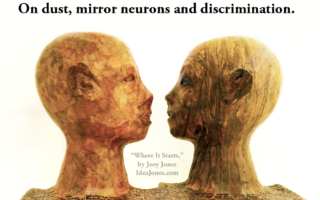
    As I worked on this sculpture, I heard another bit of information that seemed to relate — the composition of dust. Of course, there are different kinds of dust, but in general, everything is shedding and flaking off tiny bits, and those tiny bits become dust, which swirls all over the world on the wind. This includes shed cells from other people. Many of these bits are too small to see with the naked eye, but we’re all breathing them in. So what?

    So we are all taking in minuscule pieces of each other constantly. The closer you are to someone physically, of course, the more you take in, but the school bully and his victim are literally part of each other. People from all over the world are walking around inside of you right now, and that’s not touchy-feely new age philosophy… it’s scientific fact.  Plus, that dust is deposited everywhere, including the soil where our food grows. The guy who thinks he’s better than everyone else? He IS everyone else.

    Those people who say “we are all one?”  They’re right.

    The first time this sculpture was shown, I saw a woman and her daughter contemplating it. They noticed me and asked about it. When I explained it, the woman laughed and told her daughter, “You’d better be careful who you breathe around!” Then I explained that we are all part of each other, even the people we don’t like. She said, “It would be hard for anyone to bully anyone else if they understood that.” Her daughter shared that she had been bullied in school, and wished the person who had bullied her had understood that they were part of each other.”

    Everyone walking around carries a part of the rest of the world within him. The people in this sculpture are talking, sharing their experiences, breathing each other in. Both will leave changed whether they realize it or not.

  • Of Love Beads and Novels

    Of Love Beads and Novels

    Hi! This month has been even busier than usual. Endings, beginnings, recuperation, it’s all been part of this month. There’s a tradition that says you should start the year as you mean to go on. Eat the foods you love, do the things you love, be with the people you love to show the new year what you want from it. If it’s true, this is going to be an interesting year.

    Excerpt on Kindle Scout — free to read!

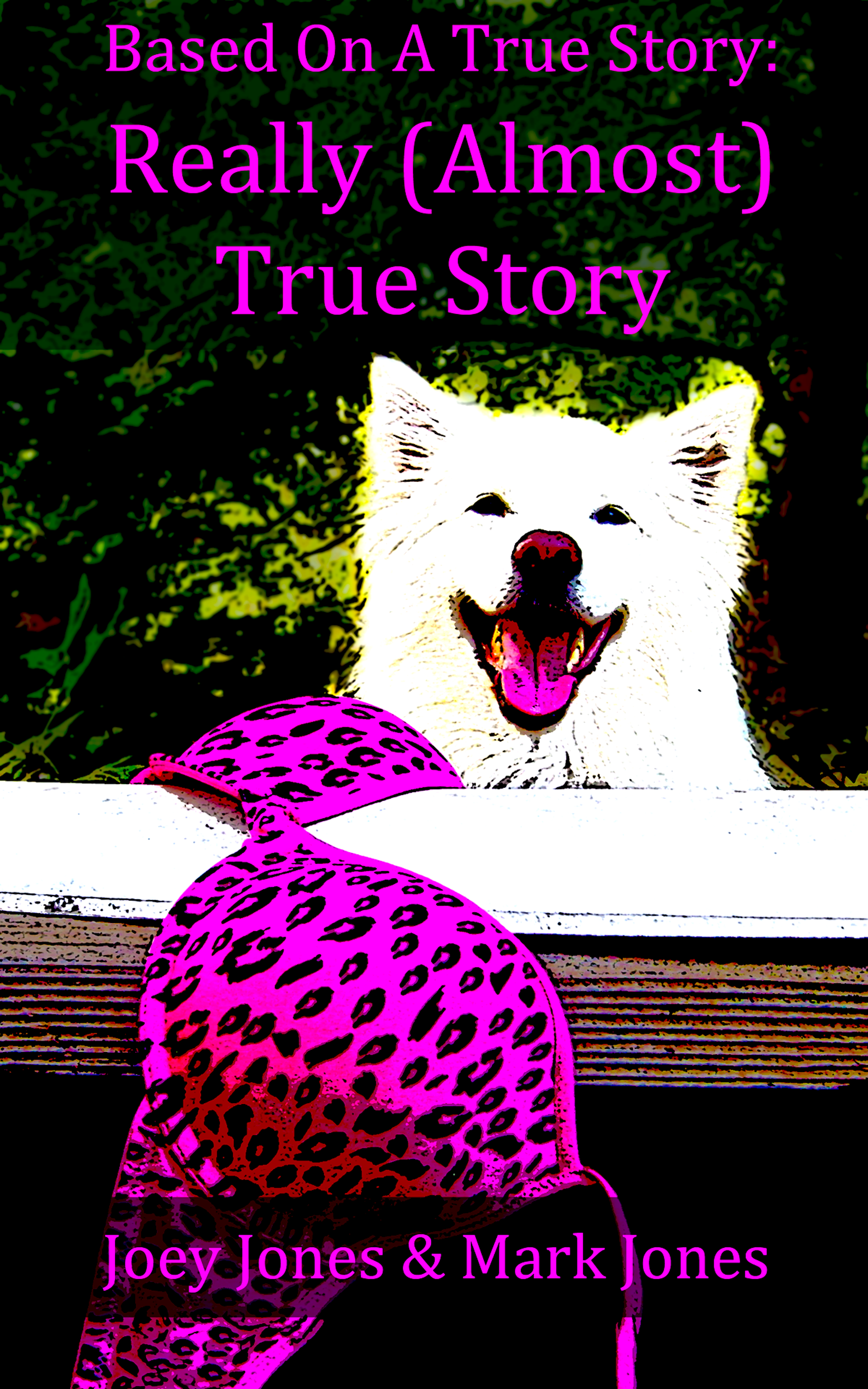
    The beginning… our book, Based On A True Story: Really (Almost) True Story, was selected for Amazon’s Kindle Scout program! This means an excerpt is available on the Kindle Scout website, and you can vote for it to be published. It’s free to participate, and if the books you vote for are selected, you get a free online copy!  You do need to sign up for an Amazon account (free) if you don’t already have one, then you can log in and become a Kindle Scout, helping new authors and getting free book! The link is: https://kindlescout.amazon.com/p/2ZS8M8QUBB0QC

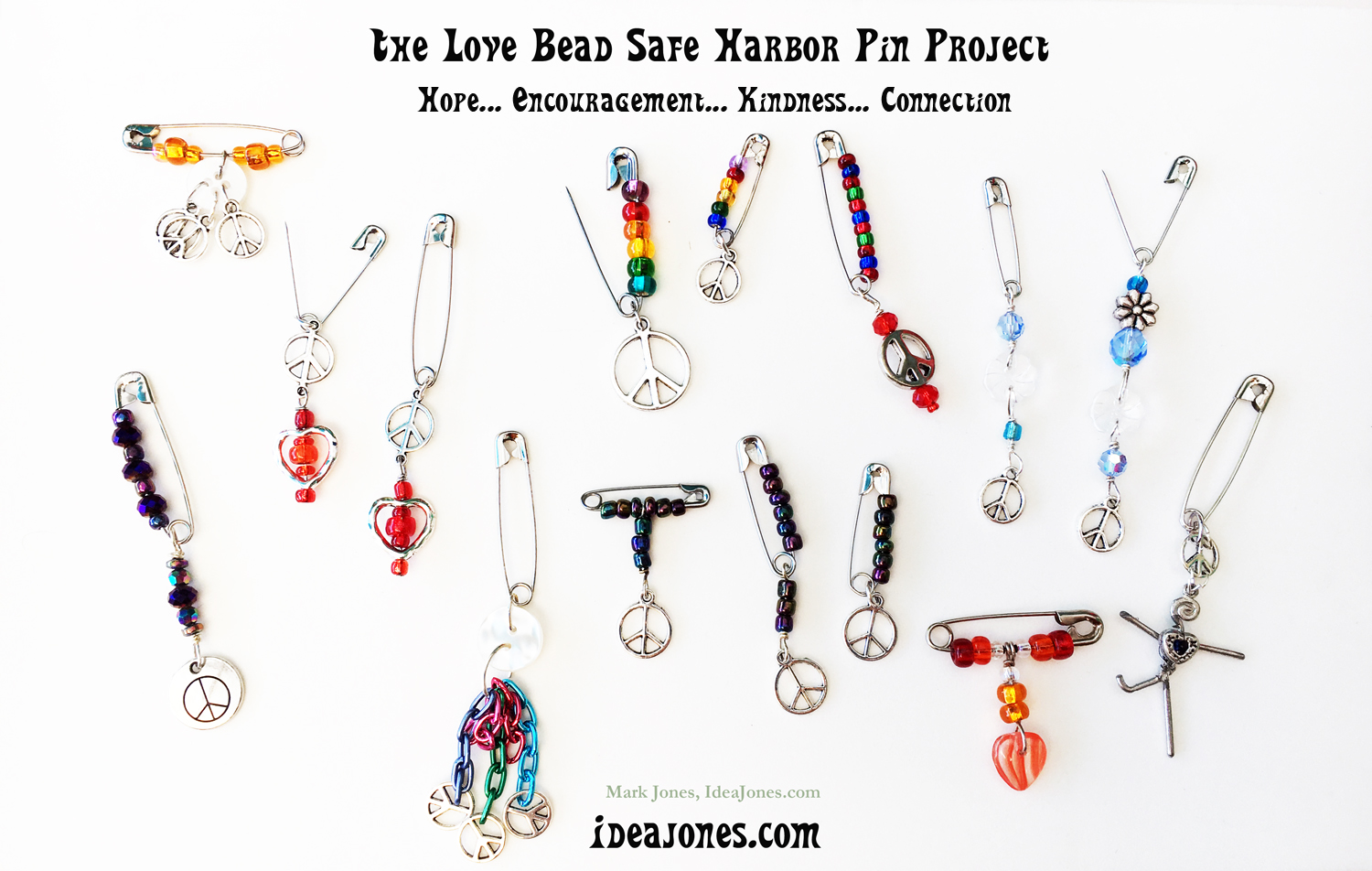
    The ending… the Love Bead Safe Harbor Pin Project is now officially over (for us — anyone can make pins and give them away). For the project, we made and gave away 2,000 hand-beaded Safe Harbor pins, promoting the idea that all human beings deserve to be treated with basic dignity and respect. In three cities, we talked to people from many countries, economic levels and cultural backgrounds about that idea. One thousand people stood up in a public place and confirmed their belief in that principle. We got to talk to so many great people, parents who used the pins to talk about respect with their kids, friends and families who chatted with us, often told us their personal stories.  In every distribution, at least one person would hug me. Some cried as they talked about the challenges they deal with.  There are stories on the website and on our Facebook page. Here are some from the Women’s March in Sacramento, CA:

    * The little boy who, after his mom accepted a set of pins, said he wanted a set as well and asked about the meanings of the various color patterns. When he saw the green “environment supporter” pin with a gear on it (for science), he got excited and shouted, “That’s it! That’s my pin!”  Later, as his family passed me, he looked back and said, “Thank you for the pins!”

    * The young women from a Feminism Club (I didn’t catch which school), who accepted pins with big smiles and talked about their Women’s Studies class.

    * The parents from Arkansas who traveled to California to march with their daughter and her family.

    * The young woman who accepted the last set of pins and received a set of three additional pins, including a set of crystal rainbow LGBTQI pins, who smiled like the rising sun and was still beaming when I looked back.

    Other people stand out from the course of the project, the tourists from France who asked wonderful questions and really engaged with the project as art; the young man who told me about how his gay friends were getting harassed and threatened and felt alone – but he would tell them there were people they didn’t even know who wished them well and believed in them; the young woman with dreadlocks who hugged me and got teary, saying, “You don’t know how bad it is out there — I was having a really bad day. It’s nice to know there are people who care;” the group of skaters under the tree in Mission Dolores Park who got excited about the project and even told other people who joined us about it, including the young man who yelled, “Fuck yeah! I’m for respect for everyone!”  So many people, so many memories, and we’re so grateful to all of you. May you be blessed.

    We also were in two art shows that ended this month. Now it’s time to regroup and create.

    The recuperation has been from a bout of flu (yes, we got the shot, and it did seem to keep the flu from being as bad as it’s been before).

    We’re spending time with friends, working on other books, and letting ourselves pause now and then to experience and enjoy the gratitude we feel towards everyone who’s voted for our book, or talked to us at a pin distribution. Thank you! May the new year to come treat us all as friends.

  • New shows to end the year…

    New shows to end the year…

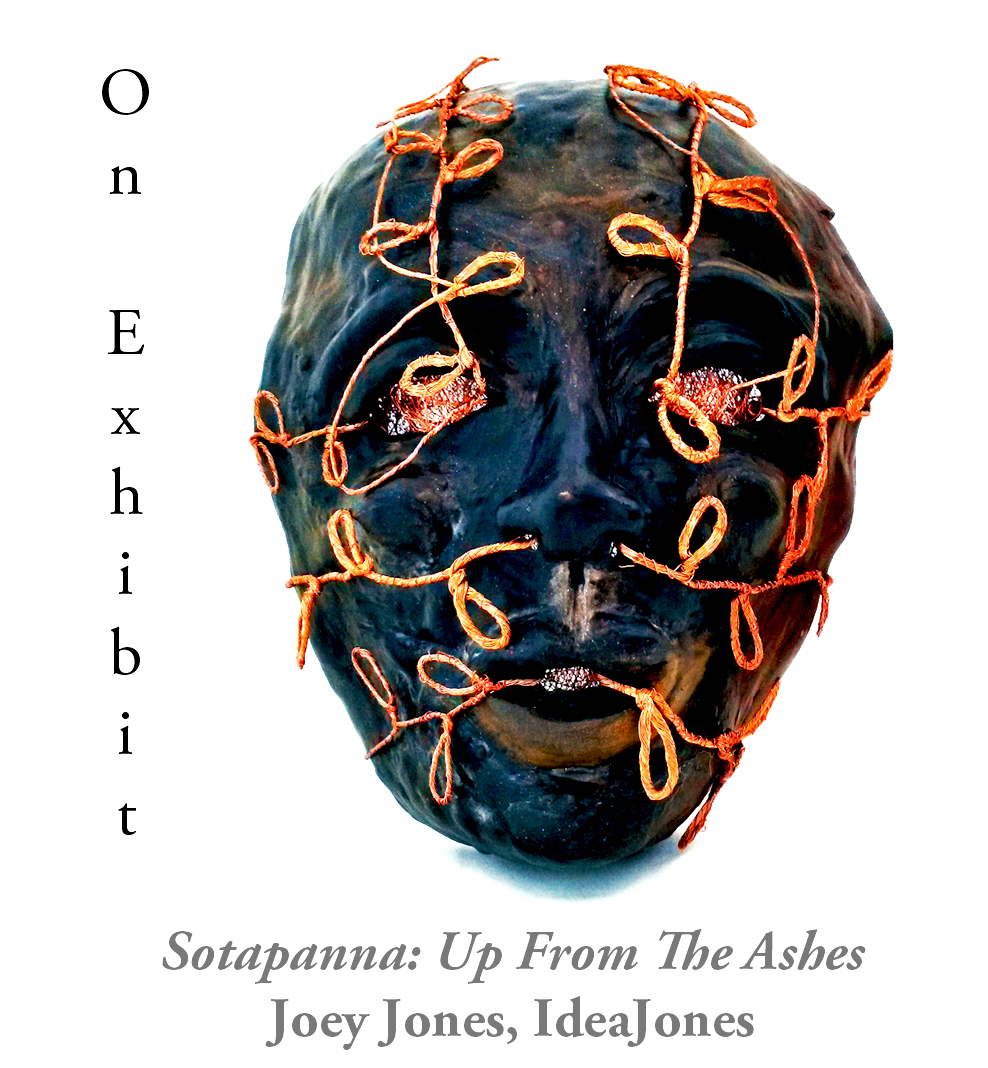
    This work is currently on exhibit.

    This holiday season has been “beautifully busy,” a nice way to end a year that started in heartbreak. Mom used to say, “Better is always coming. The trick is to hang on until it gets here.” She was right. Nothing is permanent. The secret, I think, is to convince yourself to remain open.

    A very good friend, who we lost earlier this year, started each day open to whatever good there was available. That point of view informs Sotapanna: Up From The Ashes, on exhibit in the gallery at WAL Public Market, 1104 R Street in Sacramento. The show runs from Dec. 1, 2017 until Jan. 3, 2018. The theme of it is regrowth after trauma.

    It also ties into the “Me, Too” movement of women who have been sexually assaulted telling their stories. Abuse was a part of my life for many years. Forgiving my abusers and rebuilding my life was, and is, a growth process. Even after horribly traumatic events, it’s possible to grow and go forward. Not easy — possible.

    I also have jewelry being offered for sale by Blue Line Gallery in Roseville, CA (405 Vernon Street, Roseville, CA). They have jewelry from local artists on display in the small gallery, and available for sale. If you buy a set of Love Bead Safe Harbor Pins, a portion of the sale goes to charity. The pins have never been for sale before, but Women’s Wellspring, a center for women in crisis, recently sold them to raise money for their charity (with our blessing — women who come to the center learned to make them in a free workshop we just gave, and made pins to sell to raise money for their art therapy program), and they’re for sale at Blue Line, raising money both for the nonprofit art gallery and for other charities. We may offer them online as well, with part of the money going to charity.

    Lots going on here, most of it good, so we’re tired, but happy. Hope this finds you happy, even happy-tired, storing up the energy of good moments to sustain you.