IdeaJones

Tag: Joey

Joey Jones is co-owner of IdeaJones

  • Social Art, or The Love Bead Safe Harbor Pin Project Rides Again!

    Social Art, or The Love Bead Safe Harbor Pin Project Rides Again!

    Remember when I announced that we had finished The Love Bead Safe Harbor Pin Project?

    Turns out we weren’t done — we just didn’t know it yet.

    This project really began in late November of 2016. By the end of the election that year, we’d had over a year of arguments, name-calling and accusations All of that comes with an election, but this was particularly virulent. Many of the people we knew had stopped speaking to friends, colleagues, family, us…

    We heard stories from friends who had been threatened or who had friends or family members who had been attacked for being different, for not fitting in to someone else’s idea of how people should be.

    When I first heard of Safe Harbor pins, safety pins worn to signal your belief that all people should be treated with basic human decency and respect, I loved the symbolism of it. True, no symbol solves a problem on its own, but using the symbol requires a choice on your part. Do you agree with the idea it represents? Are you willing to make that belief part of your identity? That’s not a meaningless thing. Human lives are saturated with symbols that represent how we think the world works, or ought to work, indicate our commitment to ideas, tell the world who we are. Most things carry at least some symbolic meaning. I donned my Safe Harbor pin, knowing perhaps I’d get some push back from people who disagreed with me. Mark put on his pin and wore it wherever he went.

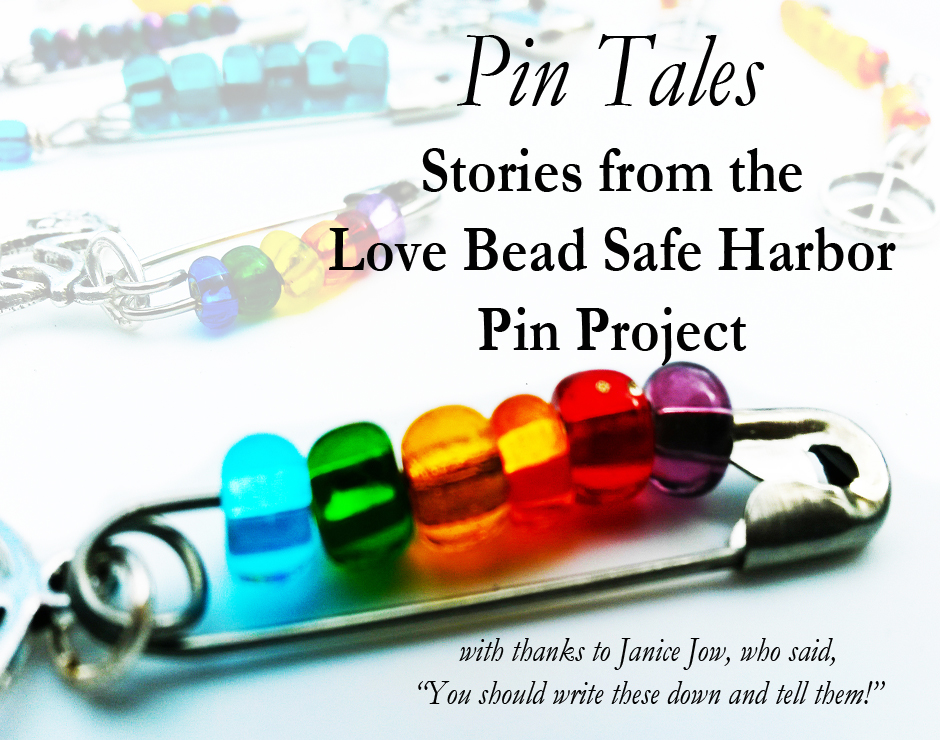
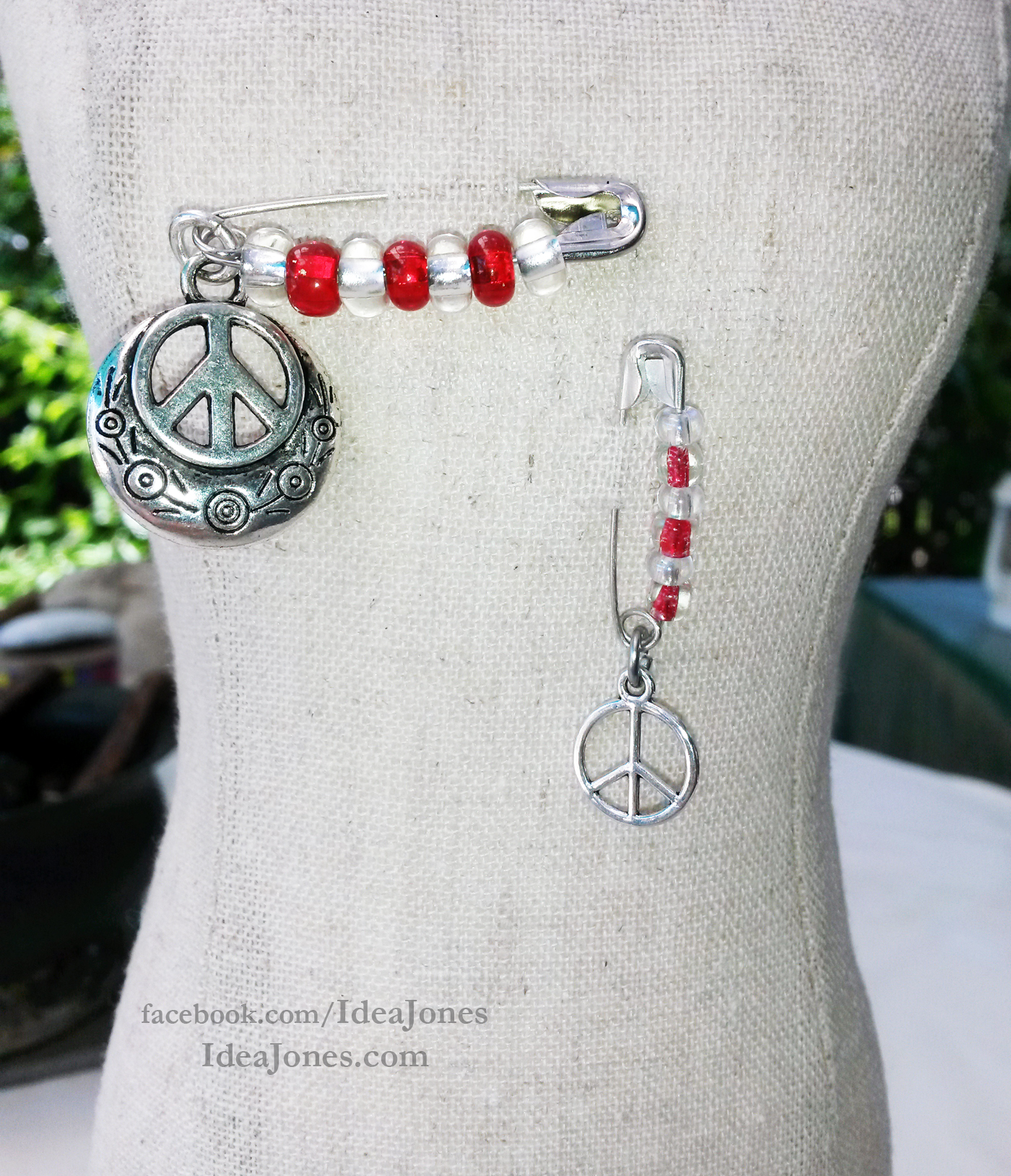
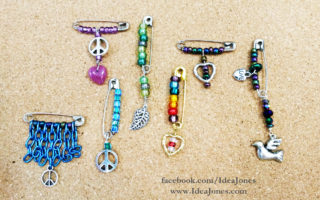
    Then white supremacists started wearing safety pins, co-opting the symbol and turning it. I wasn’t willing to relinquish it and have a symbol of decency and kindness come to stand for the opposite. So I started beading pins. I work with wire a lot in sculpting, so I figured out how to bead the pins so I could take them on and off without losing beads. I hung charms on them. I started giving them away.

    Honestly, I didn’t know what would happen. I’m an introvert, for one thing. Talking to strangers isn’t my strongest skill. I didn’t know how the idea would be received. They’re inexpensive, humble little things. The first time I did a large giveaway, I told Mark, who was parking the car, that I had no idea if it would take me hours to give them all away, or even if anyone would want them.

    Within fifteen minutes, I had none left. Hundreds of pins. Hundreds of people who consciously chose to adopt a symbol. I explained briefly what the pins stand for when I offered them. Each person made a conscious choice to affirm his or her belief that people, all people, should be treated with basic courtesy and respect. Even people they might not understand, agree with, or even like.

    We continued giving away pins. Even just giving them away casually in multiple cities, more and more pins found homes. Then we saw that the 50th anniversary of the Summer of Love in San Francisco was coming, and decided to be part of the celebration. There was a specific part of the celebration we wanted to honor. When scores of young people, most without jobs, housing or money, descended on the city of San Francisco in 1967, the city was overwhelmed. There was no infrastructure to take care of hundreds of homeless, jobless kids. Something like that, on that scale, just hadn’t happened before.

    So some of the residents stepped up. They set up soup kitchens. They distributed clothing. They helped kids find places to stay and health care. Confronted with a horde of hungry kids, those people chose to take care of them. They did urge them to return home to where they had some sort of support system, but in the meantime, they fed and clothed them.

    That was the legacy we wanted to honor.

    So we set about making over 1400 pins. We stood on street corners and walked through parks, we stood in front of a museum. Over and over, we offered strangers the following choices:

    • Will you interact with a stranger?
    • Will you listen to a brief description of an idea, Radical Respect, the idea that all human beings should be treated with basic courtesy and respect?
    • Will you accept a symbol of that idea?

    Accepting the symbol after the explanation means accepting the idea, and making it at least a small part of your identity. It was a public decision and affirmation.  We also tried to keep track of our results. The overwhelming majority of people we encountered chose to talk with me, listen to the idea, discuss it with me, and accept the pins.

    All in all, so far, over 750 people have made that choice. People from every economic level, from different cultures, countries and educational backgrounds have stood up in public and affirmed their commitment to supporting human decency for everyone.

    On days when the cacaphony of argument and accusation makes me want to become a hermit, I remember some of the people we met and talked with.

    We had planned to end the project after the Summer of Love anniversary. It consumed a lot of our lives for almost a year. But we had some materials left, so I offered a free workshop at a program for women and children in crisis. It seemed like a good way to wrap up the project. The workshop went so well, and I had so much fun making pins with some of the women there.

    On the way out, the art therapy coordinator introduced me to a member of the Board of Directors of the center. She accepted a set of pins, and asked if they could make pins to sell at an event to raise money. She and the art coordinator were so respectful, asking if what they wanted to do would fit into the goals of the project. I really appreciated their courtesy, and yes, while it’s true that we gave away pins, selling them to benefit a charity, especially one helping people who aren’t often treated with the respect they deserve, is in keeping with the project’s point of view. Anyone who buys a set of pins will get the pins mounted on a card describing Radical Respect, and will also  be making a choice to support people who could use help.

    So the project isn’t quite over. And I may make a few to sell as a separate-but-related project to raise money for other charities.

    Perhaps it’s not consuming my life as it did, but almost a year later, the Love Bead Safe Harbor Pin Project goes on.
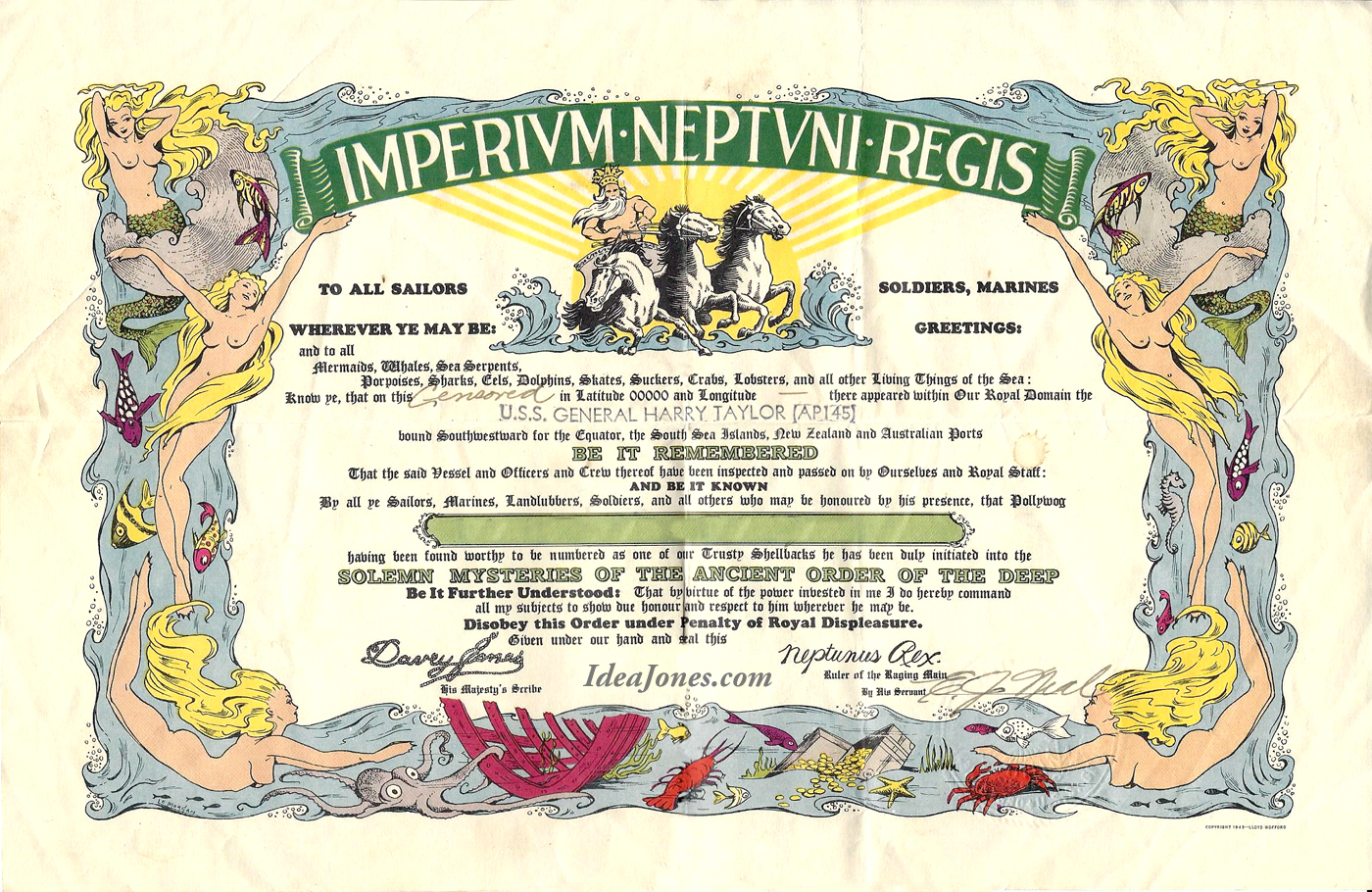
  • Imperium Neptuni Regis… The Shellback

    Imperium Neptuni Regis… The Shellback

    Neptune and Naked Women

    Imperium Neptuni Regis: The Ancient Order of the Deep

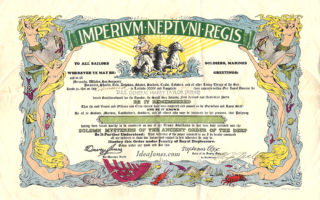
    Another certificate from WWII, again from the USS General Harry Taylor (for more about that ship, see the post on The Domain of the Golden Dragon). Here, the certificate a sailor got when he became a “shellback,” a sailor who had crossed the equator. Before that, he would have been a “tadpole.”

    The tradition, in addition to boosting morale, may have also indicated to other sailors that this one could handle long sea voyages. That’s something you need to know during times of war, when voyages can end up being far longer and more dangerous than expected. There can be an initiation ceremony to go with the certificate, although not always. Conditions didn’t always permit it. Some of the ceremonies described sound like the more benign college fraternity hazing rituals, with tests of strength or endurance, and a fair amount of rough-housing.

    Note the women on the certificate. This being WWII, women served primarily in medical services, administration or training. They weren’t part of the ship’s regular crew. These young guys could go a long time without seeing many women, or any. So no wonder the certificate features lots of naked women. The mermaids in the upper corners you would expect to find in a certificate featuring Neptune, but unlike the Golden Dragon certificate, there are also human women swimming around naked (how are they breathing?), including two who are about to get in trouble with an octopus and a crab.

    I could chalk up the representation of naked women to the era, but let’s face it, what else does a young, straight, healthy guy dream of? Well yes, food… the only thing that would make this a more complete fantasy would be if the women were naked and holding trays of steaks and baked potatoes.

    The sailor who earned this (whose name has been removed for the post) was a big fan of steak and potatoes. He had his problems with women.


  • WWII… Domain of the Golden Dragon

    WWII… Domain of the Golden Dragon

    By virtue of the power of The Golden Dragon…

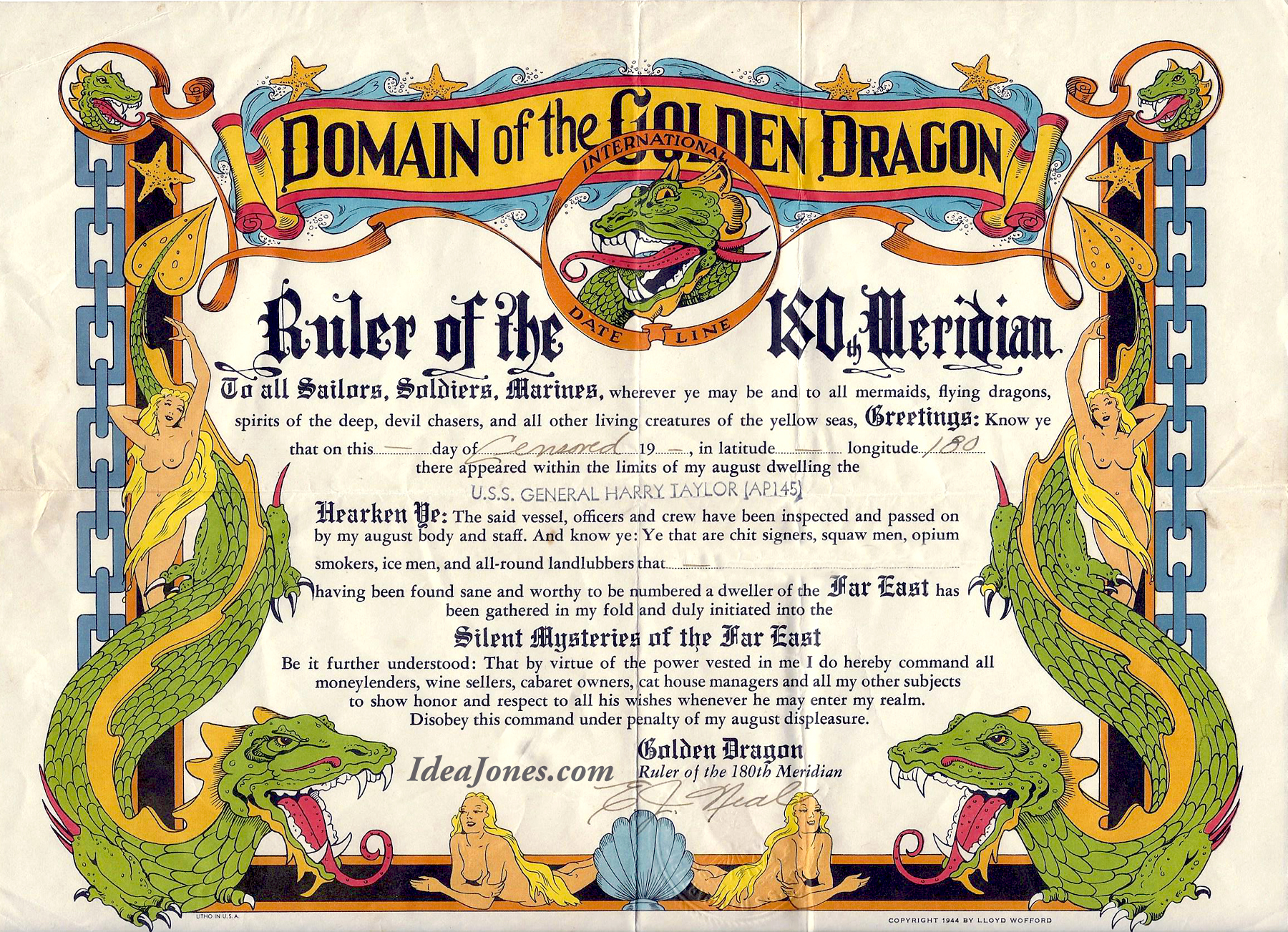
    The Domain of the Golden Dragon

    This is a certificate awarded during WWII (the recipient’s name has been removed for this picture). Certificates were awarded to Navy sailors who crossed the International Date Line aboard ship. The recipient of this certificate earned both this one and the Imperium Neptuni Regis (more about that in another post).

    With so much activity during WWII, there probably wasn’t much of an award ceremony. There are some interesting things to note here, though…

    The date is listed as “Censored,” and only the longitude is filled in. This is common for WWII paperwork. Security was a serious consideration (still is), and if the enemy knew where ships had been and were, they could guess where they were headed.

    The ship given is the U.S.S. Harry Taylor. The Harry Taylor was a General G.O. Squier Class Transport, or troop carrier that was used in WWII from 1944 to 1946.  Thousands of soldiers slept in its bunks and walked its decks en route to battle or coming home. After that, it transported all sorts of people, including refugees. It made over 30 trips ferrying refugees to their new homes, then was used to track missiles. Now? It’s part of an artificial reef helping to protect marine life.

    The sailor who earned this certificate? He survived WWII, although many of his friends did not. He got married, had kids, tried to work though the problems he carried with him, some of them due to his wartime experiences. Is there more to that story? Of course. But for now, he rests, under the protection of the Golden Dragon.

    Here’s a link to the remembrances of a soldier transported on the Harry Taylor during WWII: https://www.guideposts.org/how-we-help/military-outreach/the-uss-general-harry-taylor-the-answer-to-a-soldiers-prayer

    Save

    Save

  • Places We Like: The Back Room, Berkeley, CA

    I missed the whole 1960s-hippies-coffeehouse-folk music thing. For me, the 1960s was learning to tie my shoes (some day I’ll tell you my penny loafer story, but let’s just say it wasn’t easy to learn shoe tying when one parent was right-handed and the other was left-handed), reading, playing with my dog and trying to “fly up” from Brownie to Girl Scout.  Weird my parents might have been, but they weren’t going to let their five-year-old hang out with the hippies at the coffee house. I saw that stuff on tv and in movies.

    But guess what? If, like me, you missed out on the 60s or you were there and you’re nostalgic, or you just like seeing music in small venues where you can actually hear and nobody’s blocking your view by standing on a chair, you’re in luck, if you can get to Berkeley, CA. Next time you’re in the San Francisco Bay Area, make time to go to a show at The Back Room.

    It’s got that funky, comfortable feeling, brick walls, sofas (they also have some tables and chairs in the back). It’s “intimate,” both in the usual way that word is used to describe a venue (small) and in a real, accessible, welcoming way. My friend Janice and I saw James Lee Stanley there (and James Lee Stanley is a whole separate post, or will be), and it was all kinds of fun. The overall feeling is of seeing a performer at a house party. In the case of James, he chatted with the audience, asked for (and got) requests… it felt more like watching a friend perform in his living room than, say, an arena show. You feel like an insider.

    This is a venue that, based on our visit, deserves to thrive. It’s fairly new, so I’m hoping people get the word and try it, so it continues. If you live in the area, you’re in luck. If not, but you want to visit San Francisco in the future, make sure you bookmark their website, which is here: backroommusic.com

  • Love Bead Safe Harbor Pin Project: Finding Your Tribe

    Love Bead Safe Harbor Pin Project: Finding Your Tribe

    This project is about human interaction and conscious choices.

    You’ve found a project you’re passionate about. You think you’d be good at it. You’re excited! You tell your friends and family and… pfffft, the air goes out of the balloon. Nobody’s interested. What now?

    This has happened to me more than once over the years, so I feel you. The natural feeling, when you’re excited about something, is that the people around you will see how great it is and get excited about it, too. Or at least be excited for you. You’re hoping for encouragement, for someone else to be excited for you, happy that you’re happy. If you run headfirst into a wall of indifference, it can bring your momentum to a halt. There you stand, looking around, baffled and hurt — why doesn’t anybody seem to give a fig? Don’t they care about you?

    I used to let that stop me. If the people around me weren’t interested, then ( so I thought) either (1) whatever I was excited about wasn’t important, or not “worthy,” or (2) I wasn’t important or worthy. That is not true, and here’s why.

    People who like you like you. They may or may not like your work, or be interested in the same things you are. They may enjoy your company and think you’re great and still not get your work. I have a couple of really good friends who, so far as I can tell, don’t get what I do. Everything isn’t for everyone, just as every person isn’t for everyone. I don’t much care for cauliflower, or the paintings of Jackson Pollock. This doesn’t mean that cauliflower is bad, or that Jackson Pollock’s paintings aren’t “worthy.” It means that neither does much for me.

    Yet I might have liked Jackson Pollock, and I can like someone who is passionate about the paintings of Jackson Pollock (a passion for cauliflower might be harder to take. I really don’t like the smell). The people who like you have found something they enjoy, or admire, or both, in you. But they might look at your painting, or whatever your project is, and be mystified, or disinterested. It doesn’t move them — you do.

    The flip side of this is that you shouldn’t let their reactions determine how you view your project. Get it out there and let your work find its tribe. Chances are there will be someone who will look at it and know just what you were trying to do, and be excited about it. Just as you have your tribe, so will your work.

    Case in point… I put together an art show for a local radio station. Eight artists were involved (including me). It was, by design, a range of styles, disciplines and media. Everything from painting and sculpting to jewelry and clothing. The reception was a crush, a great crowd, many of them very enthusiastic. But there was one man, nicely-dressed, who looked over the gallery and asked, “Why jewelry? Why clothes? I understand why you’d include sculpture and painting, but,” and here he actually sniffed in disdain, “why would you include crafts?” And he said “crafts” with great condescension.

    The inclusion of jewelry and clothing was deliberate, I explained. Personal ornamentation is one of the oldest forms of art, possibly the oldest. Most major museums have collections of jewelry and clothing. He wasn’t convinced, but said that it did offer “the uneducated” something they could “understand,” which was “probably clever” on my part. (*sigh*). So he clearly didn’t get it. That didn’t make my choices wrong. Most of the people at the show didn’t even question the “why” of that, and enjoyed the show.

    My latest project, the Love Bead Safe Harbor Pin Project? Most people who know me could not possibly care less about it. They like me, but they aren’t interested in my work or this project. But over 500 people so far are. They get it. They understand that those little pins are a symbol of an important idea. They think the pins are fun. They get that the pins start conversations. They like the idea of deciding, consciously, to try to treat other people, even people they might not understand or approve of, with respect. They are my project’s “tribe.”

    The “Access To Health Care” Pin

    The acceptance rate for the pins is about 91%. Nine out of ten people offered pins accepted them. Their reactions range from mildly pleased to very enthusiastic. I get to have interesting, challenging, enjoyable conversations with so many people about respect, who we give it to and why, what it means… all because of a pair of little, beaded safety pins in a packet. Another artist said she thought this was “the most important work of social art” she had heard of in years, and I’m still dumbfounded by that. People hug me. They tell me their stories. Parents talk to their kids about respect. It has been amazing — and had I not put it out there, I’d have missed it.

    Yes, you might put your work out there and it might prove hard to find its tribe. But for sure you won’t find that tribe if you don’t try. People can’t want what they can’t conceive of, and they can’t conceive of your project before you put it out there. If the people in your life don’t get it, accept that and keep moving.

    The people who like you, but don’t get your work? Appreciate the role they play in your life, even if it’s just to enjoy your company. You need them. It’s great to have people like your work… but it’s just as great to have people like you as a person. On days when the work just won’t cooperate, you’ll be glad to have someone who, independent of your work, looks forward to talking to you, to seeing you.

    And when you do find people who get your work, listen to them! Let the opinions of people who have experienced what you’re trying to do weigh more than those who haven’t. When I would get discouraged, my husband Mark kept saying, “Listen to  the people who have experienced what you’re doing and told you that it meant something to them. They know what you’re doing.” They are my project’s tribe, and I wouldn’t have found them if I hadn’t taken a chance that they might be out there.

    Save

    Save