IdeaJones

Tag: author

  • Chick Lit v. Women’s Fiction

    Chick Lit v. Women’s Fiction

    I get it — human beings like labels (applied to others). It’s a natural function of the brain to categorize. It’s how we navigate the world. “That is similar enough to this so that I sort of know what to expect.”  Without it, we’d constantly be stuck, trying to evaluate every person, experience or thing that is even slightly unfamiliar.

    But nobody likes to feel “labeled,” especially when those labels are dismissive or derogatory.

    When we completed the first draft of Based On A True Story: Really (Almost) True Story, a writer acquaintance said it was great, he enjoyed it a lot, but he’d only read it if his wife bought it and left it lying around. He wouldn’t buy it for himself, he said, because it’s “Chick Lit.”

    I wasn’t sure how to take that. Here, in order, are the usual reasons people are dismissive of “Chick Lit:

    • It’s about relationships.  Well, so is almost every other book, with the possible exception of Chilton automotive repair guides, and the dictionary. The Bible talks a lot about relationships. So does War & Peace.  Humans are social animals, and relationships are central to how we live our lives, and most of the things we do. Try building a freeway by yourself. If you build it with others, that involves relationships. So as a criticism, “it’s about relationships” falls flat.
    • It’s escapism. Well, duh. So is Treasure Island, Moby Dick, and a lot of other novels. It may talk about “important” themes, but the first job of any novel is to entertain. I grew up around entertainment — the working, blue collar end of it, like boardwalks and nightclub shows. The ride has to be worth the price of the ticket. Nobody cares what you have to say if you’re not entertaining when you say it. And life includes a lot of seriousness and pain. The mini-vacation brought to you by a good book can save your sanity. If a book manages to take someone away from a stressful day and make her (or him) forget and have fun for a little while, that is a beautiful thing.
    • It’s “too light” or “frothy.” By which you mean…? Go ahead and try to come up with a valid explanation that doesn’t include sexism in it. I’ll wait…

    Ultimately, that’s what is at the bottom of “Chick Lit as insult.”  It’s usually by women. Has female protagonists. Generally includes humor.  But because it’s “female,” it gets relegated to a pink, frilly literary ghetto. You don’t see the “dick lit” section in a book store.

    As near as I can tell, most often, “Women’s Fiction” is “Chick Lit” without a sense of humor. This is not a criticism of books labeled “Women’s Fiction,” by the way. What I’m saying is that because they usually have female protagonists, “Women’s Fiction” or “Women’s Literature” books aren’t simply considered Fiction, or Literature. No, they’re off in their own category, as though they couldn’t lift the barbells and were relegated to the sidelines. And yet, being more serious in general, Women’s Fiction books are considered more important and valuable than Chick Lit books.

    I’ve heard it described as the difference between steak and popcorn, steak being considered more worthy than popcorn. Yet both steak and popcorn follow the same path, from a digestive standpoint. Popcorn is a whole grain, with its own nutritive value. It isn’t that steak is better somehow. Steak and popcorn are both good and give you different things. I wouldn’t want to watch a movie with a bucket of hot, buttered steak.

    A good laugh when you need it, whether it’s a bark of surprise or a hoot of recognition, helps relieve stress, so it’s good for your health, and lowering your stress makes you better able to deal with the often confusing, confounding humans around you, so it’s also good for their health when you laugh.

    So I’ll go on peddling popcorn and busking on the boardwalk, proudly, and let others categorize my work in whatever way works for them. My big hope is that I can do for someone else through my writing what books have done for me in my darkest times. And if someone else calls my work “Chick Lit,” I’ll wear the badge with pride.
  • A Dog’s Guide To Humans: Piddle & Doody

    A Dog’s Guide To Humans: Piddle & Doody

    A word about wiz.

    You might want to go relieve yourself before you start reading this dispatch.

    Of all the things I’ve observed about humans, the most perplexing is their attitude toward their own bodies and natural processes. Honest to Dog, it’s confounding. I’ll see if I can make even minimal sense of it, but some of this you will just have to accept on faith. I swear on my favorite squeaky toy, what I’m about to tell you is true.

    • They are embarrassed by the fact that they poop.

    I’m not talking about someone seeing them poop. When someone watches you go, it’s awkward and weird, no doubt about it. I’m talking about simply acknowledging that you do poop, or pee, at some point in your day.

    I think it’s some sort of sacred ritual for them. They even have special rooms in which to relieve themselves. They also wash themselves in that same room, which is odd unless you consider it as part of a ritual. You have the shameful elimination, then the ritual cleansing. This might explain why it’s considered such a private event.

    Outside of the Altar of Elimination, though, they try hard to pretend they don’t have to go. Some humans use special code words for elimination. Piddle, which sounds like an endearment for a puppy, is actually a code word for peeing. There are many others. One is “tinkle.” I met a dog named Tinkerbelle and she said her name was very confusing as nobody ever rang a bell when she tinkled. I theorized that maybe they were saying it sounded like a bell when she tinkled. Human hearing is quite limited, after all. This seemed to satisfy her and make her far more happy with the situation.

    There are also many words for defecation, including “doody.” My humans like to watch historic recordings of the stories that appear on the glowing boxes. One featured a man in a cowboy suit who talked to a wooden toy he called “Howdy Doody.” I do not believe he would have greeted even a toy by saying, “Hello, Turd,” but “Howdy, Doody” seemed to be not only acceptable but much admired, to judge by the humans slapping their front paws together (known as “applause,” the equivalent of a happy tail wag).

    They have a great many words for peeing and for pooping, from those supposed to be rebellious (“shit”) to those meant to be euphemisms (“do your business,” for example. This one confused me quite a bit at first as it seems an odd business to be in).  A species only exhibits this behavior in regards to things seen as taboo.

    • Some of them are driven insane by elimination.

    Not their own, I hasten to add. They might be uncomfortable with their own elimination, but they are downright neurotic about ours. My own humans will not let me eliminate in their Altar of Elimination, although they do allow human visitors to do so, so I must go in the back yard. Strange as this is, it is nothing to the behavior of some humans.

    I have been told of dogs who are swatted with objects when they eliminate inside the dwelling. It has even entered their language. To be “hit with a rolled-up newspaper” is a general term for being corrected. It is uncertain what the thinking is, but I’m inclined to accept the explanation given to me by Runs With Nose Lifted (aka “Wowzer”), a Great Dane I met. He theorizes that as uncomfortable as humans are with elimination in general, some are driven mad in the presence of it. Wowzer said he solved the problem by going behind the sofa to eliminate.

    Another dog, Steps High And Walks Fast (aka “Charlie”), said she tried designating her own altar — the tiny room in which the humans store their clothing — but this proved displeasing to her human companions, so as of that morning, she had started going under their bed, which seems reasonable.

    There is more to write on this subject, but I am still compiling my notes, and will send another dispatch as soon as I can.


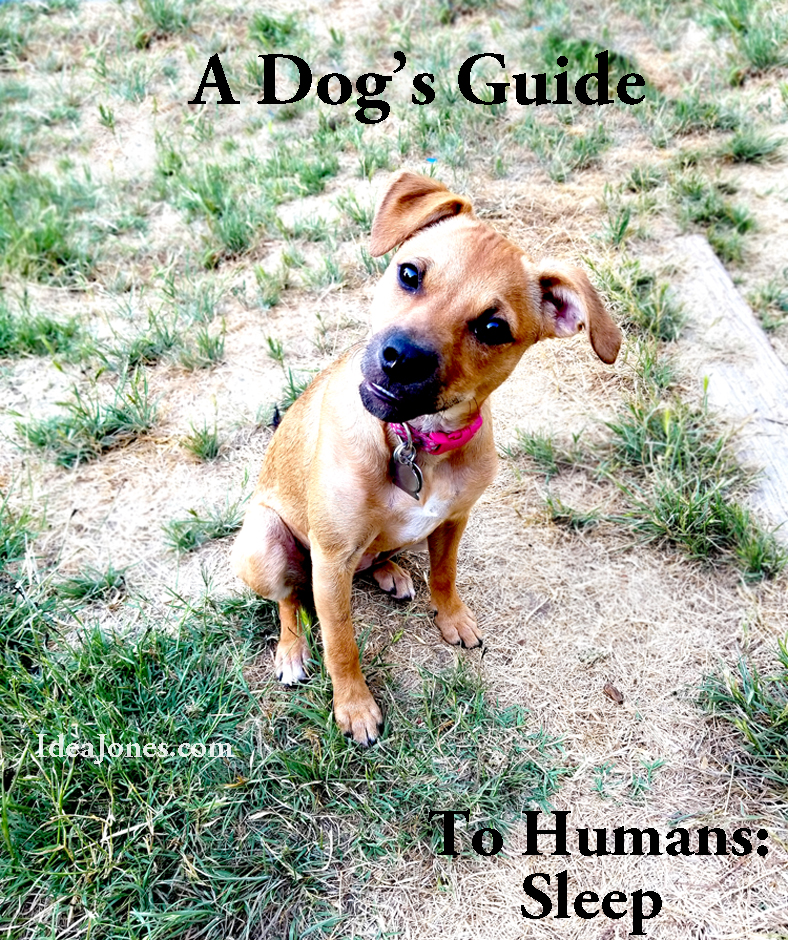
  • A Dog’s Guide To Humans: Sleep

    A Dog’s Guide To Humans: Sleep

    Humans are always tired.

    As with so many things, humans have a strange relationship with their own bodies (just wait until I get to humans and elimination. Oh my dog, that’s a whole subject in itself).  They are so uncomfortable in their own skins that they do things to themselves that can only be described as straight-up freaky. One of the things they really can’t figure out is sleeping.

    How, when, where or with whom, humans can screw all of that up beyond any dog’s ability to understand, but I’ll do my best to explain it.

    • Humans don’t understand sleep.

    I mean, quite literally, they don’t grasp the concept. Not really. They seem to do all right as puppies, but once they can walk unassisted, they start experimenting with it.  Their puppies, called “babies,” are the most sensible stage of their development. They eat when they’re hungry (well, they demand food), poop when they need to, and sleep when they’re tired, unless someone or something prevents them. Yes, you read that right — adults try to manipulate their puppies so they sleep not when they’re tired, but when it is most convenient for other adults. This isn’t surprising when you realize that this is what the adults do to themselves and to each other.

    They have a schedule that is baffling. They wake up, usually after not getting enough sleep, so they’re cranky and clumsy. By ingesting the runoff of water in which various plants have been dredged, they open their eyes, at least somewhat, and begin to communicate. Prior to drinking the runoff, they communicate mostly in grunts and gestures. After, they communicate in sharp, harried barks and run around grabbing things and  putting them into other things, usually some sort of bag or box, and complaining that they are now late.

    Laugh if you will — this is how they start most of their days.

    They spend their days in a variety of behaviors, most of which seem to have little practical value, but do keep them occupied and, for the most part, out of trouble. During the afternoon, when their energy dips, they do not rest. Instead, they ingest more runoff so they can keep doing whatever it is they’re doing.

    Then they come home and do more things, not very effectively, because they’re tired. When they get tired enough, they slump on the supplementary dog bed (aka “sofa”) and stare at boxes with emit light and sound, which helps keep them awake. Sometimes these are thin, small boxes they can hold in their hands. Other times they are very large boxes.

    Eventually, long after they should be asleep, they will topple over and sleep in front of the glowing boxes, still resisting the urge to go to their comfortable beds to sleep. Eventually, many of them do rouse somewhat and stagger to their beds, but some stay in front of the glowing boxes so they can wake in the morning and complain about the parts of their bodies that hurt.

    • Humans don’t trust sleep.

    You might have read that more than once only to discover that it still makes no sense.  This is because it makes no sense.

    Humans dislike sleep. They brag about how little they get. They pretend they don’t need it. They talk about “snatching” or “grabbing” it. Where any sensible dog will tell you that if you’re tired it’s time to sleep, humans avoid it as long as they can.

    Instead of viewing sleep as a necessary part of the healing process, humans treat it like an enemy who must be conquered. Even as they are staggering, bleary-eyed and foggy-brained, they tell anyone who will listen that they “don’t need that much sleep.” It causes them untold health risks from accidents to heart attacks, but they take pride in their unwillingness to lie down and close their eyes as if simply being able to keep their eyes open long after their brains have stopped working were some sort of accomplishment.

    It is worth considering what marvels they could accomplish if only they weren’t so tired all of the time. And cranky. I’ve heard the phrase so often that the one word doesn’t sound right without the others. Tired and cranky.

    I doubt we’ll ever know what humanity could be if it only it got the occasional nap.

    I will write my next dispatch as soon as I can. Meanwhile, it’s time to go to bed. ~ Gingeroo

  • Writer’s Gold

    Writer’s Gold

    That’s what I call it, “writer’s gold,” when you meet someone who enjoys your writing. Writing is such a solitary art. It’s ceremonial. Writers have their traditions, habits and rituals. For me, it’s turning the lights low, getting a cup of tea, putting on some soft, quiet music, turning off the ringer on my phone, and surrendering to the gravitational force of the story. It pulls me in and I’m there, with those characters, seeing, hearing, smelling and experiencing what they do.  Mark says that you could light fire to my chair when I’m writing and I wouldn’t notice — and he’s not far off.

    But you walk forward, struggling to capture the vision in your mind and describe it, not knowing if anyone will understand what you’re trying to say, or enjoy what you’re creating. It goes out and (hopefully) people read it, but you don’t sit there with them while they do (and good thing — when a writer watches someone read his work, it’s uncomfortable for both parties. The writer is hyper-focused on the reader and trying not to ask “What? Where are you?” at each sigh, laugh, gasp or facial expression, which is annoying for the reader and I’ve been there, but trust me, it’s almost impossible to resist).

    So for the most part, a writer works in solitude, builds his paper boat, launches it onto the pond, and retreats to build another boat. That’s why it’s so great when someone has read something you wrote and really enjoyed it. I talked with someone the other day who read the opening of “Based On A True Story: Really (Almost) True Story,” and told me she enjoyed it a lot, it made her laugh, she recognized moments in it as moments like ones she’s had… She went on to talk about the scene with the cake and said she could see it in her mind and feel what was going on, laughing as she recounted it back to me… She also said that she was frustrated because she couldn’t keep reading and wants to buy the book!

    What I hope is that the book will give the reader a bit of an escape. Life can be stressful and when it is, books have been my refuge. This person has a stressful job, and the idea that for a moment she left it behind while laughing over our book makes me happy. Hearing her enjoyment gives me heart to build more paper boats and launch them.

  • Arts Life — Dispatches From The Trenches #4

    As we gather information from those who know about promoting artists and arts groups, we're sharing them. May your art thrive!
    As we gather information from those who know about promoting artists and arts groups, we’re sharing them. May your art thrive!

    Here’s the final dispatch in this series (until we learn more)… the last part of Why Should Anyone Give A Rat’s? Advice Gleaned From The Gatekeepers:

    3) Know who you’re talking to.

    Before you submit a story idea or send a press kit, pay attention to what is on that station. Read that publication at least once and pay attention to what is in it, including the ads. Look at the website. How is it written? What does it talk about? That gives you clues to their target audience. How well does that mesh with the target audience for what you’re promoting?

    If it’s not a natural match but there’s something special, that’s your hook. Your ballet recital might not be what your average reader of Biker Bar Monthly is looking for… unless your event is Ballet and Bikes and your dancers will be performing with, or around, motorcycles. Not that there aren’t motorcyclists who like the ballet — but as Mom used to tell me, “You shoot ducks where ducks like to gather.” Your chances are better in a setting that is more in line with the style of the event.

    I’m told that if you pitch something that isn’t obviously for that publication, show or website without making the case for why it really is a good fit, that’s a big red flag.

    Also, for local stations or publications, pay attention to what your local connection is. If you don’t have any, you don’t, but if the director, or a performer, or the writer, or the artist was born in that area, lived in that area, had parents who lived there, something that connects it to that area, feel free to mention it. Not belabor it, but mention it.

    4) Remember what you’re up against.

    Don’t let it stop you — just don’t forget it. In any midsized city, there are many, many events happening almost any week in the year. That’s your competition for time/space/attention. So do your homework. Which leads me to the last one for now:

    5) Follow the *&#(#! instructions.

    Contact whoever the way they want to be contacted. There’s not one magic format. Some like email, some like snail mail. Some have an online form to fill out. Whatever it is, show the basic respect of paying attention and following instructions.

    Any show or publication gets many pitches for stories, for calendar items, for PSAs. The instructions aren’t meant to make your life difficult. They’re meant to help smooth the flow of information coming in. That’s how they are set up to handle incoming information. No point railing against it. Show that you value the chance to promote your art, your event, your performance.

    Actually, that’s the biggest complaint I’ve heard. The #1 thorn in the side of gatekeepers — people who don’t bother to do the homework or follow the instructions. Do that and you’ve just increased your chances of a favorable reception.

    There are no guarantees. You can do everything right and still not get it every time. But you can increase your chances. Good luck!