IdeaJones

Tag: author

  • Prince Charmish

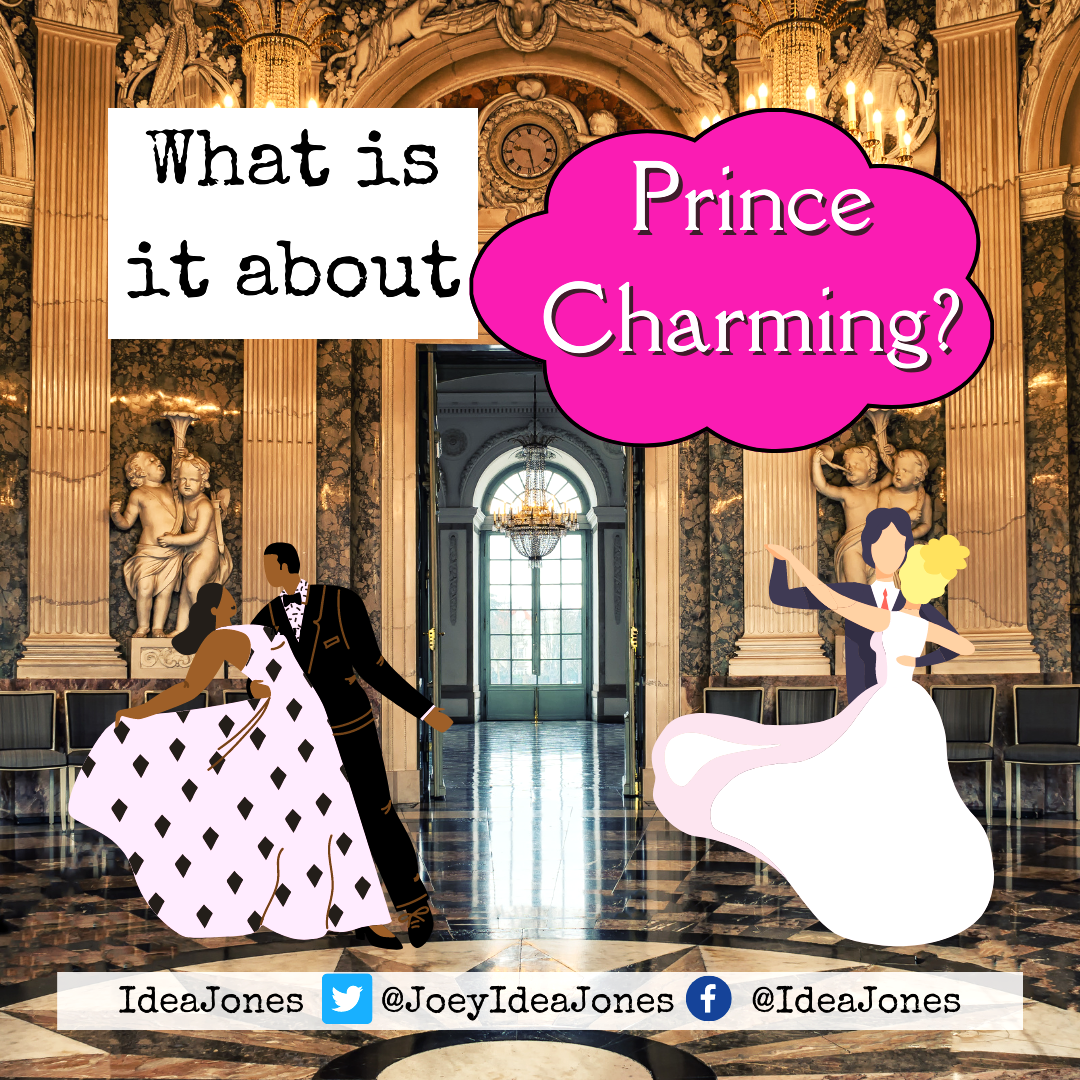
    So I’m talking with Mark about fairy tales, and it occurs to me… Prince Charming. He’s been a literary character, a cartoon, a meme, and yet…

    What is it about Prince Charming? I read the Brothers Grimm version, as a kid and as an adult. I swallowed the animated, kind of 2D-Ken doll versions as a kid. I’ve absorbed the cultural visions of him through my pores like almost every woman (it’s not just Western culture — other cultures have their own versions) in movies, in books, magazines, television, songs…  It’s embedded into our view of the world, the idea of the perfect man. It’s so prevalent that it took me years to examine it. When I did, I realized something…

    Nobody tells you what makes him charming. We’re simply told he’s charming, and that’s that. In the original, he’s simply a prince, and that’s enough. Then he becomes a handsome prince. He dances with Cinderella, and he’s charmed by her, but does he do anything particularly charming himself? Not really. In later versions, he acquires the name, Prince Charming, but still we’re not given any evidence that he is, indeed, charming. He ignores the other guests at the ball to dance with the most beautiful girl in the room, flattering for her, but hardly charming for everyone else there. He chases a girl who’s trying to get away from him. Not so charming, that. He takes her shoe on an obsessive quest,  prepped to marry the first woman who wears that size shoe in the kingdom, assuming there’s only one, and it must be her. Not too bright. If you find intelligence charming, you’re out of luck.

    To a lonely, abused girl, maybe the very fact that he could take her away and presumably give her a place to bathe, a change of clothes, and a bed that wasn’t the floor was probably enough, to start. How likely is it that her standards were high? We don’t hear from her five years into the marriage. By that time, he might be “Prince Too Dim To Follow A Thought From One End To The Other,” or “Prince I Think He’s Sleeping With The Maids, And Not One At A Time, Either.” 

    So what is it that drives the myth of Prince Charming? He’s a mirror. You bring to him whatever needs and desires you’re carrying with you. He’s featureless. You can hang whatever fantasies you want onto him, and he’ll wear them, much like dressing a Ken doll. We all know Ken only exists so that Barbie doesn’t have to go stag if she doesn’t want to. Pre-media celebrity, we had Prince Charming. Much as we approach celebrities with our load of issues and paint them to suit us, we create our own Prince Charmings, one for each of us. Mine might be, probably is, very different from yours.

    All of which is fine, if you see it for the fantasy it is. Instructive, even, if you look at why your Prince Charming looks and acts as he does. That could tell you a lot about yourself. If, however, you go out in the world skipping any guy who doesn’t fit the suit, Prince Charming becomes a problem. He gets in the way. Which isn’t charming.

    Yes, guys have their own versions of this (“Hooker with a heart of gold, beautiful but unappreciated, disease-free, no addictions, not planning to steal my wallet, just needs someone perceptive and kind to rescue her”). No, I don’t have any deep, insightful lessons to impart from it all. I just find it interesting that in looking slightly to the left or right of the real people standing right in front of us, we might be missing something.  — Joey

    What makes him Charming, anyway?

  • Likes (The Idea Of) Walking In The Rain

    Dear Strange Dude:
    Thanks, but…

    Dear Guy From The Computer Dating Service Who Keeps Messaging Me:

    You seem like a nice guy. It even says in your profile that you’re “mature,” which is not a claim many people can honestly make, so mad props to you. Yes, I’m sure we like a lot of the same things, although I have to tell you I don’t really like walking in the rain. I like rain, and the idea of walking in it, but as with many things, the reality differs from the fantasy in important ways.

    Fantasy: walking in a light, steady rain, more of a heavy mist, that turns my skin dewy and glowing. Reality: squelching along, my hair plastered to my scalp by drops that splat on me like water balloons, in shoes that will, as soon as they get warm, smell funky.

    What I really like is sitting at a table under an awning or on a covered porch, sipping hot tea and reading, alone or with someone who doesn’t interrupt, because he’s reading his own book. I’ve left “splashing in puddles” territory and “I’ve fallen, and I can’t get up!” isn’t far enough away to leave room for romance on slippery surfaces.

    Which reminds me, no to the making love on satin sheets.

    No to all of it, really. I never did sign up for that online dating service. I took what was advertised as a fun personality test about romance. I’ve been married since before the invention of dirt, and was wondering if there were any romantic notions left in my aging and more than somewhat befuddled brain.

    Turns out the answer is “no,” at least as defined by an online dating service. Fancy dinners mean taking more trouble than I care to in order to get dressed, and sitting on uncomfortable furniture. I’d rather slide into a comfy booth at a diner where the waitress calls me “hon” and serves me a good burger, well done. Candlelight means squinting or rooting around in my purse for my glasses.

    I suspect that people who serve food in the dark are hiding something. Not that the lighting has to be “interrogation scene in a film noir,” but I do like enough lighting to read the menu and see the person I’m eating with. You only have to have the lights come up and find yourself murmuring fondly into the ear of a total stranger once to learn your lesson.

    Fortunately for you, I’m already married, so you don’t have to deal with me. Fortunately for me, I’m married to someone who dislikes dark restaurants and walking in the rain, and does like me.

    So you have to stop messaging me. I hope you find someone who likes walking in the rain, candlelit restaurants, and satin sheets as much as you do, although it seems likely you’ll see more of the staff of the hospital ER than each other. Which might work out, come to think of it. You need someone who knows her way around bandages.

  • A Cinematic Book

    A Cinematic Book

    We made the quarterfinals of the ScreenCraft Cinematic Book Competition! (Update… we made the semifinals!)

    Just got the word that we made the semifinals of ScreenCraft’s competition for “cinematic” books, which means script readers could see this as a movie.

    There are a lot of great books that wouldn’t make good movies. To be made into a movie, a book needs a visual language. Long ago, we took a series of classes from Dale Wasserman, who wrote the play “Man of La Mancha.” He wrote the “book” of the play (as opposed to the music and lyrics — although he maintained some of the lyrics were lifted from his text). He also wrote for film and tv as well as theater.

    He said that books are the most literate art form, then plays, then film, then tv. It wasn’t an insult — it’s just that film and tv are more dependent on visuals than language. Language matters in film and tv, but first, you have to have pictures.

    Mark and I have placed in screenwriting contests, and Mark writes in pictures. He’s good about prodding me to look at what I’m writing and think about what it looks like. “It’s a movie in the reader’s head,” he told me one time. “When I read, I see it and hear it.” Plus, he trained me in producing for radio, where creating mental pictures is what it’s all about. It’s something I still work on… as you can tell, I tend to be verbal.

    Lots of writing is you alone with your thoughts and your computer (or notebook, or…). I talk to myself when I’m writing, wondering if anyone but me will understand what I’m trying to convey. There’s no way to tell until someone reads it. First we had beta readers, then did live readings, then got feedback from a reviewer, and at every stage, examined what was working and what wasn’t. Every time a reader says they enjoyed it, and tells me what connected with them, I want to cheer. Now we’re querying it. It’s a terrifying process.

    I overwrite, then have to cut like the villain in a slasher film. There’s always a struggle to cut what is “extra” without taking all the juice out of it.

    To know that the ScreenCraft readers, who have never met me and don’t know what I sound like, “hear” and “see” this novel is a joy. Congratulations to my fellow semifinalists, and to everyone who completed a novel they were proud enough of to enter it in a competition — that’s a big achievement right there.

  • Gatekeeper Secrets: 5 Ways To Start Off Ahead

    Continuing my online writer conference (since I had to miss the PNWA con this year). Day 5 — Gatekeeper Secrets

    Because I interviewed a bunch of “gatekeepers,” people who look over submissions and decide if they merit consideration, I have some advice to pass along. Also, I’ve been a gatekeeper (I was once an Editor for a magazine). So I’ve had to climb Mt. Slushmore in search of gold nuggets myself.

    Some of this may sound obvious. Most of it sounds obvious once you’ve heard it. But an agent at a recent conference talked about some of this stuff and it reminded me that it’s still the place most hopeful beginners fall on their climb to “published.” It also applies to other arts as well, fine art, music, acting, etc.

    Even for people who have been published, it’s good to be reminded that The Basics still count. I’m trying to go from “published in newspapers and magazines” to “published book author,” so I’m climbing Mt. Slushmore again myself. Since we’re trying to climb Mt. Slushmore and reach the peak, let’s start at the bottom:

    5) Don’t bother anyone until you’re ready to go. This is at the bottom not because it’s unimportant, but because it’s the first step, and you shouldn’t even attack the mountain until you complete it.  Agents want to know you have AT LEAST one book COMPLETED (or, if you’re an actor, have actually acted in something, taken classes, etc.).  You have a great idea? Good for you!

    Now make it. Write the songs, paint the painting, write the screenplay, etc.  If you’re trying to get an assignment to write an article (say for a magazine), and you haven’t had anything else published, be ready to work “on spec” and get paid only after you’ve written the article and the editor has decided to buy it and run it.

    I keep meeting nice people who have ideas for books, articles, radio stories, etc. that they “just need someone to write up,” or that they are writing and have yet to finish, who expect to find buyers for their uncompleted (or in some cases, unstarted) debut projects. You are up against people who are working at their craft. Taking it seriously. Developing their chops.  Be a professional.  Respect your idea by taking it seriously.

    After you’ve created it… edit, revise, polish. You’re trying to convince people you are a producer of diamonds. Have at least one polished diamond to show them.

    4) Get your supplies in order. Your book, your article, needs to be as good as you can make it. Professionally edited, if you aren’t an editor (and even if you are, have someone else check it, proofreading, notes, etc.).

    Workshop your novel, and pay attention to audience reaction. The best advice I’ve gotten so far (regarding improving my work) was, “Read it aloud.” Mark and I started participating in an open mic night for writers, in a book store, reading our work and paying attention to the reactions, both from the other writers, and the people in the book store. If attention is wandering, make a note where it starts to drift. I have to tell you, watching people linger in the stacks, taking a book off the shelf, putting it back, repeat, repeat, to hear the end of your story is a high.

    If you’re only writing for  yourself, great, you don’t need to know what people think. If you’re writing for an audience, you do.

    3) Research the mountain. No matter what professional mountain you want to climb, someone has climbed it before. Never in the history of humanity has information been so easy to come by. Sure, you have to look at the source and figure out how reliable that information is… but that’s doable. And you can average. If 25 people with professional credentials tell you that you need a certain sort of rope to climb that sort of mountain, you need to look closely into getting that sort of rope.

    For writers, you can go to professional conferences, join writing organizations, and yes, read. I mean, if you don’t like to read, why do you want to write? Take writing classes. Do writing exercises. In California, the California Writers Club, for example, has chapters all over the state, with workshops, speakers and sometimes even those open mic nights.

    If you were an acrobat, you would stretch a lot and do muscle-strengthening exercises (or you’d plunge to your death. At least writing isn’t that dangerous).  Whatever profession you’re trying to break into has its own series of stretches and exercises. Expect to do them.

    2) Don’t Be An Asshole. Good advice generally, but in the arts? Crucial. Plus, in the internet age, everything lives forever and comes back to haunt you. Be polite to the Receptionist. Don’t argue with people and get defensive (especially the people you’re trying to get to consider you. Have you ever been argued into liking someone? No, and neither have they). And every career has its ups and downs. You meet the same people going both directions, and sometimes they can give you enough of a boost to stop you from falling off the mountain entirely. It’s good ethics, good karma. Don’t fawn (don’t lick boots unless you’re addicted to the taste of shoe polish). Just be polite.

    This includes other people in your field. Again, both for professional reasons, and so you can like yourself. It’s not like there are only so many cookies, and if someone gets a cookie, you get none, so don’t run down other people.  It makes you look insecure. And it’s nice to be able to talk to people who get what you’re trying to do and think it’s worth doing (because they are, too). In radio, I’ve referred other engineers and field producers when I couldn’t take a gig — and they’ve referred me when they couldn’t.

    1) Follow. The. Guidelines. The most obvious advice is still the advice most people don’t bother to follow. If you’re submitting to agents or editors (or whatever is the equivalent in your art form), look at the website. Read the Submission Guidelines. Treat them like gospel.

    Every publication, every agent, has The Way We Do Things Here. By not reading and following those guidelines, you come off as an arrogant amateur. It’s basic courtesy, really. If you rang on someone’s doorbell and asked to come in, and he said, “Well, okay, but we have a white carpet, so you have to take your shoes off,” would you say, “I paid a lot for these shoes and matched my outfit to them, so even though everyone else takes his shoes off, I’m special?”  If you did, you should expect to feel the door slamming shut on your snout. It’s rude. It’s inconsiderate. And it’s dumb.

    It doesn’t matter how you like to do things. You are approaching that publication, that editor, that agent, and asking to be considered. You are ringing their doorbells. They aren’t ringing yours. Don’t cheese them off by swanning about, expecting them to bend the rules for very special  you.

    Some agents, for example, want the first ten pages. Others want the first  two chapters. Some want a bio and a synopsis of the book. Others don’t care about that unless they like the first chapter. Some want a letter. Others don’t.  Whatever they want to see, that’s what they feel they need to see in order to get a feel for whether or not they’re interested in you.

    As the agent at the workshop said, “By following the guidelines, you lift yourself above 50% of the people who submit from the start. And I’m not kidding. It might even be more than that.”

    Why start climbing by stepping on your own toes?

    Whatever mountain you’re trying to climb, be it Mt. Slushmore, the Hollywood Hills, or your mountain of choice, climb smart and you might just make it. I hope we both do. Good luck!