Rough hands grab my skin, tearing it from my body. I groan as it is ripped away. As calluses abrade each new strip, I shudder, trying to hold myself together. There is life inside me. I must not give in to the pain, the pain, the pain. All is pain.
One nail is slowly pried off and I cry, loud, noisy, no pride left, please, no! Inside me, my heart flinches as I vibrate from the grasping hands flaying me, yanking my nails away, and all I can think of is the life I keep safe within despite the pain. All is pain. Everything, everywhere, is pain.
The night is cold, so cold. Skinned as I am, the cold penetrates me. I am weakened, vulnerable. Within me, the life I strain to protect shivers and dreams of peace, of a time without the cold and the pain, but all that is not cold is pain. There is nothing anywhere but cold, and pain. Pounding shakes me as pieces of new skin are forced onto me, nailed into place. With each blow, I tremble. My skeleton shakes as each nail is forced into me, but I stand.
At last, new hands spread cool, soothing salve over my bruised body. My new skin is not yet so comfortable as it will be, but the pain gives way and I settle, wearily. From within, the life I guard creeps out to examine every inch of my new, wet skin.
The four-legged lives sniff me. One lifts his leg but I understand he is telling the world that I am his own.
“They did a good job,” one of the two-legged ones says.
“For that amount of money, they should,” says another.
“Still,” muses the first, “should last for years.” He pats me, gently, as if he were the one who was big and I the one who was small. “The house is good and solid again. I’m glad we got the new siding on and painted before it rains.”
That is the moment I understand. I have not been tortured. I have been reborn.
As we learn the fine art of querying a novel to agents, there are a few things that are becoming clear. One is that rejection comes in flavors, like ice cream (I know, you probably think getting a rejection is more like eating cat litter and the “flavors” are just “used and unused,” but…
Rejection isn’t just a one-size-doesn’t-fit-any, unredeemable experience. It’s not poking your head into a dumpster, where everything stinks and the only detail is “stinks of what, exactly?” Some rejections are actually useful, and others are, if not exactly enjoyable, more than merely nutritious.
First, the “no flavor” rejections. A lot of agents and agencies specify that you will only hear from them if they’re interested. Which leaves you wondering if anyone even saw your query letter. Saying “no” is not fun (unless you’re an unpleasant person, more about that in a moment). So, like the first date who ghosts you, it’s understandable if sad that so many don’t even bother to acknowledge your submission. This isn’t ice cream. It’s a glass of air.
Next comes the form letter. These come from really formulaic letters that you can tell nobody spent time on (“Thank you for your submission which doesn’t fit our needs goodbye”) to ones where they’re at least trying (“Thank you for your submission and while we are unable to represent it, we realize it’s not easy to go through this process and you have to understand, it’s all very subjective, so don’t give up and good luck”).
The former is “school ice cream” that comes in a paper cup and tastes like cold milk someone packed while looking at a bottle of vanilla they never thought to pour into the ice cream. The latter is the least expensive store brand vanilla, that might not be memorable, but at least has some flavor.
Kudos to the people who at least send the form letter, who stand high above the ones who don’t even bother to do that. At least you know they saw your submission.
After that comes the personal note. We’ve gotten a number of those, and they range from one who said “I really wish I could identify what isn’t quite working for me here,” which, while not especially helpful, at least is a personal response from a human being, to “this strong writing and funny, it just isn’t quite right for my list. I really want to see the next book you write, if you don’t have an agent already, but you will.”
The writer of that last one will live in my heart with gratitude. And will definitely see the next book I’m working on, if I don’t have an agent by the time it’s done.
But I’m grateful to anyone who takes time to write even a brief personal note. I’ve gotten a few, some very encouraging. Agents, especially good ones, get a ton of submissions. So to give you a personal response, that person has to take time out of her (or his) day, think about you for a bit, write a note and send it, knowing that you, a stranger, may simply be hurt by the “no” and not appreciate the time and effort it took to write to you. It’s been explained to me that once you’re getting personal notes, it’s another step toward achieving your goal, because agents don’t take time to write those unless they see something they want to encourage.
These rejections are, as rejections go, the good stuff, ranging from “better than the cheap stuff, with some flavor” to “this is the luxury ice cream you serve to company or buy to spoil yourself, or to eat after a really bad breakup, because it’s good enough to remind you life is still worth living.”
Finally, and I’ve only gotten one of these, the really awful rejection, where you get a personal note, and it’s useless, uninformative, and just plain mean. I found out later the same agent had sent variations of that letter to multiple people. We’re back to cat litter here. You may well get at least one pint of used cat litter ice cream. Just know that it isn’t you. Nobody worth bothering about sends anyone used cat litter ice cream.
I don’t know the average, but looking into it, I found that those “I showed my first book to one agent, who signed me and sold it for many dollars” story is so rare as to be almost (not quite) an urban myth. The usual story is “I wrote a book and queried 50-200 agents before one took a chance on me, and wrote the next book in the year+ it took her to sell the first one.”
Rejection is baked into the professional writing experience. I’ve been an editor, and can tell you I hated saying “no.” Hated. It. You’d much rather say “yes,” but you can’t say yes as often as you would like to. There is nothing, with the possible exception of oxygen, that is for everyone. Once you get published, not everyone will like what you write. It’s just that way.
If you get a “school ice cream day” vanilla form letter, or an “I sent this and never heard back” glass of room-temperature air, well, that’s one closer to finding your agent, the one who gets what you’re doing. If you get a “store brand vanilla,” be grateful that someone at least took time to let you know. If a “luxury brand” rejection comes your way, mine it for anything useful, be grateful for the time that person took to encourage you, and keep going.
We made the quarterfinals of the ScreenCraft Cinematic Book Competition! (Update… we made the semifinals!)
Just got the word that we made the semifinals of ScreenCraft’s competition for “cinematic” books, which means script readers could see this as a movie.
There are a lot of great books that wouldn’t make good movies. To be made into a movie, a book needs a visual language. Long ago, we took a series of classes from Dale Wasserman, who wrote the play “Man of La Mancha.” He wrote the “book” of the play (as opposed to the music and lyrics — although he maintained some of the lyrics were lifted from his text). He also wrote for film and tv as well as theater.
He said that books are the most literate art form, then plays, then film, then tv. It wasn’t an insult — it’s just that film and tv are more dependent on visuals than language. Language matters in film and tv, but first, you have to have pictures.
Mark and I have placed in screenwriting contests, and Mark writes in pictures. He’s good about prodding me to look at what I’m writing and think about what it looks like. “It’s a movie in the reader’s head,” he told me one time. “When I read, I see it and hear it.” Plus, he trained me in producing for radio, where creating mental pictures is what it’s all about. It’s something I still work on… as you can tell, I tend to be verbal.
Lots of writing is you alone with your thoughts and your computer (or notebook, or…). I talk to myself when I’m writing, wondering if anyone but me will understand what I’m trying to convey. There’s no way to tell until someone reads it. First we had beta readers, then did live readings, then got feedback from a reviewer, and at every stage, examined what was working and what wasn’t. Every time a reader says they enjoyed it, and tells me what connected with them, I want to cheer. Now we’re querying it. It’s a terrifying process.
I overwrite, then have to cut like the villain in a slasher film. There’s always a struggle to cut what is “extra” without taking all the juice out of it.
To know that the ScreenCraft readers, who have never met me and don’t know what I sound like, “hear” and “see” this novel is a joy. Congratulations to my fellow semifinalists, and to everyone who completed a novel they were proud enough of to enter it in a competition — that’s a big achievement right there.
If you’ve ever uttered the words, “I’d like to write a book some day,” then it’s time to take a chance on your dream. National Novel Writing Month is almost here (starts November 1), and if you go to https://nanowrimo.org , you can sign up (it’s free) and join other writers working on their books. Lots of budding novelists bloom in November by taking part in this.
It holds you accountable. You log in every day in November and submit your word count for the day, and it tracks your progress. You’d be surprised how far you can get with just a little every day. Sure, some weeks you can come up with hours to write, but other days you may have only 30 minutes. Thirty days hath November, which means that by the end of the month, with just 30 minutes a day, you’ll have put in at least 15 hours on your book!
Our NaNoWriMo book for 2018: East-West Crazy
Our NaNoWriMo book is “East-West Crazy,” which is a Women’s Fiction novel with dark humor. It’s already started, but I plan to make real progress in November, and I’m looking forward to it.
My mom used to say that time is a gift so precious, we rarely give it to anyone. For many of us, this is especially true of ourselves. But even if it’s only 15 minutes a day, that’s one whole work day you invested in yourself and your dreams by the end of the month. You’re worth that… and no matter how tight your budget may be, you can afford 15 minutes a day.
By the end of the month, your “some day” will be a lot closer.
Mark and I woke a few days ago to the news that a Facebook friend I’ve known for years, a private individual I’ll call “Lady K,” had died suddenly. Later that day, we learned that our friend, musician John Wicks, had also passed. We’re still trying to process it.
Lady K was a blogger who wrote about mental health issues. She was courageous in talking about her own challenges, and always encouraging to others. She was also a good person with a big heart and a lovely, warm and supportive friend.
Lady K was a warm, kind soul
She was a recreational shopper, a person who took joy in finding the least expensive way to buy an item. She would show you the item (for example, a bedspread listed for $100), then show you the receipt ($15), and walk you through how she got the price down that far.
I thought of her today. I’m not much of a recreational shopper (although I love yard sales and thrift stores). We went to the grocery store and bought, among other things, beets. I like beets, but not as much as I like beet greens. But most people tear them off and sure enough, that section of the produce bin was littered with big, fresh beet greens. I collected them in a bag and at the checkstand, gave the clerk the bag and said, “I don’t know what you charge for these… they’re the beet greens that people tore off of the beets and threw back into the bin.” The clerk smiled and put them with our groceries. “How about free?” I was happy — I got free, organic beet greens. He was happy — the produce department doesn’t have to clean up a bunch of beet greens. It was a small coup, but I wished I could tell Lady K, who would have understood.
She lived life wide open, which sometimes meant she got hurt, and badly, but she remained an open, good-hearted friend, who loved to laugh and was quick to give others a boost up, even when she didn’t feel all that confident herself. She helped this introvert learn to ask for what she wants.
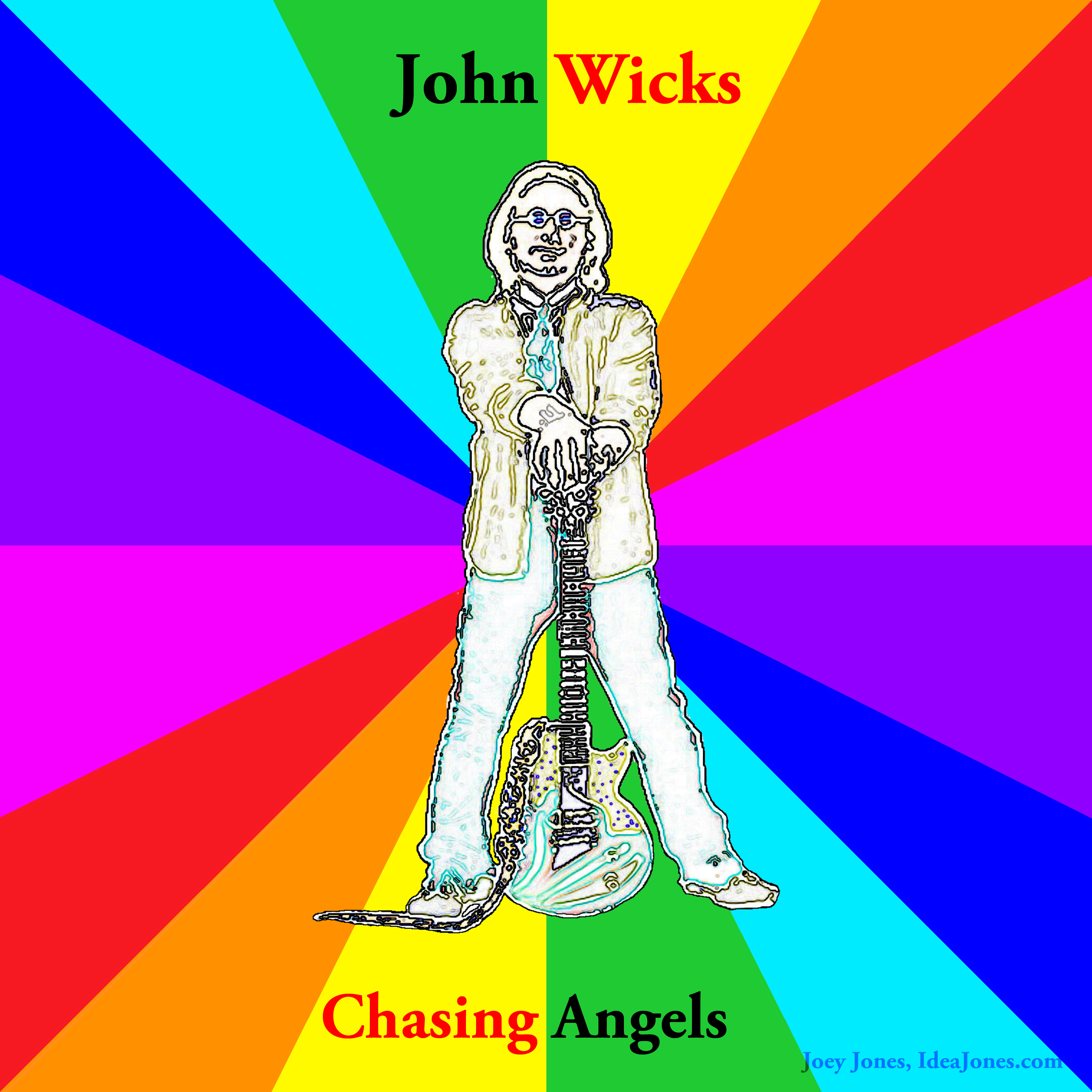
Johnny Wicked was a public personality (singer/songwriter) and a private one (our friend, John). We got to see the public personality in concert a few times. Once, and our guess is John and his wife arranged this, we were seated in the VIP section at the club. We sometimes spring for the VIP seats, but not often, and we hadn’t that time — but we arrived and the staff seated us in the VIP section, and told us we had been moved there. It added another layer of fun to an already fun night.
John Wicks, aka Johnny Wicked, was a wonderful performer. He was what the old vaudeville performers would have called “a trouper.” The performer who understands what he owes his audience. He truly believed that old show business adage that “the show must go on.” Once he told me, “The audience pays their money and they deserve the best you can give them.” Even as cancer racked his body, he gave everything he had. You were guaranteed a good time at a John Wicks show, whether he played solo, in duets with performers such as Debbie Peterson of The Bangles, or with his band, The Records. You never got less than the best he had to offer.
He had high artistic standards and got frustrated when he, or the situation, couldn’t meet them, a thing we talked about more than once as Mark and I can be the same way.
My favorite of John’s songs, and personally relevant as we think of our friend.
When John was first hospitalized, I drew a silly cartoon of him and sent it to give John and his wife Valerie a laugh, thinking they’d get a chuckle out of it and toss it in the trash. But no, John kept it up in his room. Other cartoons followed, getting more outrageous. Privately, we talked about so many things, life in the arts, what we were up to, challenges we faced… but mostly, we cracked jokes.
John could tell a funny story, usually scandalous, true, and worthy of his nickname, Johnny Wicked. He was kind, gentle, and supportive. He had a great laugh and was absolutely honest about himself. He’d had fame, suffered setbacks, and had to reinvent himself, and while he was disappointed in some things, with reason, he never seemed bitter, only frustrated. Where some would have become cynical, selfish and cold, John was a warm, open guy. He continued to play benefits even as his illness grew.
I was proud to count both Lady K and John among my friends, and feel their loss keenly. The world is never so well-supplied with good people that we can afford to lose one, and now we have lost two.