IdeaJones

Tag: #writinglife

  • Into The Twitter(pitch)verse

    Into The Twitter(pitch)verse

    More on Twitter pitch events… Da Etiquette

    Into the Twitter Pitchverse. An introduction to Twitter pitch events for writers.
    Navigating the world of Twitter pitching.

    I’m not an expert, just another writer trying to navigate the jungle of getting and agent and getting published. In that quest, I’ve been finding my way through Twitter Pitch Valley, and in the interests of #WritingCommunity, I’m offering what I’m figuring out in the hopes it might be helpful to someone else. First, because it’s that important, Da Etiquette.

    As mom used to say, “Manners matter.” There is etiquette to Twitter pitch events. If you don’t follow it, you will probably get chastised, and may find yourself banned, so it’s worth noting.

    1) Be thou not a jerk. Criticize not the pitches of other participants.

    2) Follow thou the rules. If allowed three pitches, confine yourself to three. If allowed six, whoopee! Do six. Not seven. Read Da Rules and follow same.

    3) Seriously, be thou not a jerk. Don’t criticize the worthiness of other participants, or their right to participate.

    For example, one pitchfest for books is #DVpit. For writers from marginalized groups, such as the disabled. It’s on the honor system and if someone cheats they will be found out, but it’s not for you to make that call. If you personally know this participant and have concerns you can politely DM, I suppose, but otherwise? Leave ya nose outta it.

    4) Only “like” a pitch if you are a legit agent or editor and wish to see the manuscript. That’s how this works. If not, some allow you to retweet pitches you like. Some ask you not to. Read and follow Da Rules.

    If allowed to RT pitches you like, it’s a nice way to show support.

    So it follows that you do NOT “like” your own pitches, as you are not an agent looking to see your own manuscript.

    5) Be not a daft twit. Check Da Rules. If it’s a genre thing, be sure you legit fit somewhere in that genre before you participate. If you don’t know what the genres are and where you fit, for crying out loud, do some research.

    If it’s for left-handed writers and you can’t even brush your hair left-handed, stay out of it. If it’s for Women’s Fiction and your book is about a guy who hates women and kills people with a dinner fork, stay out of it.

    6) Time marches on — and you need to know which way. Most of those I’ve seen are Eastern Standard Time. If you live otherwhere than the east coast of the United States, plan accordingly. If it ends at 8 pm EST and you post your pitch at 8 pm PST, It’s 11 pm where the organizers are and nobody will see your post.

    7) Don’t take any of this too seriously. Just seriously enough. Do your homework. Follow the rules. Set up your pitch event calendar so you don’t forget when the next one is coming. Get your pitches ready and polished. Be ready to tweet when the time comes… then relax. You may or may not get requests. The requests may or may not pan out. It’s a chance, not a guarantee. You can still query agents traditionally whether they request you through the event or not. Enjoy life. Don’t let your happiness hang on this. Take the chance because it’s a chance, then take the next one, until one pans out.

    Good luck!

    #writing #writingcommunity #writingtips #writerlife

  • A Cinematic Book

    A Cinematic Book

    We made the quarterfinals of the ScreenCraft Cinematic Book Competition! (Update… we made the semifinals!)

    Just got the word that we made the semifinals of ScreenCraft’s competition for “cinematic” books, which means script readers could see this as a movie.

    There are a lot of great books that wouldn’t make good movies. To be made into a movie, a book needs a visual language. Long ago, we took a series of classes from Dale Wasserman, who wrote the play “Man of La Mancha.” He wrote the “book” of the play (as opposed to the music and lyrics — although he maintained some of the lyrics were lifted from his text). He also wrote for film and tv as well as theater.

    He said that books are the most literate art form, then plays, then film, then tv. It wasn’t an insult — it’s just that film and tv are more dependent on visuals than language. Language matters in film and tv, but first, you have to have pictures.

    Mark and I have placed in screenwriting contests, and Mark writes in pictures. He’s good about prodding me to look at what I’m writing and think about what it looks like. “It’s a movie in the reader’s head,” he told me one time. “When I read, I see it and hear it.” Plus, he trained me in producing for radio, where creating mental pictures is what it’s all about. It’s something I still work on… as you can tell, I tend to be verbal.

    Lots of writing is you alone with your thoughts and your computer (or notebook, or…). I talk to myself when I’m writing, wondering if anyone but me will understand what I’m trying to convey. There’s no way to tell until someone reads it. First we had beta readers, then did live readings, then got feedback from a reviewer, and at every stage, examined what was working and what wasn’t. Every time a reader says they enjoyed it, and tells me what connected with them, I want to cheer. Now we’re querying it. It’s a terrifying process.

    I overwrite, then have to cut like the villain in a slasher film. There’s always a struggle to cut what is “extra” without taking all the juice out of it.

    To know that the ScreenCraft readers, who have never met me and don’t know what I sound like, “hear” and “see” this novel is a joy. Congratulations to my fellow semifinalists, and to everyone who completed a novel they were proud enough of to enter it in a competition — that’s a big achievement right there.

  • On Falling, Getting Up, Finding the Neosporin, and Trying Again

    On Falling, Getting Up, Finding the Neosporin, and Trying Again

    I had a whole plan, at least for the next week. My bags were packed for the Pacific Northwest Writers Association conference in Seattle, WA. I had spent time researching the workshop presenters, the agents, and the publishers who would be there. Even designed new business cards (and I really like those business cards. They could be our trading cards). Knew every workshop I wanted to go to, every event I would attend… then late last night, the Snot Goblins (and just try to get that phrase out of your head now) pounced and I was sick. By early this morning, I had the sore throat and the whole thing. Trip cancelled, and me with extra ballpoint pens and undies packed and ready to go.

    Really disappointed, sure. Would have been my first PNWA event (I joined earlier this year). I had my pitch ready for the agent meetings (more about that in a second). Having worked out the logistics, I was ready to go, in mind if not, as in turns out, in body.  Next year, I hope. This year?

    I’m having my own mini-con. Writers Who Live At My House. Spent part of the morning forcing fluids and watching videos about writing and publishing. Lindsay Ellis has a whole series on Youtube from three years ago on her journey to create and publish a lurid novel (in the Twilight and 50 Shades of Grey vein). Not only is it a fun series (if you haven’t checked out Lindsay Ellis on Youtube, you’re missing out. Her film analysis alone is worth it), but inspirational for an aspiring author. I’ll read books about writing. I’ll read books, period, and figure out what I like (or don’t) about them. I’ll talk about writing, to Mark, to friends online. I’ll write about writing (here, for example).

    The big difference, I think, about being a professional in the arts is that you have to develop a thicker skin, and some resiliency. I’ve been published both as a freelancer and a staff writer in print and produced on radio. Once you put your work out there, you will hear from people at every stage of the process, from the receptionist to the readers.  TIP: I was a receptionist, back inna day. Always be nice to receptionists and assistants, both because you’ll like yourself better if you’re not an asshole, and because they are the Gatekeepers and have ways, subtle and overt, of rewarding or punishing you.

    Once I listened to a reporter moan about not being able to get through to someone he needed to interview. I asked him for the name of that person’s receptionist. He had no idea, looked at me like I was nuts for asking. I explained that it is good business to treat people with respect, the receptionist is a Gatekeeper, and if he wanted her help, he should treat her with more courtesy. He tried it, and got the interview. Doesn’t always work, but often, it does. And even when it doesn’t — you feel better about yourself.

    Agents… I’m prepared for it to take a lot of effort to find an Agent who gets our work, likes it, and with whom we would likely have a good working relationship. I’ve set a target of 150 rejections to find our agent. One is looking at the first few chapters now. I met this person and really enjoyed it. We had one of those great conversations where you go back and forth quickly, finishing each others’ sentences. A promising sign. We didn’t agree about everything, which would be freakish and not very interesting or maybe even beneficial, but we agreed about enough and more importantly, we communicated well. So fingers crossed.

    I want someone who can, and will, be honest — this is a business relationship, after all — but can do it with basic courtesy.  So honest, and direct, but not “brutally honest,” a term I’ve always hated — honesty is useful, but brutality is not.  I don’t need my hand held (well, rarely need it, professionally). An architect and a construction foreman need to communicate clearly what is needed or the building will fall over. Criticism aimed at making the work better? That’s fine. But there’s no need for insults. So I’m looking for a balance. A true professional.

    Speaking of Brutal Honesty:  Had another meeting with a potential agent. These were timed meetings (ten minutes, I think). I’d spoken with the moderator, tasked with telling people when the time was up, and we’d laughed about it being like speed dating, those events where you talk to someone until a timer goes off, then talk to someone else.  I took my seat, and… that agent and I just didn’t hit it off. I don’t mean we disliked each other — I didn’t take it personally and I have no idea what she thought of me as a person based on that limited exposure. We just did not click. At all.

    She didn’t get the book’s premise, clearly didn’t like my pitch, had not one positive thing to say and lots of negative stuff to say based on assumptions of what the book, which she hasn’t seen, would be like. I tried to answer the issues she raised, which are dealt with in the book, but we kept talking past each other, never connecting. It was very evident that we were not a match, not meant to work together. It didn’t bother me. I did try to reword things in an effort to communicate, but by that point, it was an intellectual exercise.

    At some point, I laughed, “Well, clearly this is not for you. Nor am I.” She stared at me like I had three heads, and two were drooling. A friend explained that people are usually desperate in these meetings. She might have been prepared for me to try to argue her around, or, I don’t know, fall to the floor, clutch the hem of her garment, and beg?  Not that I’m above that, mind you, but I couldn’t see it helping. Just for the record, when it’s really necessary, I can beg with the best of them. I once held an airplane at the gate because my mother-in-law didn’t realize that when she went in search of the ladies’ room, she walked back through the TSA security screening area. Without her purse. Or her phone. So she couldn’t get back in and had no way to tell us. As the staff at that Alaska Airlines desk can tell you, I can beg, baby, and beg hard.

    There was no point in going on. I wouldn’t enjoy working with her, nor she with me. Humor is subjective and while lots of people do get my sense of humor, there is no such thing as “universally funny.” And if you have to explain a joke to someone, he isn’t going to suddenly get it and laugh. If the joke doesn’t land for that person, let it fly away. We weren’t for each other. No harm, no foul. I wasn’t angry. As mom used to say, “Not everyone takes to everyone else, and that’s a good thing. Several billion people would have trouble going through life hand in hand.” But it didn’t seem polite to just leave, so we made very awkward conversation, the sort where you just know if the first people to talk had that sort of conversation, humans would never have bothered to talk again. Then I spotted the moderator. Hooray! Saved! I bent to scoop up my stuff. Aaaand he told me we still had three minutes left.

    Three minutes can be an eternity in Hell’s waiting room for two people who just don’t click. We stumbled around pointlessly, two social animals trying to make some sort of human connection. Anything? Nope. I could feel the individual seconds limping by like Tiny Tim trying to run a marathon. When the moderator announced our time was up, I grabbed my gear and came as close to a sprint as I could manage.

    Even so, I didn’t take it personally and I wasn’t upset. Everyone is not for everyone else. Mom was right. It’s like dating. Sure, it’s more fun to be wanted than not, but you’re not looking for “someone.” You’re looking for “my one.” My quest is not to find “an agent,” but “our agent.”

    I ran into her a couple of times over the next few hours and it was fine. She was supposed to be at this conference, and I admit I was looking forward to running into her again. I never remembered to tell her that I really enjoyed the presentation she gave at that other conference.

    #pnwa #ideajones #joeyjones #writerlife #writinglife #authorlife #books
  • Conferences for Introverts: Big Events for People Who Like People In Small Doses

    Conferences for Introverts: Big Events for People Who Like People In Small Doses

    Huge groups of people! Yay?

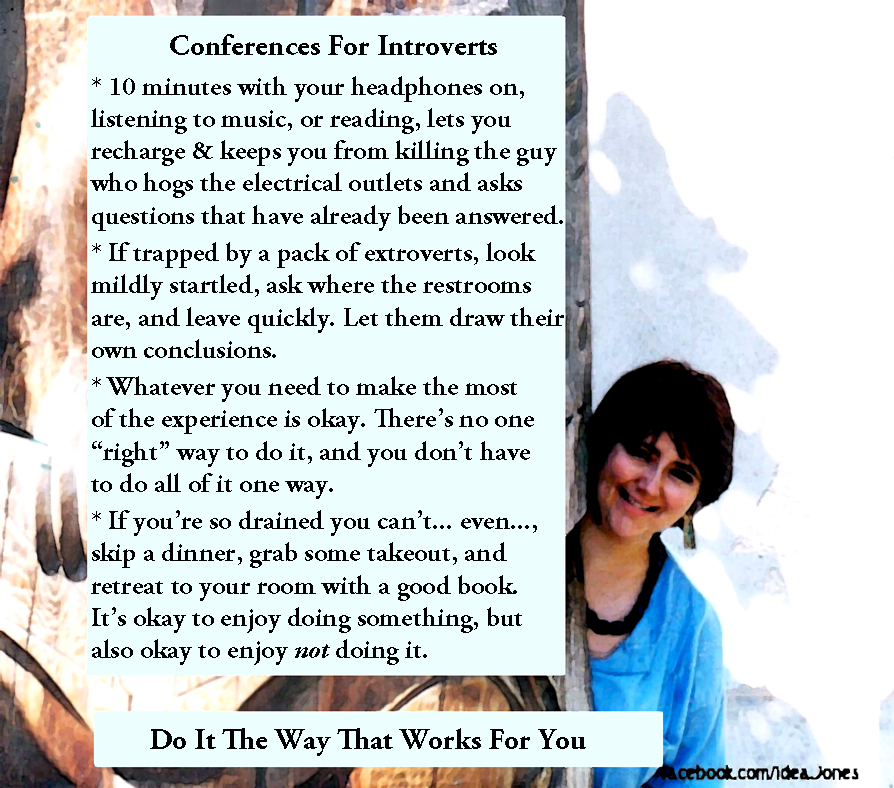
    Often, extroverts (and there are far more of them than introverts, which makes sense — who is more likely to get out and find people to mate with?) think introverts don’t like people, or don’t like to go out.  They don’t understand that being an introvert has nothing to do with liking (or not liking) people. It’s about energy — what charges you, and what drains you.

    Extroverts are energized by being around people. They need to be around people as much as possible. This doesn’t mean they never like to be alone, but they don’t need to be alone.

    Introverts? We like being around people, but it drains our batteries. To recharge, we need to be alone. I can’t tell you how many times I’ve been running on fumes and really needed some alone time, only to be asked what was wrong or who made me mad. Nothing. Nobody. I just need to fill that battery — and being an introvert, that means some alone time.

    So how to cope with crowded events, like conferences and conventions? I’ve been going to more conferences lately, and having to think about how to get the most out of them (they’re expensive and you want to feel you got your money’s worth, which means identifying what take-away would be satisfying).  How to not drain my batteries to the point where I can’t take in any more input, or worse, Dr. Bruce Banner becomes The Incredible Hulk.

    The first step sounds obvious, but when you try it, you realize it isn’t. Accepting that you are an introvert, what you need to be at your best, and that it’s okay not to be an extrovert. Extroverts make up more of the population. The world is thus geared toward them. Like being left-handed in a right-handed world, introverts bump up against expectations that they want and need what extroverts do, and operate the way extroverts do. Nope.

    Where extroverts might look see, “6:30 PM: Cocktail Mixer” and think, “Hey! People! Fun! Drinks!,” your average introvert thinks, “Ooh. More people after a whole day of people. Trying to make conversation with strangers. Standing around feeling awkward. Meh.” This is because extroverts will get charged up and introverts will get more drained.  And if you say you just want to go to your room and watch tv, prepare to be asked if you’re okay. Several times.  It takes self-knowledge and self-acceptance to withstand well-meaning pressure to conform.  If you want to go and it sounds good, go and enjoy, and leave whenever you feel like it. If not? Don’t go, and enjoy, and hear the stories about what went on the next day.

    If you’ve met a few interesting people, you can also see if anyone wants to have dinner together, just a few of you. Then see them off to the mixer with your blessings. Best of both worlds. You get to really talk to a few people instead of making small talk with a lot of people, and then get your alone on.  Getting coffee is also good.

    Personally, I’d rather really enjoy and make a connection with a few people than try to paper a crowd with my business cards. The people I do chat with remember me, and I remember them.  Introverts tend to be good listeners.  I can’t give 50 people my full attention at the same time — but I can give 50 people my full attention one, two or three at a time.

    The next step is to plan a bit. Have those ear buds available. Have a book on you. Look at the schedule for a few minutes you can retreat from the crowd. The classes are usually too close together to give you a break. Get the feel of the event. Is it okay to be a few minutes late for something? Is there one you really can skip? It’s often not necessary to do every single thing available to you — and better to be really present for what you do attend.

    Really, the secret seems to be doing it  your own way, in whatever way works for you and most promises that you’ll be able to get the most from the event. My mom and I had a saying, “Better to be a really good donkey than a sub-par fake horse.” We’re all weird. Be weird in your own way and rather than trying to be a fake extrovert, be a really good introvert.

  • Chick Lit v. Women’s Fiction

    Chick Lit v. Women’s Fiction

    I get it — human beings like labels (applied to others). It’s a natural function of the brain to categorize. It’s how we navigate the world. “That is similar enough to this so that I sort of know what to expect.”  Without it, we’d constantly be stuck, trying to evaluate every person, experience or thing that is even slightly unfamiliar.

    But nobody likes to feel “labeled,” especially when those labels are dismissive or derogatory.

    When we completed the first draft of Based On A True Story: Really (Almost) True Story, a writer acquaintance said it was great, he enjoyed it a lot, but he’d only read it if his wife bought it and left it lying around. He wouldn’t buy it for himself, he said, because it’s “Chick Lit.”

    I wasn’t sure how to take that. Here, in order, are the usual reasons people are dismissive of “Chick Lit:

    • It’s about relationships.  Well, so is almost every other book, with the possible exception of Chilton automotive repair guides, and the dictionary. The Bible talks a lot about relationships. So does War & Peace.  Humans are social animals, and relationships are central to how we live our lives, and most of the things we do. Try building a freeway by yourself. If you build it with others, that involves relationships. So as a criticism, “it’s about relationships” falls flat.
    • It’s escapism. Well, duh. So is Treasure Island, Moby Dick, and a lot of other novels. It may talk about “important” themes, but the first job of any novel is to entertain. I grew up around entertainment — the working, blue collar end of it, like boardwalks and nightclub shows. The ride has to be worth the price of the ticket. Nobody cares what you have to say if you’re not entertaining when you say it. And life includes a lot of seriousness and pain. The mini-vacation brought to you by a good book can save your sanity. If a book manages to take someone away from a stressful day and make her (or him) forget and have fun for a little while, that is a beautiful thing.
    • It’s “too light” or “frothy.” By which you mean…? Go ahead and try to come up with a valid explanation that doesn’t include sexism in it. I’ll wait…

    Ultimately, that’s what is at the bottom of “Chick Lit as insult.”  It’s usually by women. Has female protagonists. Generally includes humor.  But because it’s “female,” it gets relegated to a pink, frilly literary ghetto. You don’t see the “dick lit” section in a book store.

    As near as I can tell, most often, “Women’s Fiction” is “Chick Lit” without a sense of humor. This is not a criticism of books labeled “Women’s Fiction,” by the way. What I’m saying is that because they usually have female protagonists, “Women’s Fiction” or “Women’s Literature” books aren’t simply considered Fiction, or Literature. No, they’re off in their own category, as though they couldn’t lift the barbells and were relegated to the sidelines. And yet, being more serious in general, Women’s Fiction books are considered more important and valuable than Chick Lit books.

    I’ve heard it described as the difference between steak and popcorn, steak being considered more worthy than popcorn. Yet both steak and popcorn follow the same path, from a digestive standpoint. Popcorn is a whole grain, with its own nutritive value. It isn’t that steak is better somehow. Steak and popcorn are both good and give you different things. I wouldn’t want to watch a movie with a bucket of hot, buttered steak.

    A good laugh when you need it, whether it’s a bark of surprise or a hoot of recognition, helps relieve stress, so it’s good for your health, and lowering your stress makes you better able to deal with the often confusing, confounding humans around you, so it’s also good for their health when you laugh.

    So I’ll go on peddling popcorn and busking on the boardwalk, proudly, and let others categorize my work in whatever way works for them. My big hope is that I can do for someone else through my writing what books have done for me in my darkest times. And if someone else calls my work “Chick Lit,” I’ll wear the badge with pride.