IdeaJones

Tag: #writerlife

  • Goodbye, 2018!

    Goodbye, 2018!

    This has been a year, hasn’t it? I mean, they all are, of course, but this one seems to have had more than 12 months in it.

    We had to spend the first eight months fighting to protect our little family. Someone got it into her head to try to take our puppy away from us. Lots of drama, strangers being sent to our door, the police sent to our house (first time that’s happened), going to court… in the end, Good won, Evil lost, and Gingeroo is right where she belongs — with us.

    It chewed up months of our lives. Our birthdays, our anniversary, everything got swallowed by The Battle For Gingeroo. But in the end, we found out we have a few really good, true friends who were willing to help us, we met an absolutely genius lawyer, and we reaffirmed that Good can triumph, if it’s willing to keep fighting and take good advice.

    We finished our novel, and saw it getting favorited on Amazon’s new book program, so much so that it made the “hot list” several times — but then Amazon ended the program. Oops! Back to square one, so we’re shopping for an agent, while writing three new books. Meanwhile, the first novel has done well with beta readers and in live readings, in addition to the love it got during the Amazon program, and a great review. So we know there’s an audience and just have to keep plugging away.

    During the process, we’re learning a lot about querying, social media, all the stuff that comes with being an author. We’ve been writers (magazines, newspapers, radio), but now we’re becoming a brand. Which feels odd. And requires learning lots of new skills, which is actually more fun than I thought it’d be.

    We lost two of our friends at the same time, people who had never met but who both left our lives at almost the same moment. This is an experience I’ve had before — my mother and grandmother died 30 days apart — but is also one for which you can’t prepare. We’ve lost people slowly, and lost them quickly, and there is no “better” way. You’re never ready to lose someone you’re fond of. It still doesn’t seem quite real that both John and Kathleen are gone.

    But we’re taking what they’ve taught us into the world. Kathleen was an enthusiastic, generous person. She loved to shop. I’m not much of a shopper, so I don’t have the skills a talented shopper has. Kathleen was great about sharing tips and tricks. I recently used some things she taught me to score something Mark and I wanted, on clearance, free shipping… Kathleen would have understood why I was trying to “high five” myself (for the record, I still haven’t found a way to do it that doesn’t feel lame).

    John was a singer/songwriter, a musician and music producer. Music was his life, and he was really good at it. He was also funny, generous and kind. Even when illness was bringing him to his knees, he played benefit concerts. If he couldn’t play, he sang. Every holiday season, we would visit and join John and his wife (a lovely, fierce, wonderful lady who hadn’t planned to be a public person but fell in love with John, so I won’t put her name here) for dinner. Mark and John usually talked shop — music, audio, recording. They agreed about a lot, but had some things they didn’t agree on that became running gags.

    His wife and I would catch up on family and friends, and just, y’know, chat, the way you do with a friend. Mark and I would get tickets for the benefit John was sure to be playing, and the shows were always great, but the best memories are of the four of us around a table, eating and talking.

    One time, we went to Barton G’s in Hollywood. It was hilarious. They brought out the food with props. Popcorn shrimp in a big popcorn machine. Sushi with a sword stuck into the platter. The best were the desserts. John and his wife ordered an ice cream sundae that came in a pirate’s treasure chest (a big one), surrounded by edible gold nuggets, graham cracker crumb “sand.” John looked at the shovel sticking out of the sundae, started laughing, and said, “Do we eat the shovel? I can’t tell what’s food and what isn’t!”

    Our dessert had a cotton candy bouffant hairdo on a wig head, with candy stuck all over it. The four of us found ourselves acting like sharks, nibbling random things just to see if they were edible.

    Before we left, they invited us over and we met the sister of John’s wife, who was charming. John played tracks of songs he was working on and told scandalous stories, and we all just relaxed.

    Thinking about all of this has me more than usually aware that I need to be fully present when I’m with a friend. Not distracted by things I want to get done, or things I think I should be doing. Someone once said, “If you ain’t where you is, you ain’t nowhere.” I’m going to try to be where I am in the new year.

    I hope wherever you are, your “where” is good to you. Happy New Year!
  • NaNoWriMo Is Almost Here!

    NaNoWriMo Is Almost Here!

    If you’ve ever uttered the words, “I’d like to write a book some day,” then it’s time to take a chance on your dream. National Novel Writing Month is almost here (starts November 1), and if you go to https://nanowrimo.org , you can sign up (it’s free) and join other writers working on their books. Lots of budding novelists bloom in November by taking part in this.

    It holds you accountable. You log in every day in November and submit your word count for the day, and it tracks your progress. You’d be surprised how far you can get with just a little every day. Sure, some weeks you can come up with hours to write, but other days you may have only 30 minutes. Thirty days hath November, which means that by the end of the month, with just 30 minutes a day, you’ll have put in at least 15 hours on your book!

    Our NaNoWriMo book for 2018: East-West Crazy

    Our NaNoWriMo book is “East-West Crazy,” which is a Women’s Fiction novel with dark humor. It’s already started, but I plan to make real progress in November, and I’m looking forward to it.

    My mom used to say that time is a gift so precious, we rarely give it to anyone. For many of us, this is especially true of ourselves. But even if it’s only 15 minutes a day, that’s one whole work day you invested in yourself and your dreams by the end of the month. You’re worth that… and no matter how tight your budget may be, you can afford 15 minutes a day.

    By the end of the month, your “some day” will be a lot closer.

  • Gatekeeper Secrets: 5 Ways To Start Off Ahead

    Continuing my online writer conference (since I had to miss the PNWA con this year). Day 5 — Gatekeeper Secrets

    Because I interviewed a bunch of “gatekeepers,” people who look over submissions and decide if they merit consideration, I have some advice to pass along. Also, I’ve been a gatekeeper (I was once an Editor for a magazine). So I’ve had to climb Mt. Slushmore in search of gold nuggets myself.

    Some of this may sound obvious. Most of it sounds obvious once you’ve heard it. But an agent at a recent conference talked about some of this stuff and it reminded me that it’s still the place most hopeful beginners fall on their climb to “published.” It also applies to other arts as well, fine art, music, acting, etc.

    Even for people who have been published, it’s good to be reminded that The Basics still count. I’m trying to go from “published in newspapers and magazines” to “published book author,” so I’m climbing Mt. Slushmore again myself. Since we’re trying to climb Mt. Slushmore and reach the peak, let’s start at the bottom:

    5) Don’t bother anyone until you’re ready to go. This is at the bottom not because it’s unimportant, but because it’s the first step, and you shouldn’t even attack the mountain until you complete it.  Agents want to know you have AT LEAST one book COMPLETED (or, if you’re an actor, have actually acted in something, taken classes, etc.).  You have a great idea? Good for you!

    Now make it. Write the songs, paint the painting, write the screenplay, etc.  If you’re trying to get an assignment to write an article (say for a magazine), and you haven’t had anything else published, be ready to work “on spec” and get paid only after you’ve written the article and the editor has decided to buy it and run it.

    I keep meeting nice people who have ideas for books, articles, radio stories, etc. that they “just need someone to write up,” or that they are writing and have yet to finish, who expect to find buyers for their uncompleted (or in some cases, unstarted) debut projects. You are up against people who are working at their craft. Taking it seriously. Developing their chops.  Be a professional.  Respect your idea by taking it seriously.

    After you’ve created it… edit, revise, polish. You’re trying to convince people you are a producer of diamonds. Have at least one polished diamond to show them.

    4) Get your supplies in order. Your book, your article, needs to be as good as you can make it. Professionally edited, if you aren’t an editor (and even if you are, have someone else check it, proofreading, notes, etc.).

    Workshop your novel, and pay attention to audience reaction. The best advice I’ve gotten so far (regarding improving my work) was, “Read it aloud.” Mark and I started participating in an open mic night for writers, in a book store, reading our work and paying attention to the reactions, both from the other writers, and the people in the book store. If attention is wandering, make a note where it starts to drift. I have to tell you, watching people linger in the stacks, taking a book off the shelf, putting it back, repeat, repeat, to hear the end of your story is a high.

    If you’re only writing for  yourself, great, you don’t need to know what people think. If you’re writing for an audience, you do.

    3) Research the mountain. No matter what professional mountain you want to climb, someone has climbed it before. Never in the history of humanity has information been so easy to come by. Sure, you have to look at the source and figure out how reliable that information is… but that’s doable. And you can average. If 25 people with professional credentials tell you that you need a certain sort of rope to climb that sort of mountain, you need to look closely into getting that sort of rope.

    For writers, you can go to professional conferences, join writing organizations, and yes, read. I mean, if you don’t like to read, why do you want to write? Take writing classes. Do writing exercises. In California, the California Writers Club, for example, has chapters all over the state, with workshops, speakers and sometimes even those open mic nights.

    If you were an acrobat, you would stretch a lot and do muscle-strengthening exercises (or you’d plunge to your death. At least writing isn’t that dangerous).  Whatever profession you’re trying to break into has its own series of stretches and exercises. Expect to do them.

    2) Don’t Be An Asshole. Good advice generally, but in the arts? Crucial. Plus, in the internet age, everything lives forever and comes back to haunt you. Be polite to the Receptionist. Don’t argue with people and get defensive (especially the people you’re trying to get to consider you. Have you ever been argued into liking someone? No, and neither have they). And every career has its ups and downs. You meet the same people going both directions, and sometimes they can give you enough of a boost to stop you from falling off the mountain entirely. It’s good ethics, good karma. Don’t fawn (don’t lick boots unless you’re addicted to the taste of shoe polish). Just be polite.

    This includes other people in your field. Again, both for professional reasons, and so you can like yourself. It’s not like there are only so many cookies, and if someone gets a cookie, you get none, so don’t run down other people.  It makes you look insecure. And it’s nice to be able to talk to people who get what you’re trying to do and think it’s worth doing (because they are, too). In radio, I’ve referred other engineers and field producers when I couldn’t take a gig — and they’ve referred me when they couldn’t.

    1) Follow. The. Guidelines. The most obvious advice is still the advice most people don’t bother to follow. If you’re submitting to agents or editors (or whatever is the equivalent in your art form), look at the website. Read the Submission Guidelines. Treat them like gospel.

    Every publication, every agent, has The Way We Do Things Here. By not reading and following those guidelines, you come off as an arrogant amateur. It’s basic courtesy, really. If you rang on someone’s doorbell and asked to come in, and he said, “Well, okay, but we have a white carpet, so you have to take your shoes off,” would you say, “I paid a lot for these shoes and matched my outfit to them, so even though everyone else takes his shoes off, I’m special?”  If you did, you should expect to feel the door slamming shut on your snout. It’s rude. It’s inconsiderate. And it’s dumb.

    It doesn’t matter how you like to do things. You are approaching that publication, that editor, that agent, and asking to be considered. You are ringing their doorbells. They aren’t ringing yours. Don’t cheese them off by swanning about, expecting them to bend the rules for very special  you.

    Some agents, for example, want the first ten pages. Others want the first  two chapters. Some want a bio and a synopsis of the book. Others don’t care about that unless they like the first chapter. Some want a letter. Others don’t.  Whatever they want to see, that’s what they feel they need to see in order to get a feel for whether or not they’re interested in you.

    As the agent at the workshop said, “By following the guidelines, you lift yourself above 50% of the people who submit from the start. And I’m not kidding. It might even be more than that.”

    Why start climbing by stepping on your own toes?

    Whatever mountain you’re trying to climb, be it Mt. Slushmore, the Hollywood Hills, or your mountain of choice, climb smart and you might just make it. I hope we both do. Good luck!

  • On Falling, Getting Up, Finding the Neosporin, and Trying Again

    On Falling, Getting Up, Finding the Neosporin, and Trying Again

    I had a whole plan, at least for the next week. My bags were packed for the Pacific Northwest Writers Association conference in Seattle, WA. I had spent time researching the workshop presenters, the agents, and the publishers who would be there. Even designed new business cards (and I really like those business cards. They could be our trading cards). Knew every workshop I wanted to go to, every event I would attend… then late last night, the Snot Goblins (and just try to get that phrase out of your head now) pounced and I was sick. By early this morning, I had the sore throat and the whole thing. Trip cancelled, and me with extra ballpoint pens and undies packed and ready to go.

    Really disappointed, sure. Would have been my first PNWA event (I joined earlier this year). I had my pitch ready for the agent meetings (more about that in a second). Having worked out the logistics, I was ready to go, in mind if not, as in turns out, in body.  Next year, I hope. This year?

    I’m having my own mini-con. Writers Who Live At My House. Spent part of the morning forcing fluids and watching videos about writing and publishing. Lindsay Ellis has a whole series on Youtube from three years ago on her journey to create and publish a lurid novel (in the Twilight and 50 Shades of Grey vein). Not only is it a fun series (if you haven’t checked out Lindsay Ellis on Youtube, you’re missing out. Her film analysis alone is worth it), but inspirational for an aspiring author. I’ll read books about writing. I’ll read books, period, and figure out what I like (or don’t) about them. I’ll talk about writing, to Mark, to friends online. I’ll write about writing (here, for example).

    The big difference, I think, about being a professional in the arts is that you have to develop a thicker skin, and some resiliency. I’ve been published both as a freelancer and a staff writer in print and produced on radio. Once you put your work out there, you will hear from people at every stage of the process, from the receptionist to the readers.  TIP: I was a receptionist, back inna day. Always be nice to receptionists and assistants, both because you’ll like yourself better if you’re not an asshole, and because they are the Gatekeepers and have ways, subtle and overt, of rewarding or punishing you.

    Once I listened to a reporter moan about not being able to get through to someone he needed to interview. I asked him for the name of that person’s receptionist. He had no idea, looked at me like I was nuts for asking. I explained that it is good business to treat people with respect, the receptionist is a Gatekeeper, and if he wanted her help, he should treat her with more courtesy. He tried it, and got the interview. Doesn’t always work, but often, it does. And even when it doesn’t — you feel better about yourself.

    Agents… I’m prepared for it to take a lot of effort to find an Agent who gets our work, likes it, and with whom we would likely have a good working relationship. I’ve set a target of 150 rejections to find our agent. One is looking at the first few chapters now. I met this person and really enjoyed it. We had one of those great conversations where you go back and forth quickly, finishing each others’ sentences. A promising sign. We didn’t agree about everything, which would be freakish and not very interesting or maybe even beneficial, but we agreed about enough and more importantly, we communicated well. So fingers crossed.

    I want someone who can, and will, be honest — this is a business relationship, after all — but can do it with basic courtesy.  So honest, and direct, but not “brutally honest,” a term I’ve always hated — honesty is useful, but brutality is not.  I don’t need my hand held (well, rarely need it, professionally). An architect and a construction foreman need to communicate clearly what is needed or the building will fall over. Criticism aimed at making the work better? That’s fine. But there’s no need for insults. So I’m looking for a balance. A true professional.

    Speaking of Brutal Honesty:  Had another meeting with a potential agent. These were timed meetings (ten minutes, I think). I’d spoken with the moderator, tasked with telling people when the time was up, and we’d laughed about it being like speed dating, those events where you talk to someone until a timer goes off, then talk to someone else.  I took my seat, and… that agent and I just didn’t hit it off. I don’t mean we disliked each other — I didn’t take it personally and I have no idea what she thought of me as a person based on that limited exposure. We just did not click. At all.

    She didn’t get the book’s premise, clearly didn’t like my pitch, had not one positive thing to say and lots of negative stuff to say based on assumptions of what the book, which she hasn’t seen, would be like. I tried to answer the issues she raised, which are dealt with in the book, but we kept talking past each other, never connecting. It was very evident that we were not a match, not meant to work together. It didn’t bother me. I did try to reword things in an effort to communicate, but by that point, it was an intellectual exercise.

    At some point, I laughed, “Well, clearly this is not for you. Nor am I.” She stared at me like I had three heads, and two were drooling. A friend explained that people are usually desperate in these meetings. She might have been prepared for me to try to argue her around, or, I don’t know, fall to the floor, clutch the hem of her garment, and beg?  Not that I’m above that, mind you, but I couldn’t see it helping. Just for the record, when it’s really necessary, I can beg with the best of them. I once held an airplane at the gate because my mother-in-law didn’t realize that when she went in search of the ladies’ room, she walked back through the TSA security screening area. Without her purse. Or her phone. So she couldn’t get back in and had no way to tell us. As the staff at that Alaska Airlines desk can tell you, I can beg, baby, and beg hard.

    There was no point in going on. I wouldn’t enjoy working with her, nor she with me. Humor is subjective and while lots of people do get my sense of humor, there is no such thing as “universally funny.” And if you have to explain a joke to someone, he isn’t going to suddenly get it and laugh. If the joke doesn’t land for that person, let it fly away. We weren’t for each other. No harm, no foul. I wasn’t angry. As mom used to say, “Not everyone takes to everyone else, and that’s a good thing. Several billion people would have trouble going through life hand in hand.” But it didn’t seem polite to just leave, so we made very awkward conversation, the sort where you just know if the first people to talk had that sort of conversation, humans would never have bothered to talk again. Then I spotted the moderator. Hooray! Saved! I bent to scoop up my stuff. Aaaand he told me we still had three minutes left.

    Three minutes can be an eternity in Hell’s waiting room for two people who just don’t click. We stumbled around pointlessly, two social animals trying to make some sort of human connection. Anything? Nope. I could feel the individual seconds limping by like Tiny Tim trying to run a marathon. When the moderator announced our time was up, I grabbed my gear and came as close to a sprint as I could manage.

    Even so, I didn’t take it personally and I wasn’t upset. Everyone is not for everyone else. Mom was right. It’s like dating. Sure, it’s more fun to be wanted than not, but you’re not looking for “someone.” You’re looking for “my one.” My quest is not to find “an agent,” but “our agent.”

    I ran into her a couple of times over the next few hours and it was fine. She was supposed to be at this conference, and I admit I was looking forward to running into her again. I never remembered to tell her that I really enjoyed the presentation she gave at that other conference.

    #pnwa #ideajones #joeyjones #writerlife #writinglife #authorlife #books

  • Conferences for Introverts: Big Events for People Who Like People In Small Doses

    Conferences for Introverts: Big Events for People Who Like People In Small Doses

    Huge groups of people! Yay?

    Often, extroverts (and there are far more of them than introverts, which makes sense — who is more likely to get out and find people to mate with?) think introverts don’t like people, or don’t like to go out.  They don’t understand that being an introvert has nothing to do with liking (or not liking) people. It’s about energy — what charges you, and what drains you.

    Extroverts are energized by being around people. They need to be around people as much as possible. This doesn’t mean they never like to be alone, but they don’t need to be alone.

    Introverts? We like being around people, but it drains our batteries. To recharge, we need to be alone. I can’t tell you how many times I’ve been running on fumes and really needed some alone time, only to be asked what was wrong or who made me mad. Nothing. Nobody. I just need to fill that battery — and being an introvert, that means some alone time.

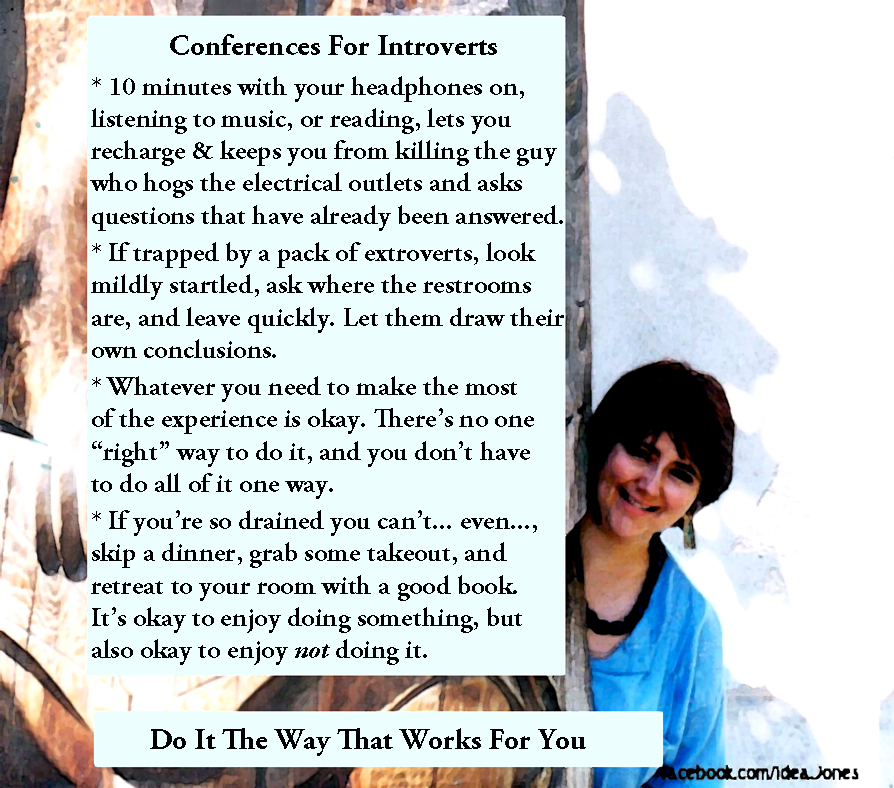
    So how to cope with crowded events, like conferences and conventions? I’ve been going to more conferences lately, and having to think about how to get the most out of them (they’re expensive and you want to feel you got your money’s worth, which means identifying what take-away would be satisfying).  How to not drain my batteries to the point where I can’t take in any more input, or worse, Dr. Bruce Banner becomes The Incredible Hulk.

    The first step sounds obvious, but when you try it, you realize it isn’t. Accepting that you are an introvert, what you need to be at your best, and that it’s okay not to be an extrovert. Extroverts make up more of the population. The world is thus geared toward them. Like being left-handed in a right-handed world, introverts bump up against expectations that they want and need what extroverts do, and operate the way extroverts do. Nope.

    Where extroverts might look see, “6:30 PM: Cocktail Mixer” and think, “Hey! People! Fun! Drinks!,” your average introvert thinks, “Ooh. More people after a whole day of people. Trying to make conversation with strangers. Standing around feeling awkward. Meh.” This is because extroverts will get charged up and introverts will get more drained.  And if you say you just want to go to your room and watch tv, prepare to be asked if you’re okay. Several times.  It takes self-knowledge and self-acceptance to withstand well-meaning pressure to conform.  If you want to go and it sounds good, go and enjoy, and leave whenever you feel like it. If not? Don’t go, and enjoy, and hear the stories about what went on the next day.

    If you’ve met a few interesting people, you can also see if anyone wants to have dinner together, just a few of you. Then see them off to the mixer with your blessings. Best of both worlds. You get to really talk to a few people instead of making small talk with a lot of people, and then get your alone on.  Getting coffee is also good.

    Personally, I’d rather really enjoy and make a connection with a few people than try to paper a crowd with my business cards. The people I do chat with remember me, and I remember them.  Introverts tend to be good listeners.  I can’t give 50 people my full attention at the same time — but I can give 50 people my full attention one, two or three at a time.

    The next step is to plan a bit. Have those ear buds available. Have a book on you. Look at the schedule for a few minutes you can retreat from the crowd. The classes are usually too close together to give you a break. Get the feel of the event. Is it okay to be a few minutes late for something? Is there one you really can skip? It’s often not necessary to do every single thing available to you — and better to be really present for what you do attend.

    Really, the secret seems to be doing it  your own way, in whatever way works for you and most promises that you’ll be able to get the most from the event. My mom and I had a saying, “Better to be a really good donkey than a sub-par fake horse.” We’re all weird. Be weird in your own way and rather than trying to be a fake extrovert, be a really good introvert.