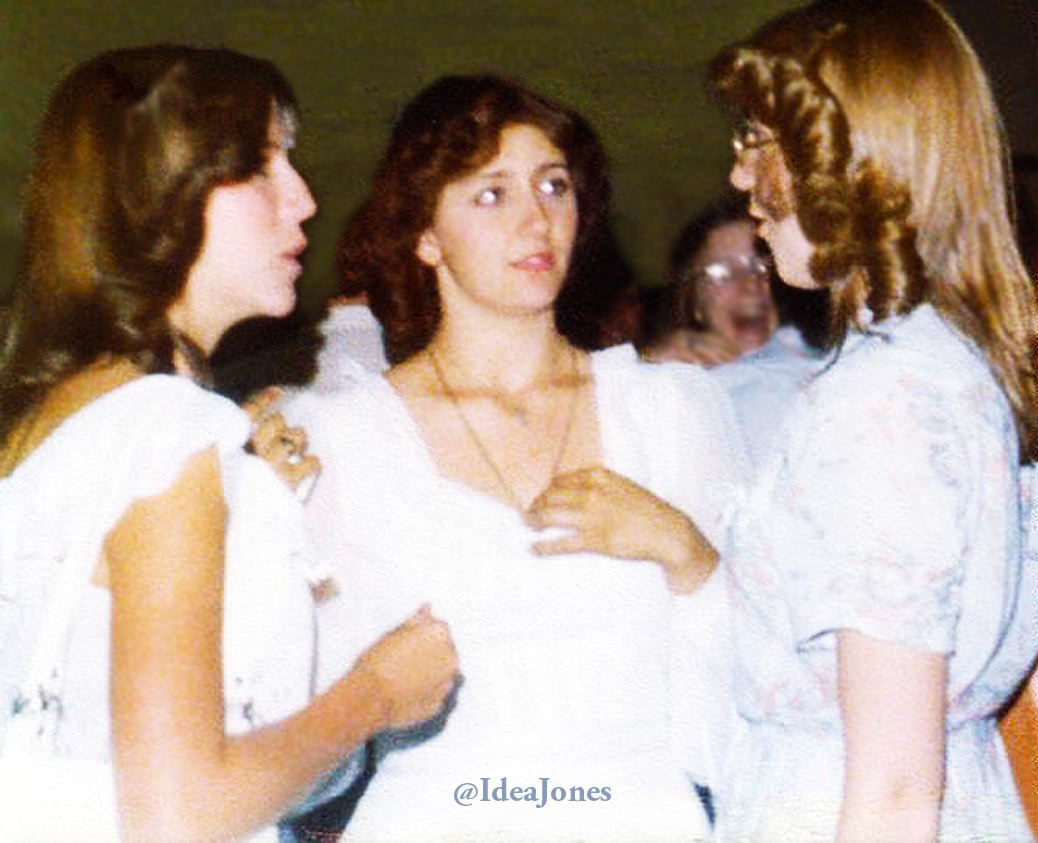
High school graduation day. This is the only photo I have from that day. I’d meet Mark a few months later, so this is basically what I looked like when he met me.
Not looking for feedback on how I looked — for one thing, that was years ago and my avatar photo is much closer to what I look like now. For another, I’m older, and my self-worth doesn’t hang on my appearance (one of the big benefits of growing up). To talk about why I posted this, I have to tell you one important thing about this picture: I never felt even passably pretty, not one day in my entire life.
If asked, I’ve always rated my looks as *shrug* “Okay.” If pressed, I’d add, “Well, I haven’t noticed anyone making the sign of the cross or building torches, so I guess I’m all right.”
My family definitely thought I was on the homely side. Mom started working on my looks when I was still a toddler, battling my fine, straight hair. I got my first home perm when I was three. The rods yanked painfully at my hair, and the solution burned my skin and stank like moldy road-killed skunk. I had to sit very still in an uncomfortable chair in grandma’s kitchen, choking on the fumes. If I fidgeted, Mom or Grandma would remind me that, “A woman has to suffer to be beautiful.”
I was put on a weight loss diet for the first time when I was five. I was a solidly-built little kid, strong from dancing (started lessons at three). We were a family of stress eaters, so various family meltdowns meant I got Hostess snack cakes (I still have a fond spot for Ding Dongs and Snowballs) whenever things were stressful, as they often were. Mom was in a perpetual binge/diet cycle, and we tried them all. Whatever was in the women’s magazines, that’s what we ate. The Grapefruit Diet (both the one where you eat little but grapefruit and the one where you take grapefruit pills), The Hard-Boiled Egg Diet (you live mostly on hard-boiled eggs and celery), Metrecal (a diet “shake” that tasted like Milk of Magnesia and tin can), and a diet supplement with a name that hasn’t aged well, “Ayds.” These were advertised as candy that made you lose weight and contained benzocaine. We drank cabbage soup and tried Weight Watchers. Before I hit high school, I was an expert in it all.
What did all of this accomplish? I was probably at a healthy weight most of that time — I was an active kid — but my weight went up and down. When I hit puberty, my mom blamed my weight and put me on yet another diet. My breasts were “too big,” so we went to war with them, trying to reduce them by any means, but they just wouldn’t go. By high school, I had a naturally hourglass figure, which I was taught to be ashamed of. It brought me attention I didn’t want (as a shy person, an introvert, and convinced I was “wrong” in almost every way, I didn’t want to be the focus of attention — yes I was a performer, but that wasn’t my idea, long story). I got creeped on starting at about age 12 by adult men who insisted my junior high student body i.d. card was a fake. Teenaged boys groped me like my body was a public park (a girl’s best friend is the ability to deliver a biting insult or a good, solid punch). All the time, Mom tried desperately to fix me. Instead of telling me I was fine and they were the problem, she put me on diet after diet, seeking to make my curves go away.
As a young adult, I continued to have to Defend The Castle from creeps. I wore baggy clothes. I gained weight (much to my mother’s dismay — she lamented that I had “let myself go”). I parried propositions, and all the time I rebelled (give me those Oreos, damn it!), I also hated my appearance. A lifetime of fad dieting had left me with a messed up metabolism, I perfected the family stress eating habits, and ballooned up until I reached 400 pounds at my heaviest. My sense of self-worth (what of it I had) came from being “useful” and “a good person,” defined largely as being useful to other people and good to them — not myself.
When Mark and I married, my mother’s wedding gift was a case of diet drink mix. Even then, people who were trying to live on that diet were dying (it would help lead to changes in how “replacement nutrition” diets are used). I had told her I was seeing a therapist and dealing with the issues that made me eat instead of trying to lose weight — and she gave me a case of diet drinks that were killing people. Dying for beauty, indeed!
This is what we do when we reduce a person’s value to appearance. First, we declare that there is only one right way to look, whether that’s thin, light-skinned, or what have you. We set up a standard almost no one can reach, naturally or at all. Everything from our noses to our feet gets measured against that standard and there are only two groups of people: people who don’t meet that standard, and people who do but worry about “slipping” in some way so they no longer can. You might attain it briefly, but God forbid you age. Aging is not on that approved list.
In order to be “okay,” you have to meet that standard. At the least, you have to be seen to be actively trying, although that won’t get you to “okay,” just “barely acceptable.” Even though I work out more than the average American, I would get comments about my weight from perfect strangers. People I hardly knew or didn’t know at all would ask me, “Are you really going to eat that?” For quite a while, I only ate salads, and sparse ones at that, in public, because being judged perpetually gives you the feeling that you are being judged constantly. God forbid some random stranger saw me eating a cheeseburger! How was he to know I hadn’t had one in months?
Getting crow’s feet? Run to the plastic surgeon. Run! How can you be okay if you have a wrinkle? Hair is a whole ‘nother subject and again, almost never right. Long, short, gray, not gray, curly, straight or none at all — boy, there’s a whole list of things our hair is supposed to be, or not be. Don’t even get me started on hair where it’s “not supposed” to be.
Next, we reduce that person to nothing but the ability to match that arbitrary standard or be seen to be actively striving to meet it every damn moment. That person’s opinion, accomplishments, everything are judged through that lens. As one young woman told me, “It wouldn’t matter if I cured cancer unless I looked hot while I did it.” But if you look good, that’s not okay, either — when I was a young journalist, I wore glasses I didn’t need when interviewing people. Ugly glasses, at that. Otherwise they didn’t take me seriously.
Especially for women, every single thing you ever do, think, are is judged through that beauty lens. We’re supposed to chase being sexually desirable (with all the baggage and problems that can bring) but, we’re also supposed to pay all the freight for how other people handle that. If you’re insulted for being judged not desirable, well, that’s your problem, isn’t it? If you get creeped on or dismissed because you are, hey, you’re responsible for handling the reactions you get. Someone makes you an offer you don’t want to accept? Let him down easy, no matter how insulting that offer was, or the problem isn’t him, it’s you, you bitch.
Finally, we move the target and keep moving it. Beauty standards change. Companies who make money selling us things declare this characteristic “in” and that one “out.” Over the years, flat chests, big chests, and medium-sized chests have all been in or out for men or for women. Same with hips, hair, the lot of it. By moving the targets none of us ever get to be okay for long and the cash keeps flowing. By the way, I have to wonder what this does to people who don’t conform to gender stereotypes. Good Lord, if I, a straight woman, find those standards punishing, what must it be like to be anything left or right of the Approved Gender List? Yikes.
Look, I’m not saying you shouldn’t try to be reasonably fit and keep yourself clean and as put together as you decide to be. That’s healthy. But most of our relationship with our bodies and faces is not healthy. It encourages self-loathing and self-harm. The moment we look at someone else and say, “Wow, look at her,” either in praise or condemnation, we imply that the world gets to weigh in with an opinion on every single one of us, that judging is the primary way we want to engage with each other. Worse yet, we encourage doing that to ourselves.
Welcome to the world in which little kids are worried about being “sexy,” diets and plastic surgery are more and more common for young people, and our problem with creepsters does not seem to be getting better. The system we have supports self-harm, self-loathing and abuse, plain and simple.
At my heaviest, as a reaction to my totally dysfunctional family and my relationship with them and with myself, I weighed 400 pounds. I weigh a lot less now, although I’d still qualify as obese. That girl with an hourglass figure has become a woman who shops in the plus sizes. I’d like to say I’m totally fine with that, but while that’s mostly true, it’s not 100% accurate. There are moments when I lament my figure. I eat a healthy diet, I exercise, but as has been explained to me, my metabolism is very messed up and losing enough weight to no longer be considered “fat” would require strict, stringent and even somewhat punishing efforts.
I’m not working on that. I’m working on living in a healthy way, both physically and mentally. I’m working on just being okay with myself, however I show up. I’m working on not giving a rat’s ass what anyone thinks of my appearance with the exception of two people, myself and my husband, who loves me as I am and likes me more than anyone else he knows, so what else do I need?
I don’t think I’ll ever feel “pretty,” but that gets less and less important. I like myself. My hair is what it is and I like it. My body is what it is and I’m grateful for it. I’ve hopped off that hamster wheel of constantly trying to reach a moving target to be okay with myself, and I’m extending that grace to other people. Hopefully, if I help take just a bit of that pressure off myself and others, we can all be more okay, and that’s a target worth pursuing.