IdeaJones

Tag: #pintales

  • Social Art, or The Love Bead Safe Harbor Pin Project Rides Again!

    Social Art, or The Love Bead Safe Harbor Pin Project Rides Again!

    Remember when I announced that we had finished The Love Bead Safe Harbor Pin Project?

    Turns out we weren’t done — we just didn’t know it yet.

    This project really began in late November of 2016. By the end of the election that year, we’d had over a year of arguments, name-calling and accusations All of that comes with an election, but this was particularly virulent. Many of the people we knew had stopped speaking to friends, colleagues, family, us…

    We heard stories from friends who had been threatened or who had friends or family members who had been attacked for being different, for not fitting in to someone else’s idea of how people should be.

    When I first heard of Safe Harbor pins, safety pins worn to signal your belief that all people should be treated with basic human decency and respect, I loved the symbolism of it. True, no symbol solves a problem on its own, but using the symbol requires a choice on your part. Do you agree with the idea it represents? Are you willing to make that belief part of your identity? That’s not a meaningless thing. Human lives are saturated with symbols that represent how we think the world works, or ought to work, indicate our commitment to ideas, tell the world who we are. Most things carry at least some symbolic meaning. I donned my Safe Harbor pin, knowing perhaps I’d get some push back from people who disagreed with me. Mark put on his pin and wore it wherever he went.

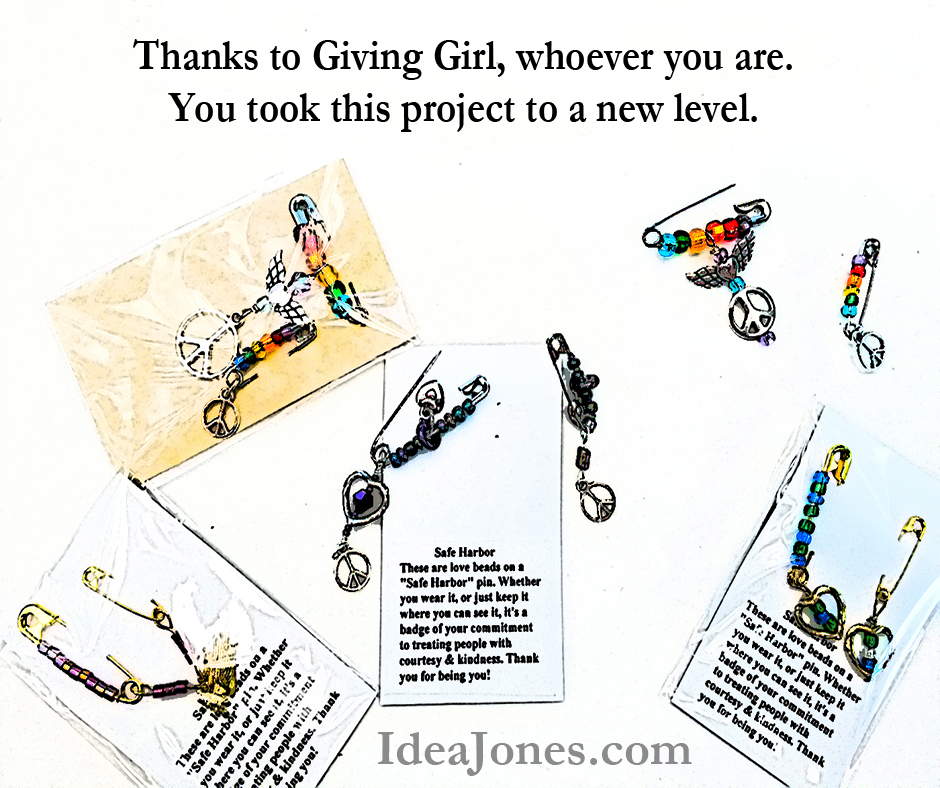
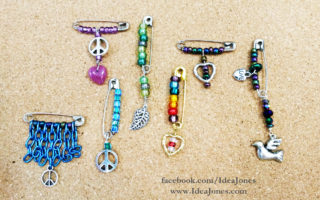
    Then white supremacists started wearing safety pins, co-opting the symbol and turning it. I wasn’t willing to relinquish it and have a symbol of decency and kindness come to stand for the opposite. So I started beading pins. I work with wire a lot in sculpting, so I figured out how to bead the pins so I could take them on and off without losing beads. I hung charms on them. I started giving them away.

    Honestly, I didn’t know what would happen. I’m an introvert, for one thing. Talking to strangers isn’t my strongest skill. I didn’t know how the idea would be received. They’re inexpensive, humble little things. The first time I did a large giveaway, I told Mark, who was parking the car, that I had no idea if it would take me hours to give them all away, or even if anyone would want them.

    Within fifteen minutes, I had none left. Hundreds of pins. Hundreds of people who consciously chose to adopt a symbol. I explained briefly what the pins stand for when I offered them. Each person made a conscious choice to affirm his or her belief that people, all people, should be treated with basic courtesy and respect. Even people they might not understand, agree with, or even like.

    We continued giving away pins. Even just giving them away casually in multiple cities, more and more pins found homes. Then we saw that the 50th anniversary of the Summer of Love in San Francisco was coming, and decided to be part of the celebration. There was a specific part of the celebration we wanted to honor. When scores of young people, most without jobs, housing or money, descended on the city of San Francisco in 1967, the city was overwhelmed. There was no infrastructure to take care of hundreds of homeless, jobless kids. Something like that, on that scale, just hadn’t happened before.

    So some of the residents stepped up. They set up soup kitchens. They distributed clothing. They helped kids find places to stay and health care. Confronted with a horde of hungry kids, those people chose to take care of them. They did urge them to return home to where they had some sort of support system, but in the meantime, they fed and clothed them.

    That was the legacy we wanted to honor.

    So we set about making over 1400 pins. We stood on street corners and walked through parks, we stood in front of a museum. Over and over, we offered strangers the following choices:

    • Will you interact with a stranger?
    • Will you listen to a brief description of an idea, Radical Respect, the idea that all human beings should be treated with basic courtesy and respect?
    • Will you accept a symbol of that idea?

    Accepting the symbol after the explanation means accepting the idea, and making it at least a small part of your identity. It was a public decision and affirmation.  We also tried to keep track of our results. The overwhelming majority of people we encountered chose to talk with me, listen to the idea, discuss it with me, and accept the pins.

    All in all, so far, over 750 people have made that choice. People from every economic level, from different cultures, countries and educational backgrounds have stood up in public and affirmed their commitment to supporting human decency for everyone.

    On days when the cacaphony of argument and accusation makes me want to become a hermit, I remember some of the people we met and talked with.

    We had planned to end the project after the Summer of Love anniversary. It consumed a lot of our lives for almost a year. But we had some materials left, so I offered a free workshop at a program for women and children in crisis. It seemed like a good way to wrap up the project. The workshop went so well, and I had so much fun making pins with some of the women there.

    On the way out, the art therapy coordinator introduced me to a member of the Board of Directors of the center. She accepted a set of pins, and asked if they could make pins to sell at an event to raise money. She and the art coordinator were so respectful, asking if what they wanted to do would fit into the goals of the project. I really appreciated their courtesy, and yes, while it’s true that we gave away pins, selling them to benefit a charity, especially one helping people who aren’t often treated with the respect they deserve, is in keeping with the project’s point of view. Anyone who buys a set of pins will get the pins mounted on a card describing Radical Respect, and will also  be making a choice to support people who could use help.

    So the project isn’t quite over. And I may make a few to sell as a separate-but-related project to raise money for other charities.

    Perhaps it’s not consuming my life as it did, but almost a year later, the Love Bead Safe Harbor Pin Project goes on.
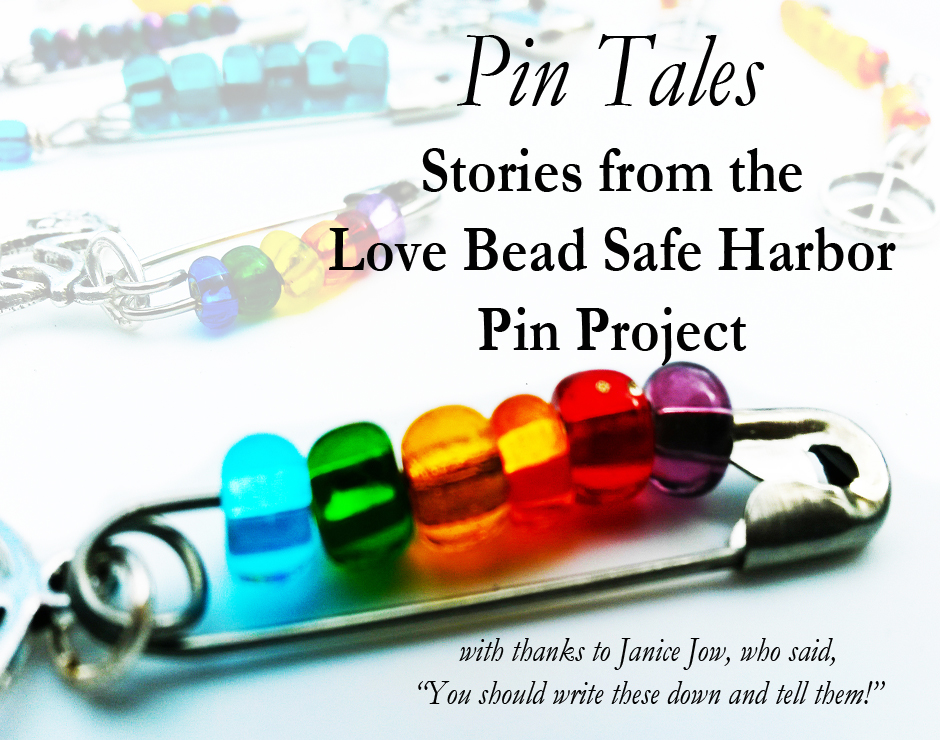
  • Pin Tales: The Waitress

    Pin Tales: The Waitress

    This project is about human interaction — how we choose to treat other people.

    With thanks to Janice Jow, who suggested writing down and sharing the stories of The Love Bead Safe Harbor Pin Project.

    This is the story of The Waitress.

    My friend and I went out for brunch one Sunday. My friend is learning to drive  (which is badass when you never planned to learn and didn’t especially want to, but you just got a job you like and they want you to drive).  When we go out now, she drives at least part of the time, and we stop to eat.

    We went to a diner, ate, caught up on what was going on in our lives, and laughed.  I approached the register, making my way through the crowd.

    The waitress who had pulled cash register duty was young, maybe mid-20s, with big, serious eyes and dark hair pulled into a ponytail, which is close to being the Universal Waitress Hairdo (I used to be a waitress, years ago, and almost all of the younger waitresses wore their hair that way. It’s a practical thing). She glanced at the Love Bead Safe Harbor pin on my blouse. “I really like that,” she said quietly.

    She wasn’t familiar with Safe Harbor pins (most people I meet aren’t), but said she really liked the idea. I offered her a set of pins, holding out several types. I explained that one was Civil Rights and Social Justice, one was Women’s Rights, and the rainbow set was LGBTQI Rights. She bent closer and pointed to the rainbow set. “I’d like to have those, please.” Her voice was almost a whisper.

    I get it. You have to be careful when you work with the public. Some people feel it is their bound duty to give you their unsolicited opinions about how you live your life (instead of, say, keeping their opinions to themselves and going about their own lives. Whenever people do that, I want to ask for all the details about their lives so I can pass judgement on them. I should get to have fun, too).

    She took the pins, met my eyes, and said, “Thank you.”

    My friend and I left the restaurant. Not everyone is in a position to bravely trumpet their beliefs everywhere they go. If putting food on the table, or paying for school, or other necessities of life depend on not offending people, your march is harder than that of someone who won’t lose much by standing up. Which means that standing up is all the more important for anyone who can, because then you’re standing up for yourself, and for someone not so fortunate.

    She picked those pins, making her public commitment to the importance of people treating each other with true respect, in a time and place when it wasn’t easy for her to do that. Sometimes heroics are quiet, life-affirming acts taken by people for whom standing up at all is hard.

    Save

    Save

  • Pin Tales: The Church Ladies

    This project is about human interaction — how we choose to treat other people.

    With thanks to Janice Jow, who suggested writing down and sharing the stories from The Love Bead Safe Harbor Pin Project.

    This is about the day I met the Church Ladies.

    I was “churched” growing up, which is to say we were members of a congregation and attended services every Sunday. Eventually, my family moved, and we stopped going to church, mostly for reasons having to do with my Dad and how he was. I remained a Christian in my heart, if a confused one (it took a lot of time to process Dad, his demons, and his effect on our family and on me). I did attend a church for a while during high school as a friend was becoming a lay minister and leaving to attend a seminary, and he asked me to go to give moral support. Then I graduated and moved away, and while I attended the occasional service, I was no longer churched and belonged to no one sect or congregation.

    Even though I was brought up in a fairly conservative Christian church, it never made sense to me that only one group of people had all the answers. I took classes in comparative theology, and have always respected other faiths and their adherents, and the right of any person to believe what he believes, whatever it is. Some people don’t believe in any god at all, and while I disagree with them, I recognize that they disagree with me as well, and we both have the right to think as we do. I no longer have much contact with churches or organized religion any more, though, except for a few friends who are members of (very) different religions.

    Some of my family members were very conservative, very evangelical, very good at lecturing and not listening, and frankly quite unpleasant human beings. The word “evil” would not be out of place when describing them. And I’ve certainly met additional people who might not be evil, but certainly use their beliefs to judge, condemn and make themselves feel superior to others. These people belong to different religions, or none, but they share an unappetizing determination to Tell You The One True Way. It’s made me wary of anyone who is quick to discuss matters of faith.

    So when I saw a group of ladies, dressed nicely, carrying a church banner at a rally… honestly, I was going to edge past them in the crowd. Which is judgemental of me. And an especially odd choice for a Christian woman to avoid a group publicly claiming their own faith. It was instinctive, pain avoidance, based on years of unpleasant experiences. It was so immediate I didn’t even make the choice consciously. It was more like the automatic reaction that sees a shadow, thinks “snake!” and recoils.

    One of the women watched with curiosity as I explained Safe Harbor to a young man with spiky, bright green hair and many piercings. He jangled as he sorted through the pins, and it made me smile. I looked up and there she was, watching us, a woman a few years older than I am, dressed in a tasteful skirt and blouse, standing under a banner proclaiming her membership in, let’s say, “Good Shepherd of the Rock Church.” She tilted her head slightly, peering at us.

    I was ready to be defensive on behalf of the young man sorting through the pins, on his behalf, certain she disapproved of him, maybe of me. Then she smiled, trying to see into the bag, clearly wondering what we were doing. It was the universal human expression that says, “Hm, that looks interesting and that person is having a good time. I wonder what’s going on?”

    As he chose his pin and left, she made eye contact. Okay, I sighed to myself, let’s get this over with. I trudged over (on my crutches), forced a smile, and said, “Would you like a free Safe Harbor pin?” I held out the bag of pins.

    She glanced into the bag, still smiling. “What is that?”

    I explained Safe Harbor, expecting her to politely refuse. Instead, she turned to the other ladies in her group. “Come here! You have to hear this!”

    The other ladies gathered around us. I explained Safe Harbor, showed them the pins, made the offer again to the group. They took pins, just reached in and grabbed a pin without the usual sifting through them. I explained that some of the pins they were taking symbolized support for LGBTQI rights, or civil rights, or…  They glanced at the pins in their hands and just nodded. It was information, okay, good to know. Nobody asked to exchange or return her pin.

    “Would you mind explaining how you made these,” one of them asked. “We’ve been looking for something like this,” said another. “There are people where our church is, they don’t belong to our church, but we talk from time to time, and they feel unwanted, rejected,” explained the first woman. “They feel unsafe,” added another. “We’ve been looking for a project we could do to show solidarity with our neighbors,” she added.

    I explained how to make the pins, answered a few questions.  “We have to let people know that if they feel unsafe, or rejected, they can come to us,” one of the ladies said. “They don’t have to join the church. They can just come in if they want to.”

    “We want them to be safe,” said another.

    Judge not, lest ye be judged, indeed.  We said goodbye, and went our separate ways.

    Save

  • Pin Tales: Giving Girl

    Pin Tales: Giving Girl

    This project is about human interaction — how we choose to treat other people.

    (Thanks to Janice Jow, who suggested writing down and sharing the stories from The Love Bead Pin Project).

    After a few months of handing out Love Bead Safe Harbor Pins informally, just carrying a few with me and handing them out whenever someone admired the pin I was wearing, I had worked out a system. By then I had started slipping the card into a cellophane sleeve, thinking that I wanted to make it clear that this hand-beaded pin was a little gift, that thought and effort had gone into its creation. Most were single pins, one on a card.

    I decided to step it up and make 125 pins. It took quite a while. They’re not something you can just crank out. It’s actually pretty tough on the hands to make a lot of them. But I picked a local event, made 125 pins and bagged them up. A few were smaller, and more simple (a plain pin with a pendant), and I put those on cards in pairs, but the fancier ones were singles.

    Mark drove me to the event because parking was hard to find and I needed him to drop me off (when you’re on crutches, as I usually am, distance is an issue). I got out with my big sling bag of pins. I didn’t know how long I would be, I reminded him. It might be hard and take time to give away 125 pins. It took 15 minutes.

    A group of young women looked through the pins, holding them up and discussing which pin would look best on which person, “You always wear pastels, so this one would look good. Hold it up to your shirt…”  One young woman watched as her friends sorted through the pins and debated. She reached in and picked a package of two pins, each just a pin with a small pendant.

    “No,” her friends told her, “not that! Here, this one is prettier…” The held up other choices, single pins, more elaborate.

    She shook her head. “I want this one,” she said, smiling as they protested that she should get something nicer. “I like the idea of keeping one and giving one away. I can share this with someone else.”

    In an instant, she had a major impact on this project.

    A light went on in my head. “That’s how it should be,” I thought. “There should be one pin to keep and one to share with someone else.” It makes giving an integral part of the project. It turns the person who shares that pin into an ambassador for the ideas behind Safe Harbor. It makes each pin even more truly Love Beads.

    Because of her, there will always be two pins on a card. One to keep, one to share. So she is a part of every set of pins we give away.