IdeaJones

Tag: #lovebeadsafeharbor

  • Love Bead Safe Harbor Pin Project: Finding Your Tribe

    Love Bead Safe Harbor Pin Project: Finding Your Tribe

    This project is about human interaction and conscious choices.

    You’ve found a project you’re passionate about. You think you’d be good at it. You’re excited! You tell your friends and family and… pfffft, the air goes out of the balloon. Nobody’s interested. What now?

    This has happened to me more than once over the years, so I feel you. The natural feeling, when you’re excited about something, is that the people around you will see how great it is and get excited about it, too. Or at least be excited for you. You’re hoping for encouragement, for someone else to be excited for you, happy that you’re happy. If you run headfirst into a wall of indifference, it can bring your momentum to a halt. There you stand, looking around, baffled and hurt — why doesn’t anybody seem to give a fig? Don’t they care about you?

    I used to let that stop me. If the people around me weren’t interested, then ( so I thought) either (1) whatever I was excited about wasn’t important, or not “worthy,” or (2) I wasn’t important or worthy. That is not true, and here’s why.

    People who like you like you. They may or may not like your work, or be interested in the same things you are. They may enjoy your company and think you’re great and still not get your work. I have a couple of really good friends who, so far as I can tell, don’t get what I do. Everything isn’t for everyone, just as every person isn’t for everyone. I don’t much care for cauliflower, or the paintings of Jackson Pollock. This doesn’t mean that cauliflower is bad, or that Jackson Pollock’s paintings aren’t “worthy.” It means that neither does much for me.

    Yet I might have liked Jackson Pollock, and I can like someone who is passionate about the paintings of Jackson Pollock (a passion for cauliflower might be harder to take. I really don’t like the smell). The people who like you have found something they enjoy, or admire, or both, in you. But they might look at your painting, or whatever your project is, and be mystified, or disinterested. It doesn’t move them — you do.

    The flip side of this is that you shouldn’t let their reactions determine how you view your project. Get it out there and let your work find its tribe. Chances are there will be someone who will look at it and know just what you were trying to do, and be excited about it. Just as you have your tribe, so will your work.

    Case in point… I put together an art show for a local radio station. Eight artists were involved (including me). It was, by design, a range of styles, disciplines and media. Everything from painting and sculpting to jewelry and clothing. The reception was a crush, a great crowd, many of them very enthusiastic. But there was one man, nicely-dressed, who looked over the gallery and asked, “Why jewelry? Why clothes? I understand why you’d include sculpture and painting, but,” and here he actually sniffed in disdain, “why would you include crafts?” And he said “crafts” with great condescension.

    The inclusion of jewelry and clothing was deliberate, I explained. Personal ornamentation is one of the oldest forms of art, possibly the oldest. Most major museums have collections of jewelry and clothing. He wasn’t convinced, but said that it did offer “the uneducated” something they could “understand,” which was “probably clever” on my part. (*sigh*). So he clearly didn’t get it. That didn’t make my choices wrong. Most of the people at the show didn’t even question the “why” of that, and enjoyed the show.

    My latest project, the Love Bead Safe Harbor Pin Project? Most people who know me could not possibly care less about it. They like me, but they aren’t interested in my work or this project. But over 500 people so far are. They get it. They understand that those little pins are a symbol of an important idea. They think the pins are fun. They get that the pins start conversations. They like the idea of deciding, consciously, to try to treat other people, even people they might not understand or approve of, with respect. They are my project’s “tribe.”
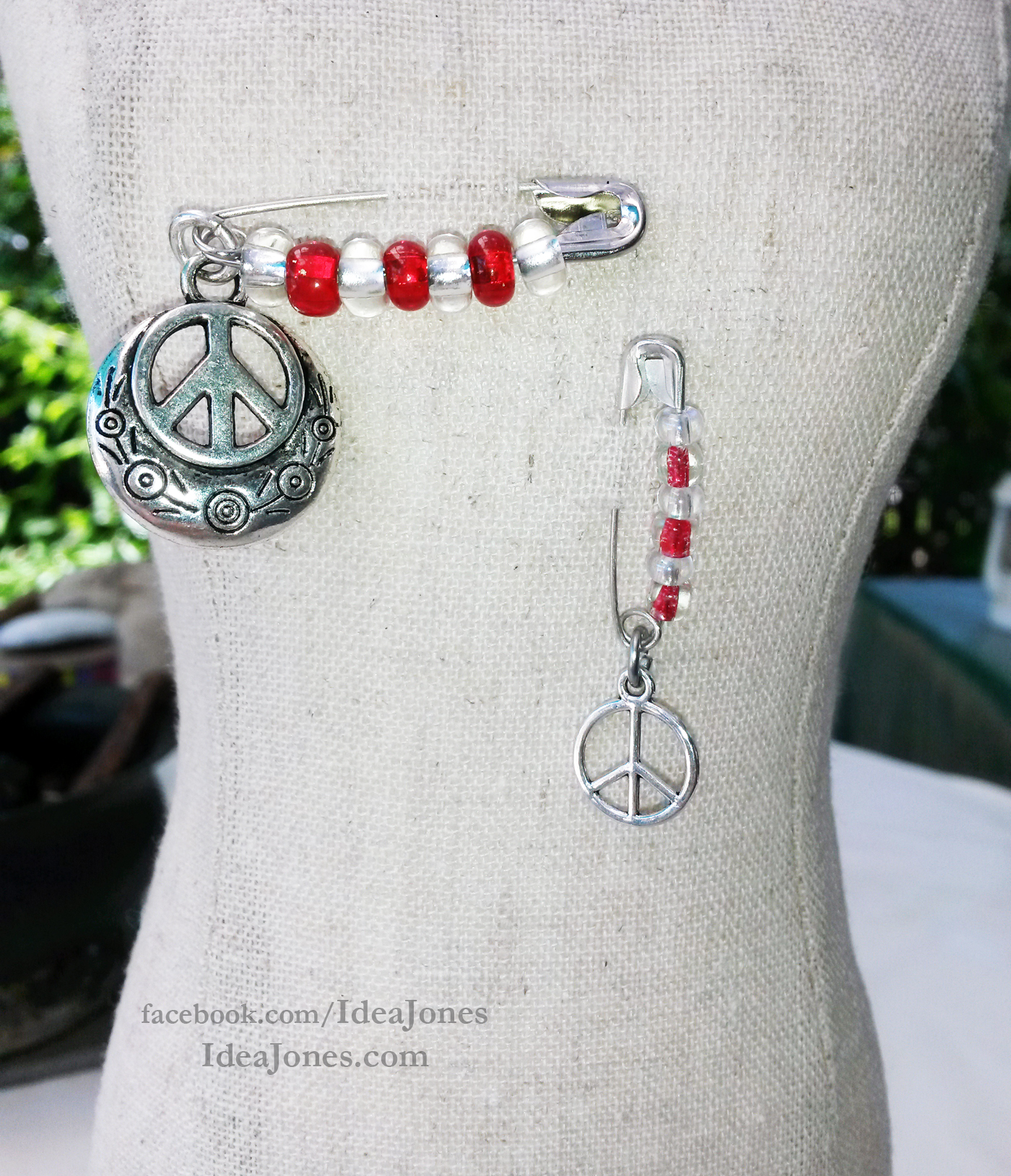
    The “Access To Health Care” Pin

    The acceptance rate for the pins is about 91%. Nine out of ten people offered pins accepted them. Their reactions range from mildly pleased to very enthusiastic. I get to have interesting, challenging, enjoyable conversations with so many people about respect, who we give it to and why, what it means… all because of a pair of little, beaded safety pins in a packet. Another artist said she thought this was “the most important work of social art” she had heard of in years, and I’m still dumbfounded by that. People hug me. They tell me their stories. Parents talk to their kids about respect. It has been amazing — and had I not put it out there, I’d have missed it.

    Yes, you might put your work out there and it might prove hard to find its tribe. But for sure you won’t find that tribe if you don’t try. People can’t want what they can’t conceive of, and they can’t conceive of your project before you put it out there. If the people in your life don’t get it, accept that and keep moving.

    The people who like you, but don’t get your work? Appreciate the role they play in your life, even if it’s just to enjoy your company. You need them. It’s great to have people like your work… but it’s just as great to have people like you as a person. On days when the work just won’t cooperate, you’ll be glad to have someone who, independent of your work, looks forward to talking to you, to seeing you.

    And when you do find people who get your work, listen to them! Let the opinions of people who have experienced what you’re trying to do weigh more than those who haven’t. When I would get discouraged, my husband Mark kept saying, “Listen to  the people who have experienced what you’re doing and told you that it meant something to them. They know what you’re doing.” They are my project’s tribe, and I wouldn’t have found them if I hadn’t taken a chance that they might be out there.
    Save

    Save

  • Pin Tales: The Waitress

    Pin Tales: The Waitress

    This project is about human interaction — how we choose to treat other people.

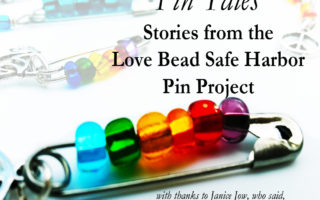
    With thanks to Janice Jow, who suggested writing down and sharing the stories of The Love Bead Safe Harbor Pin Project.

    This is the story of The Waitress.

    My friend and I went out for brunch one Sunday. My friend is learning to drive  (which is badass when you never planned to learn and didn’t especially want to, but you just got a job you like and they want you to drive).  When we go out now, she drives at least part of the time, and we stop to eat.

    We went to a diner, ate, caught up on what was going on in our lives, and laughed.  I approached the register, making my way through the crowd.

    The waitress who had pulled cash register duty was young, maybe mid-20s, with big, serious eyes and dark hair pulled into a ponytail, which is close to being the Universal Waitress Hairdo (I used to be a waitress, years ago, and almost all of the younger waitresses wore their hair that way. It’s a practical thing). She glanced at the Love Bead Safe Harbor pin on my blouse. “I really like that,” she said quietly.

    She wasn’t familiar with Safe Harbor pins (most people I meet aren’t), but said she really liked the idea. I offered her a set of pins, holding out several types. I explained that one was Civil Rights and Social Justice, one was Women’s Rights, and the rainbow set was LGBTQI Rights. She bent closer and pointed to the rainbow set. “I’d like to have those, please.” Her voice was almost a whisper.

    I get it. You have to be careful when you work with the public. Some people feel it is their bound duty to give you their unsolicited opinions about how you live your life (instead of, say, keeping their opinions to themselves and going about their own lives. Whenever people do that, I want to ask for all the details about their lives so I can pass judgement on them. I should get to have fun, too).

    She took the pins, met my eyes, and said, “Thank you.”

    My friend and I left the restaurant. Not everyone is in a position to bravely trumpet their beliefs everywhere they go. If putting food on the table, or paying for school, or other necessities of life depend on not offending people, your march is harder than that of someone who won’t lose much by standing up. Which means that standing up is all the more important for anyone who can, because then you’re standing up for yourself, and for someone not so fortunate.

    She picked those pins, making her public commitment to the importance of people treating each other with true respect, in a time and place when it wasn’t easy for her to do that. Sometimes heroics are quiet, life-affirming acts taken by people for whom standing up at all is hard.

    Save

    Save

  • Love Bead Safe Harbor Pin Project: Moving Forward

    Love Bead Safe Harbor Pin Project: Moving Forward

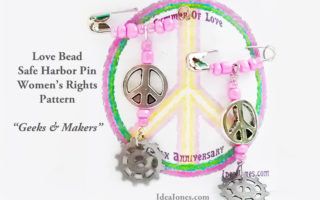
    Love Bead Safe Harbor Pin set honoring “girl geeks” and “maker mamas!”

    The big push is done (the large-scale pin giveaways) after three cities, but LBSHPP is far from over.  Here’s what’s in the works (so far):

    • A free workshop at a charity in Sacramento. Date and time TBA, but probably in July;
    • Pins for Progress, a fundraiser. We’ll be offering sets of pins in our Etsy shop (which is under construction right now). You can buy a set of pins *and* make a donation to charity! Each pin set will be $10, with 25% being split between Opening Doors, a charity helping refugees resettle in their new homes, and Mustard Seed School, helping kids from homeless families. One note — we can ship up to 8 sets in one envelope for one shipping price ($5 in the USA, message for the shipping rates outside the US) and more in a box (message for shipping rate). Date TBA, but within the next few weeks;
    • A video showing how to make your own set of pins. Date TBA, probably by the end of the summer;
    • We’ll continue to carry a few sets with us, so if you meet us, ask for a set of pins!

    In the first phase of the project, we gave away over 1,000 pins (wow… it became larger than I ever expected), but the project was largely self-funded, so we had to look at how we could continue. This way, we can keep helping others and spreading the word!

  • Love Bead Safe Harbor Pin Project: Lessons Learned #1, Do It Scared

    Love Bead Safe Harbor Pin Project: Lessons Learned #1, Do It Scared

    814 chances to choose radical respect!

    Back when I was a Girl Scout, I volunteered to pull the wagon full of cookie boxes if the other girl would ring doorbells and ask people to buy cookies. I like people, but I’m an introvert, and shy. Talk to lots of strangers? I’d rather step in front of a bus.

    There’s this feeling, and I’ve certainly had it, that we should wait to do things until we “feel like it.”  It’s not yet the time, goes that thinking, until the motivation is stronger than any reluctance we might feel.

    A good friend once listened patiently as I listed all the reasons I could think of not to start a project, including how unready and nervous I felt. When I ran out of excuses, she interrupted me before I could run through the list again and said, “You’re scared? So, do it scared.”

    That seemed too simple. Surely the answer was more complicated. “If it’s important,” she told me, “then it’s important enough to do it. If it’s not important enough to do it, the fear doesn’t matter. How important is this to you?”

    I proceeded and the project went, if not perfectly, very well. During the project, I was nervous, elated, scared, excited, all at once. After, I was very happy I’d done it. There are no guarantees — it might have gone down in flames — but I was proud of myself for tackling something I felt strongly about.

    It’s hard to explain to an extrovert, and more people are extroverts than introverts, how big a deal it is for an introvert, and a shy person, to talk to almost 600 people, even though 91% of them were receptive, everything from mildly pleased to very enthusiastic. There is not one person I met through this project who I am not glad I met.  I got to meet almost 500 intelligent, openminded, caring people (and my assistant got to meet 20-30 others). If you are one of the people we gave Love Bead Safe Harbor Pins to, know that there are no words to say how happy I am that we met, or grateful I am that you listened to me, considered what I said, and decided to make your public commitment to the dignity of all human beings, even those you might not understand or approve of.

    But it never did get easier, approaching strangers. Every time, I had to nerve myself to speak to people. Each encounter, I did it scared. I’m so glad I didn’t wait until I felt like it.


    If there’s something you want to do, or create, and it’s important to you, don’t wait until you “feel like it.” If it’s really important to you, get moving, even if just the initial planning stage that will eventually bring your idea to fruition. Pat was right, all those years ago. If you need to do it, do it scared.


    Save

    Save

  • The Love Bead Safe Harbor Pin Project: What Was It About?

    The Love Bead Safe Harbor Pin Project: What Was It About?


    The basic idea behind the Love Bead Safe Harbor Pin Project

    In November of 2016, I found myself increasingly distressed by the tone of civic life, not just in America, but around the world. There was a new level of just plain, low-down meanness. Name calling, threats… it seemed as though humanity, as a species, was bent on finding out what’s lower than living in the gutter.

    I heard from people who were being threatened, or attacked, for some perceived difference. Some way they were perceived as being strange, or not fitting in. It’s not like the abusers were taking time to get to know people and then finding them objectionable. No, this was surface stuff. A way of dressing, the sound of a voice, skin color. Based on just that, the attackers decided they knew who those people were and what that meant.

    About that time, I found out about the “Safe Harbor” pin, a plain safety pin worn to signal that you are safe to approach, that you won’t abuse or attack someone else. The idea came from Great Britain. I began wearing a safety pin. It wasn’t something I thought through deeply. It just felt right.

    Soon after, reports started surfacing of people who self-identified as “white supremacists” wearing plain safety pins, and a few people objected to the idea of the “safe harbor” pin. The first were, perhaps, trying to co-opt the safe harbor symbol and turn it. The second objected because, they said, wearing a safe harbor pin was (and I’m paraphrasing here), a way for white people to feel good about themselves without doing anything about the problems facing society.

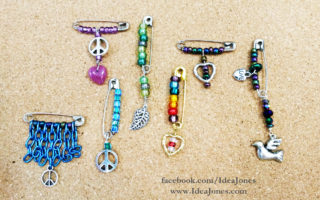
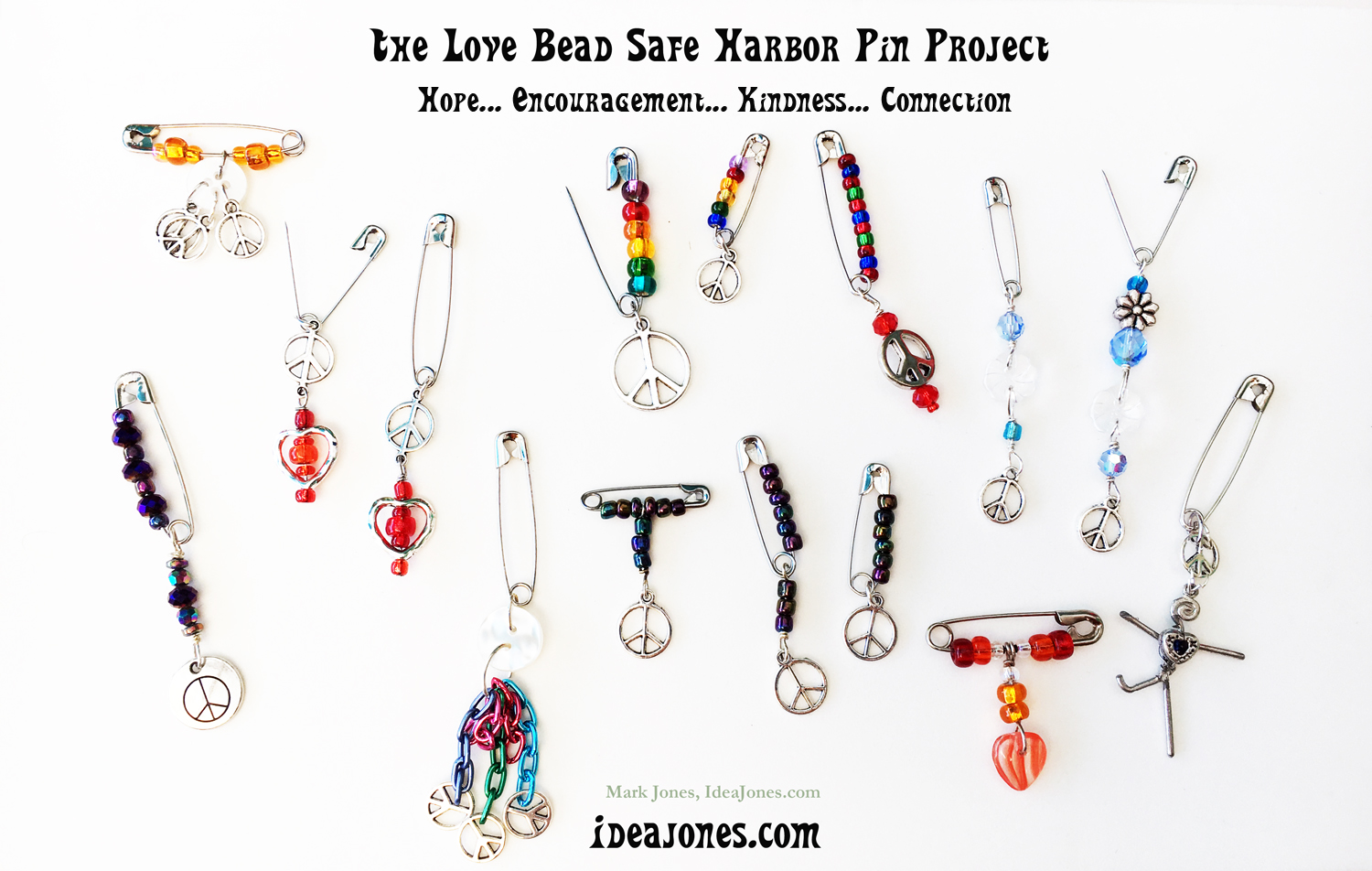
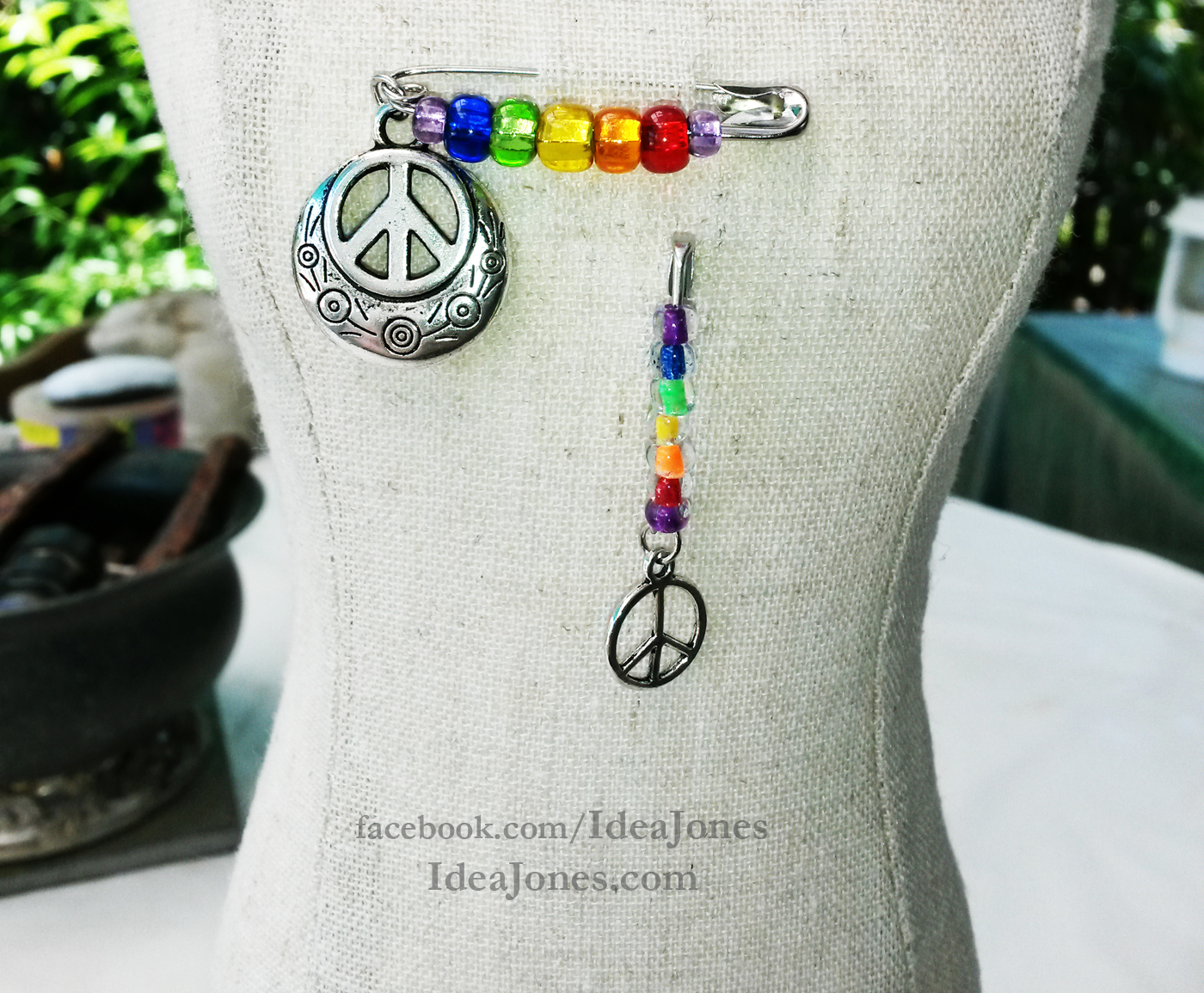
    To resist the co-opting of the symbol, I started decorating my pin, making it more flashy, not the sort of thing your average white supremacist would be comfortable with. I started beading my pins, either adopting color patterns already associated with certain causes (like the rainbow pin for LGBTQI rights), or assigning a meaning to a pattern (like the red and white pin showing a commitment to health care for all).

    Before going on, let’s address the second issue, that the pin is “just” a symbol. No symbol, on its own, solves a problem, yet human beings seem to need them. We’re always creating symbols. It’s a shorthand for an idea, and using that symbol is a way to remind yourself that you are committed to it, and to tell others that you think it’s important. I have been told by people wearing Love Bead Safe Harbor Pins that when they have them on, it alters their interactions with other people. They’re more cognizant of the choices they make. That, I believe, is a good thing.

    As I wore my pin, other people admired it and asked where they could get one. I started making extras, carrying them around and giving them to people who admired my pin. As I did, I explained briefly the significance of the pin and started using the term “radical respect” to explain the idea that we have the choice to treat other people, even people we disagree with, or don’t understand, or disapprove of, with respect. That we can respect our common humanity.

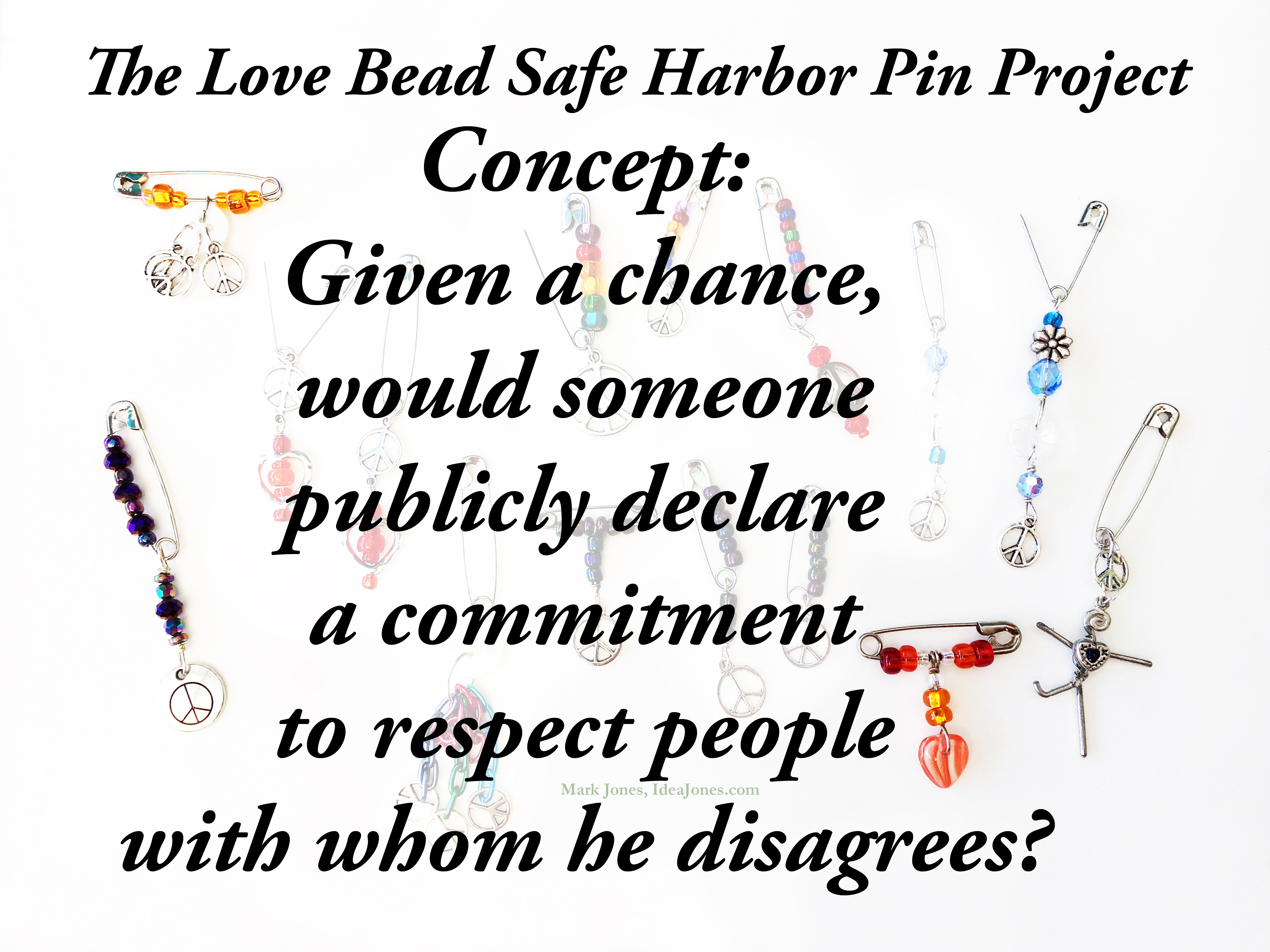
    The more I talked to people, the clearer the idea became. Given a chance, would people choose to publicly avow a belief that all people should be treated with respect?

    Looking at the conversations I was having, I realized that the pin was a means to talking about these ideas and making them conscious choices. If I simply approached someone and asked him to publicly declare his commitment to treating people with respect, most people would probably decline, if they even let me finish the thought. But I saw that offering that little keepsake, that beaded pin, gave people the opportunity to make a conscious choice. At a pin giveaway, here are the choices:

    • Make eye contact or don’t. If someone avoids eye contact, I let him walk by;
    • Talk to me or don’t. If I start to offer a pin and the person indicates he doesn’t want to talk, I let him pass;
    • Listen to me or don’t. A few people will cut me off mid-sentence and leave, or dispute the basic idea (the “yeah, but” reaction);
    • Accept a pin, or don’t. At this point, the pin has a meaning attached to it already (“Wearing it or keeping it where you can see it represents your belief that all people, even people you may disagree with, not understand, or disapprove of, should be treated with respect.”). To accept the set at this point is to accept the philosophy.  Because you are offered the pin, and the philosophy, in a public place, acceptance is a public statement;
    • Choose a basic Safe Harbor Pin, or choose one with a secondary meaning (support for women’s rights, for example, or support for access to health care);
    • Wear the pin, or don’t. What you do with the pin is another point of choice. Those who strongly agree are most likely to wear the pin (sometimes putting it on at that moment);
    • Share the second pin on the card, or don’t. I’ve seen people do it right away, or state to whom they intend to give the second pin.

    Via that little pin, people are given a way to make a conscious choice, affirm that choice, and even advocate for their belief.

    While a couple of  people contacted me online and volunteered to contribute to the cost of the materials for the pins, when I give away pins in person, I do not solicit donations, nor do I accept them. It’s important to me that it is free to the recipient. It is presented as a gift. If someone offers me money in person, I urge him to contribute that money to a cause or charity he supports.

    In total, we gave away 510 sets of pins in three cities (or 1,020 pins).

    Over and over, I’ve talked with people who get very energized and enthusiastic, far more than the offer of a free beaded safety pin can account for.  Having talked to hundreds of people and watched them react, it seems to be the idea they get excited about, that we can consciously choose how to treat people, and that those choices say something about the people we decide to be. In a couple of minutes, they are presented with that information (by being presented with the chance to consciously choose), and a symbol of the decision they made.

    I’ve had people say they like “having a name for it.” As one woman explained, “having a name for the idea makes it easier to talk about.” Another said that having the symbol helped her talk about the ideas behind it as she could show the pin and explain what it is as a way to start.

    My mother used to say that people will rise to your expectations, or fall to them. Certainly that’s been my experience in this project. Given a simple keepsake as a symbol, many people will confirm for themselves and the people around them that they aspire to ask more of themselves.

    Which is a very hopeful thing.

    I’m grateful to have been present when they made that choice. To everyone who chose to take a set of pins, thank you for letting me be part of that moment. May you be blessed and may you enjoy the pride you justifiably feel. It seemed like a brief moment and a small thing, but it was big.

    Secondary meaning came via the color pattern. Shown here: women’s rights, environmantalism, LGBTQI rights and Civil Rights & Social Justice.
    The “Access To Health Care” Pin
    The “LGBTQI Rights” Pin
    The “Women’s Rights” Pin