This holiday season has been “beautifully busy,” a nice way to end a year that started in heartbreak. Mom used to say, “Better is always coming. The trick is to hang on until it gets here.” She was right. Nothing is permanent. The secret, I think, is to convince yourself to remain open.
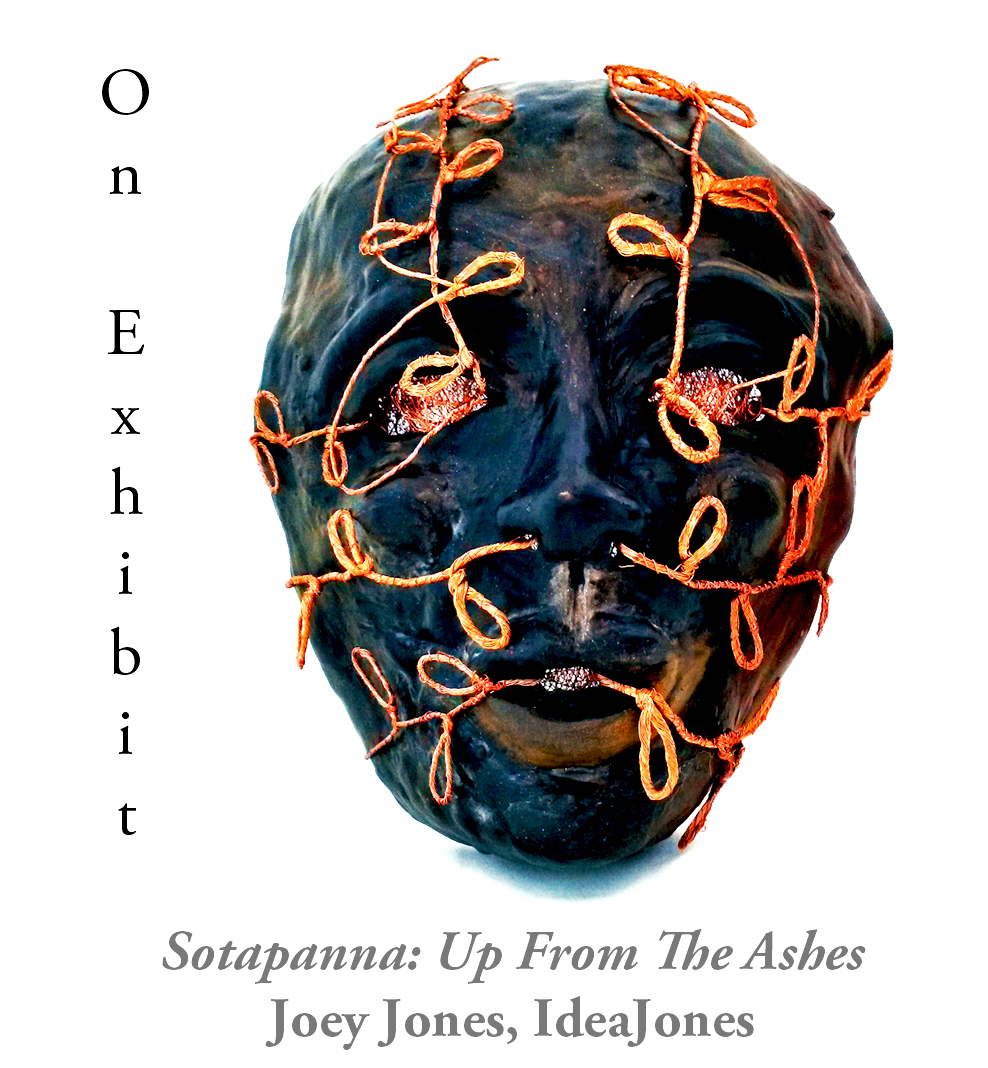
A very good friend, who we lost earlier this year, started each day open to whatever good there was available. That point of view informs Sotapanna: Up From The Ashes, on exhibit in the gallery at WAL Public Market, 1104 R Street in Sacramento. The show runs from Dec. 1, 2017 until Jan. 3, 2018. The theme of it is regrowth after trauma.
It also ties into the “Me, Too” movement of women who have been sexually assaulted telling their stories. Abuse was a part of my life for many years. Forgiving my abusers and rebuilding my life was, and is, a growth process. Even after horribly traumatic events, it’s possible to grow and go forward. Not easy — possible.
I also have jewelry being offered for sale by Blue Line Gallery in Roseville, CA (405 Vernon Street, Roseville, CA). They have jewelry from local artists on display in the small gallery, and available for sale. If you buy a set of Love Bead Safe Harbor Pins, a portion of the sale goes to charity. The pins have never been for sale before, but Women’s Wellspring, a center for women in crisis, recently sold them to raise money for their charity (with our blessing — women who come to the center learned to make them in a free workshop we just gave, and made pins to sell to raise money for their art therapy program), and they’re for sale at Blue Line, raising money both for the nonprofit art gallery and for other charities. We may offer them online as well, with part of the money going to charity.
Lots going on here, most of it good, so we’re tired, but happy. Hope this finds you happy, even happy-tired, storing up the energy of good moments to sustain you.
Remember when I announced that we had finished The Love Bead Safe Harbor Pin Project?
Turns out we weren’t done — we just didn’t know it yet.
This project really began in late November of 2016. By the end of the election that year, we’d had over a year of arguments, name-calling and accusations All of that comes with an election, but this was particularly virulent. Many of the people we knew had stopped speaking to friends, colleagues, family, us…
We heard stories from friends who had been threatened or who had friends or family members who had been attacked for being different, for not fitting in to someone else’s idea of how people should be.
When I first heard of Safe Harbor pins, safety pins worn to signal your belief that all people should be treated with basic human decency and respect, I loved the symbolism of it. True, no symbol solves a problem on its own, but using the symbol requires a choice on your part. Do you agree with the idea it represents? Are you willing to make that belief part of your identity? That’s not a meaningless thing. Human lives are saturated with symbols that represent how we think the world works, or ought to work, indicate our commitment to ideas, tell the world who we are. Most things carry at least some symbolic meaning. I donned my Safe Harbor pin, knowing perhaps I’d get some push back from people who disagreed with me. Mark put on his pin and wore it wherever he went.
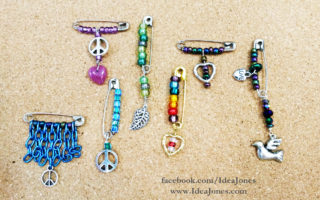
Then white supremacists started wearing safety pins, co-opting the symbol and turning it. I wasn’t willing to relinquish it and have a symbol of decency and kindness come to stand for the opposite. So I started beading pins. I work with wire a lot in sculpting, so I figured out how to bead the pins so I could take them on and off without losing beads. I hung charms on them. I started giving them away.
Honestly, I didn’t know what would happen. I’m an introvert, for one thing. Talking to strangers isn’t my strongest skill. I didn’t know how the idea would be received. They’re inexpensive, humble little things. The first time I did a large giveaway, I told Mark, who was parking the car, that I had no idea if it would take me hours to give them all away, or even if anyone would want them.
Within fifteen minutes, I had none left. Hundreds of pins. Hundreds of people who consciously chose to adopt a symbol. I explained briefly what the pins stand for when I offered them. Each person made a conscious choice to affirm his or her belief that people, all people, should be treated with basic courtesy and respect. Even people they might not understand, agree with, or even like.
We continued giving away pins. Even just giving them away casually in multiple cities, more and more pins found homes. Then we saw that the 50th anniversary of the Summer of Love in San Francisco was coming, and decided to be part of the celebration. There was a specific part of the celebration we wanted to honor. When scores of young people, most without jobs, housing or money, descended on the city of San Francisco in 1967, the city was overwhelmed. There was no infrastructure to take care of hundreds of homeless, jobless kids. Something like that, on that scale, just hadn’t happened before.
So some of the residents stepped up. They set up soup kitchens. They distributed clothing. They helped kids find places to stay and health care. Confronted with a horde of hungry kids, those people chose to take care of them. They did urge them to return home to where they had some sort of support system, but in the meantime, they fed and clothed them.
That was the legacy we wanted to honor.
So we set about making over 1400 pins. We stood on street corners and walked through parks, we stood in front of a museum. Over and over, we offered strangers the following choices:
Will you interact with a stranger?
Will you listen to a brief description of an idea, Radical Respect, the idea that all human beings should be treated with basic courtesy and respect?
Will you accept a symbol of that idea?
Accepting the symbol after the explanation means accepting the idea, and making it at least a small part of your identity. It was a public decision and affirmation. We also tried to keep track of our results. The overwhelming majority of people we encountered chose to talk with me, listen to the idea, discuss it with me, and accept the pins.
All in all, so far, over 750 people have made that choice. People from every economic level, from different cultures, countries and educational backgrounds have stood up in public and affirmed their commitment to supporting human decency for everyone.
On days when the cacaphony of argument and accusation makes me want to become a hermit, I remember some of the people we met and talked with.
We had planned to end the project after the Summer of Love anniversary. It consumed a lot of our lives for almost a year. But we had some materials left, so I offered a free workshop at a program for women and children in crisis. It seemed like a good way to wrap up the project. The workshop went so well, and I had so much fun making pins with some of the women there.
On the way out, the art therapy coordinator introduced me to a member of the Board of Directors of the center. She accepted a set of pins, and asked if they could make pins to sell at an event to raise money. She and the art coordinator were so respectful, asking if what they wanted to do would fit into the goals of the project. I really appreciated their courtesy, and yes, while it’s true that we gave away pins, selling them to benefit a charity, especially one helping people who aren’t often treated with the respect they deserve, is in keeping with the project’s point of view. Anyone who buys a set of pins will get the pins mounted on a card describing Radical Respect, and will also be making a choice to support people who could use help.
So the project isn’t quite over. And I may make a few to sell as a separate-but-related project to raise money for other charities.
Perhaps it’s not consuming my life as it did, but almost a year later, the Love Bead Safe Harbor Pin Project goes on.
This project is about human interaction — how we choose to treat other people.
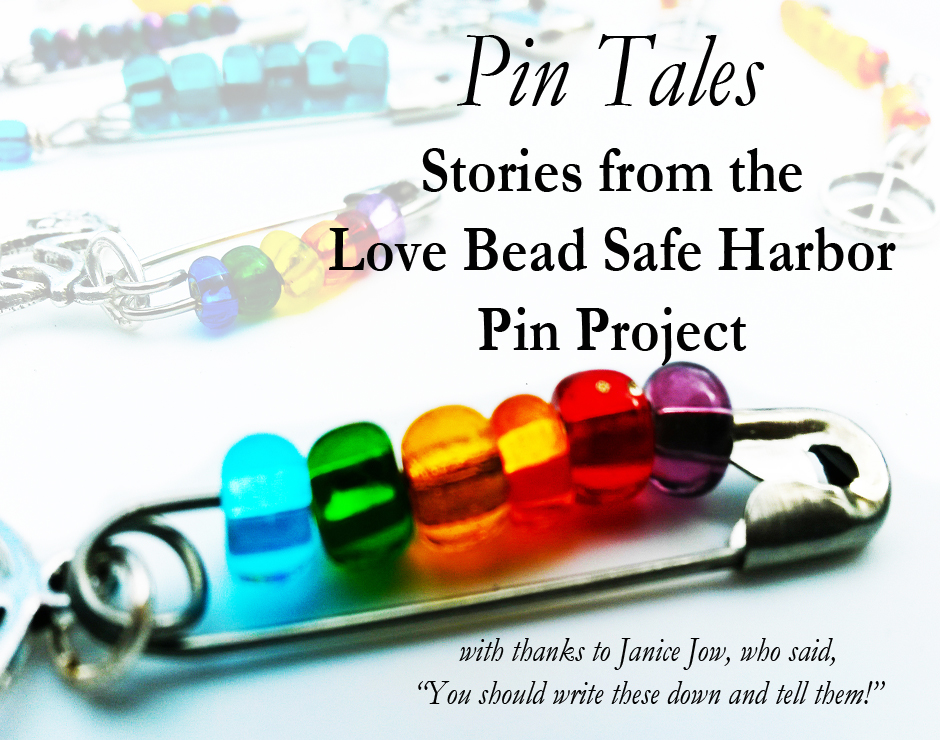
With thanks to Janice Jow, who suggested writing down and sharing the stories of The Love Bead Safe Harbor Pin Project.
This is the story of The Waitress.
My friend and I went out for brunch one Sunday. My friend is learning to drive (which is badass when you never planned to learn and didn’t especially want to, but you just got a job you like and they want you to drive). When we go out now, she drives at least part of the time, and we stop to eat.
We went to a diner, ate, caught up on what was going on in our lives, and laughed. I approached the register, making my way through the crowd.
The waitress who had pulled cash register duty was young, maybe mid-20s, with big, serious eyes and dark hair pulled into a ponytail, which is close to being the Universal Waitress Hairdo (I used to be a waitress, years ago, and almost all of the younger waitresses wore their hair that way. It’s a practical thing). She glanced at the Love Bead Safe Harbor pin on my blouse. “I really like that,” she said quietly.
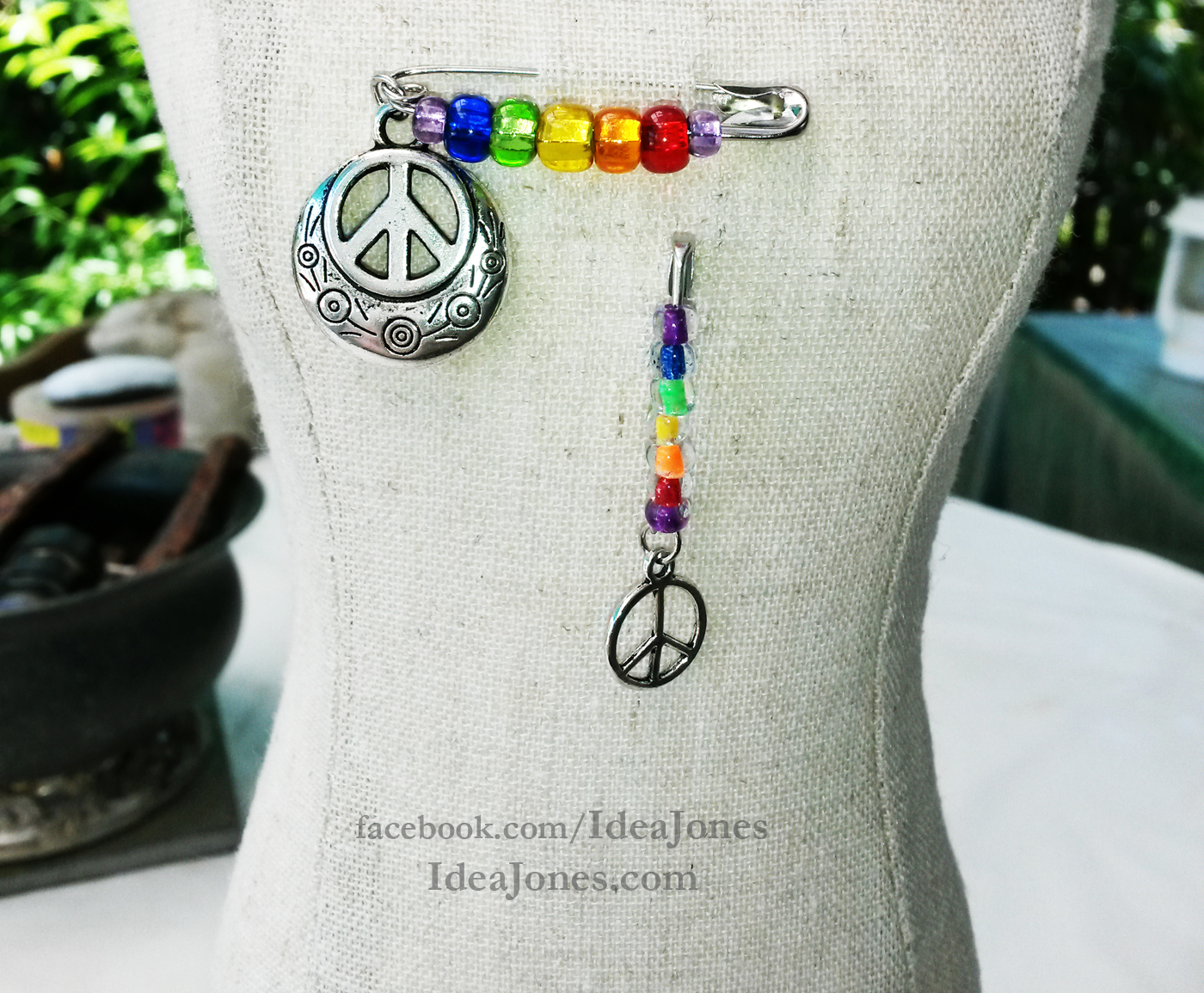
She wasn’t familiar with Safe Harbor pins (most people I meet aren’t), but said she really liked the idea. I offered her a set of pins, holding out several types. I explained that one was Civil Rights and Social Justice, one was Women’s Rights, and the rainbow set was LGBTQI Rights. She bent closer and pointed to the rainbow set. “I’d like to have those, please.” Her voice was almost a whisper.
I get it. You have to be careful when you work with the public. Some people feel it is their bound duty to give you their unsolicited opinions about how you live your life (instead of, say, keeping their opinions to themselves and going about their own lives. Whenever people do that, I want to ask for all the details about their lives so I can pass judgement on them. I should get to have fun, too).
She took the pins, met my eyes, and said, “Thank you.”
My friend and I left the restaurant. Not everyone is in a position to bravely trumpet their beliefs everywhere they go. If putting food on the table, or paying for school, or other necessities of life depend on not offending people, your march is harder than that of someone who won’t lose much by standing up. Which means that standing up is all the more important for anyone who can, because then you’re standing up for yourself, and for someone not so fortunate.
She picked those pins, making her public commitment to the importance of people treating each other with true respect, in a time and place when it wasn’t easy for her to do that. Sometimes heroics are quiet, life-affirming acts taken by people for whom standing up at all is hard.
Back when I was a Girl Scout, I volunteered to pull the wagon full of cookie boxes if the other girl would ring doorbells and ask people to buy cookies. I like people, but I’m an introvert, and shy. Talk to lots of strangers? I’d rather step in front of a bus.
There’s this feeling, and I’ve certainly had it, that we should wait to do things until we “feel like it.” It’s not yet the time, goes that thinking, until the motivation is stronger than any reluctance we might feel.
A good friend once listened patiently as I listed all the reasons I could think of not to start a project, including how unready and nervous I felt. When I ran out of excuses, she interrupted me before I could run through the list again and said, “You’re scared? So, do it scared.”
That seemed too simple. Surely the answer was more complicated. “If it’s important,” she told me, “then it’s important enough to do it. If it’s not important enough to do it, the fear doesn’t matter. How important is this to you?”
I proceeded and the project went, if not perfectly, very well. During the project, I was nervous, elated, scared, excited, all at once. After, I was very happy I’d done it. There are no guarantees — it might have gone down in flames — but I was proud of myself for tackling something I felt strongly about.
It’s hard to explain to an extrovert, and more people are extroverts than introverts, how big a deal it is for an introvert, and a shy person, to talk to almost 600 people, even though 91% of them were receptive, everything from mildly pleased to very enthusiastic. There is not one person I met through this project who I am not glad I met. I got to meet almost 500 intelligent, openminded, caring people (and my assistant got to meet 20-30 others). If you are one of the people we gave Love Bead Safe Harbor Pins to, know that there are no words to say how happy I am that we met, or grateful I am that you listened to me, considered what I said, and decided to make your public commitment to the dignity of all human beings, even those you might not understand or approve of.
But it never did get easier, approaching strangers. Every time, I had to nerve myself to speak to people. Each encounter, I did it scared. I’m so glad I didn’t wait until I felt like it.
If there’s something you want to do, or create, and it’s important to you, don’t wait until you “feel like it.” If it’s really important to you, get moving, even if just the initial planning stage that will eventually bring your idea to fruition. Pat was right, all those years ago. If you need to do it, do it scared.
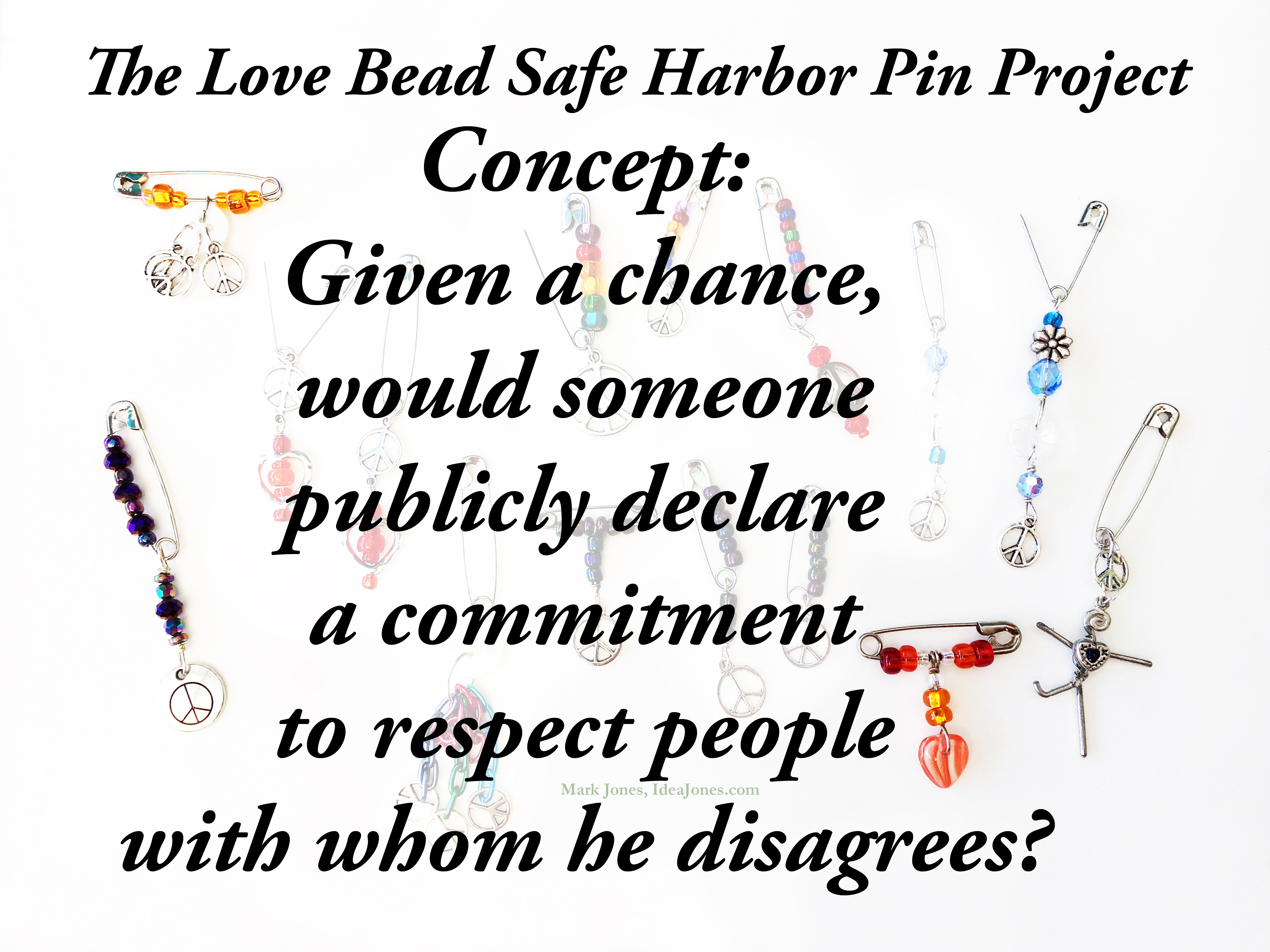
The basic idea behind the Love Bead Safe Harbor Pin Project
In November of 2016, I found myself increasingly distressed by the tone of civic life, not just in America, but around the world. There was a new level of just plain, low-down meanness. Name calling, threats… it seemed as though humanity, as a species, was bent on finding out what’s lower than living in the gutter.
I heard from people who were being threatened, or attacked, for some perceived difference. Some way they were perceived as being strange, or not fitting in. It’s not like the abusers were taking time to get to know people and then finding them objectionable. No, this was surface stuff. A way of dressing, the sound of a voice, skin color. Based on just that, the attackers decided they knew who those people were and what that meant.
About that time, I found out about the “Safe Harbor” pin, a plain safety pin worn to signal that you are safe to approach, that you won’t abuse or attack someone else. The idea came from Great Britain. I began wearing a safety pin. It wasn’t something I thought through deeply. It just felt right.
Soon after, reports started surfacing of people who self-identified as “white supremacists” wearing plain safety pins, and a few people objected to the idea of the “safe harbor” pin. The first were, perhaps, trying to co-opt the safe harbor symbol and turn it. The second objected because, they said, wearing a safe harbor pin was (and I’m paraphrasing here), a way for white people to feel good about themselves without doing anything about the problems facing society.
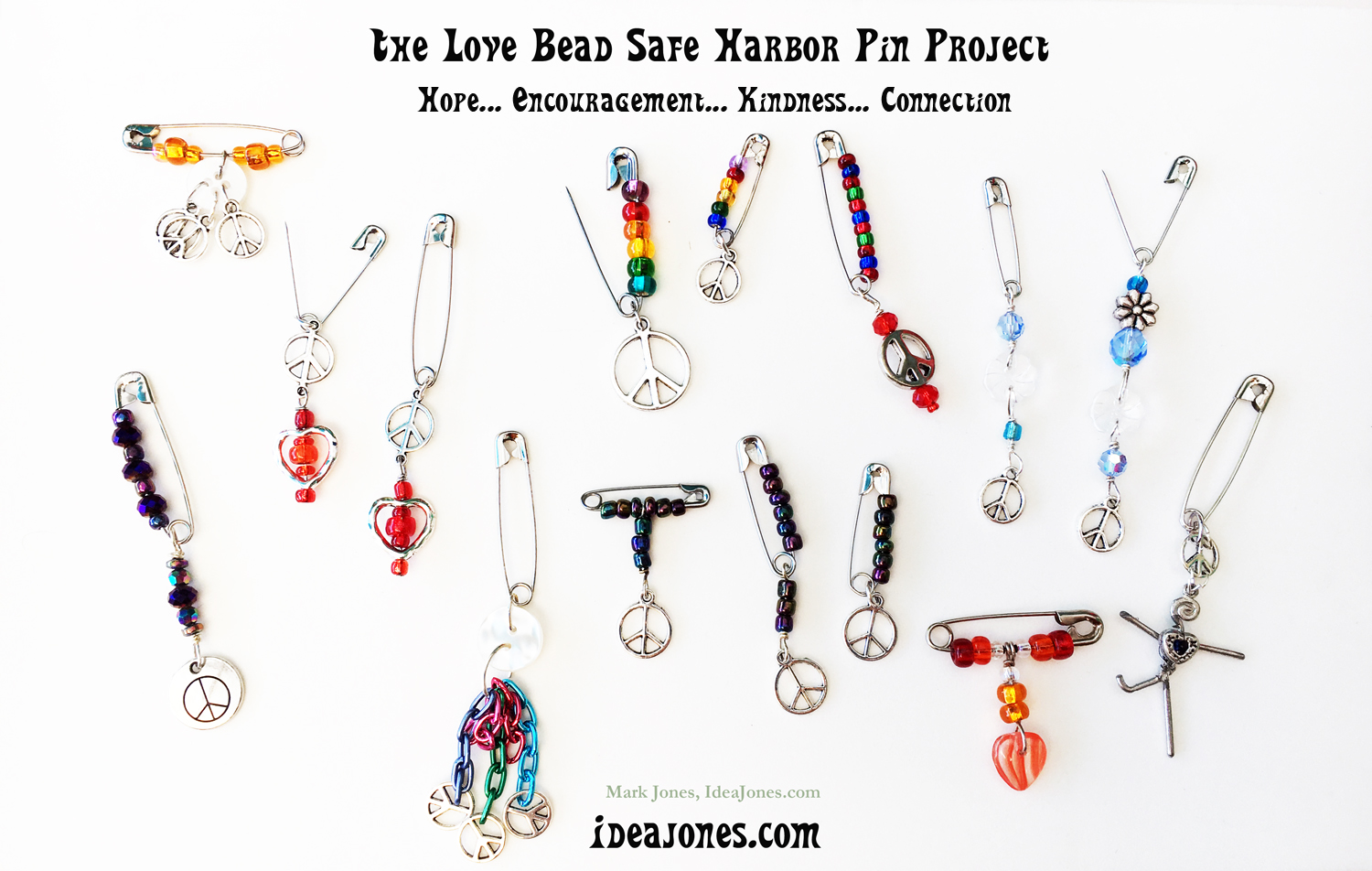
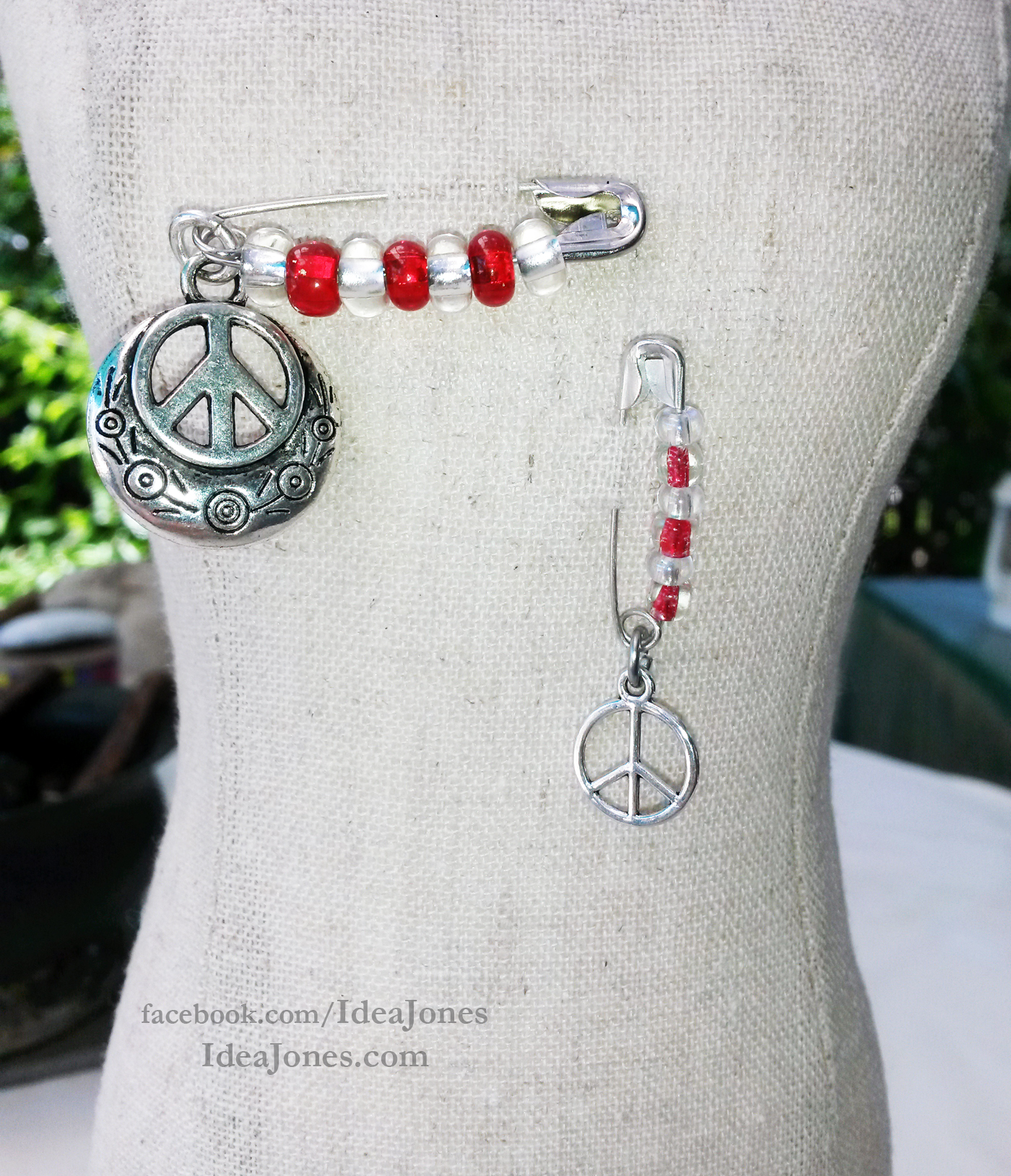
To resist the co-opting of the symbol, I started decorating my pin, making it more flashy, not the sort of thing your average white supremacist would be comfortable with. I started beading my pins, either adopting color patterns already associated with certain causes (like the rainbow pin for LGBTQI rights), or assigning a meaning to a pattern (like the red and white pin showing a commitment to health care for all).
Before going on, let’s address the second issue, that the pin is “just” a symbol. No symbol, on its own, solves a problem, yet human beings seem to need them. We’re always creating symbols. It’s a shorthand for an idea, and using that symbol is a way to remind yourself that you are committed to it, and to tell others that you think it’s important. I have been told by people wearing Love Bead Safe Harbor Pins that when they have them on, it alters their interactions with other people. They’re more cognizant of the choices they make. That, I believe, is a good thing.
As I wore my pin, other people admired it and asked where they could get one. I started making extras, carrying them around and giving them to people who admired my pin. As I did, I explained briefly the significance of the pin and started using the term “radical respect” to explain the idea that we have the choice to treat other people, even people we disagree with, or don’t understand, or disapprove of, with respect. That we can respect our common humanity.
The more I talked to people, the clearer the idea became. Given a chance, would people choose to publicly avow a belief that all people should be treated with respect?
Looking at the conversations I was having, I realized that the pin was a means to talking about these ideas and making them conscious choices. If I simply approached someone and asked him to publicly declare his commitment to treating people with respect, most people would probably decline, if they even let me finish the thought. But I saw that offering that little keepsake, that beaded pin, gave people the opportunity to make a conscious choice. At a pin giveaway, here are the choices:
Make eye contact or don’t. If someone avoids eye contact, I let him walk by;
Talk to me or don’t. If I start to offer a pin and the person indicates he doesn’t want to talk, I let him pass;
Listen to me or don’t. A few people will cut me off mid-sentence and leave, or dispute the basic idea (the “yeah, but” reaction);
Accept a pin, or don’t. At this point, the pin has a meaning attached to it already (“Wearing it or keeping it where you can see it represents your belief that all people, even people you may disagree with, not understand, or disapprove of, should be treated with respect.”). To accept the set at this point is to accept the philosophy. Because you are offered the pin, and the philosophy, in a public place, acceptance is a public statement;
Choose a basic Safe Harbor Pin, or choose one with a secondary meaning (support for women’s rights, for example, or support for access to health care);
Wear the pin, or don’t. What you do with the pin is another point of choice. Those who strongly agree are most likely to wear the pin (sometimes putting it on at that moment);
Share the second pin on the card, or don’t. I’ve seen people do it right away, or state to whom they intend to give the second pin.
Via that little pin, people are given a way to make a conscious choice, affirm that choice, and even advocate for their belief.
While a couple of people contacted me online and volunteered to contribute to the cost of the materials for the pins, when I give away pins in person, I do not solicit donations, nor do I accept them. It’s important to me that it is free to the recipient. It is presented as a gift. If someone offers me money in person, I urge him to contribute that money to a cause or charity he supports.
In total, we gave away 510 sets of pins in three cities (or 1,020 pins).
Over and over, I’ve talked with people who get very energized and enthusiastic, far more than the offer of a free beaded safety pin can account for. Having talked to hundreds of people and watched them react, it seems to be the idea they get excited about, that we can consciously choose how to treat people, and that those choices say something about the people we decide to be. In a couple of minutes, they are presented with that information (by being presented with the chance to consciously choose), and a symbol of the decision they made.
I’ve had people say they like “having a name for it.” As one woman explained, “having a name for the idea makes it easier to talk about.” Another said that having the symbol helped her talk about the ideas behind it as she could show the pin and explain what it is as a way to start.
My mother used to say that people will rise to your expectations, or fall to them. Certainly that’s been my experience in this project. Given a simple keepsake as a symbol, many people will confirm for themselves and the people around them that they aspire to ask more of themselves.
Which is a very hopeful thing.
I’m grateful to have been present when they made that choice. To everyone who chose to take a set of pins, thank you for letting me be part of that moment. May you be blessed and may you enjoy the pride you justifiably feel. It seemed like a brief moment and a small thing, but it was big.
Secondary meaning came via the color pattern. Shown here: women’s rights, environmantalism, LGBTQI rights and Civil Rights & Social Justice.The “Access To Health Care” PinThe “LGBTQI Rights” PinThe “Women’s Rights” Pin