IdeaJones

Tag: health care

  • Peeing In Humanity’s Pool

    Peeing In Humanity’s Pool

    It’s not politics. It’s good manners (and being a good person).

    Etiquette has always interested me. I noticed as a little kid that there were different rules for different people and situations. Mom pointed out early on that we don’t speak the same way to the minister as we do to friends on the playground. Twirling so your dress flies up and your underwear shows is okay at a dance, but a bad idea at the office.

    The etiquette evolving for this time of pandemic interests me. On a purely emotional level, it’s an unpleasant surprise to see how many people think not wearing a mask or distancing is some sort of statement promoting some “cause,” as opposed to simply being a practical thing recommended by experts in medicine, science and public health to slow down the spread of a very contagious new disease.

    I suspect many of them are simply terrified. Human beings don’t make our best decisions when we’re scared. The brain stops accepting any new input that’s complicated and we don’t have processing power or time to untangle anything confusing. It’s easier for some people to respond to fear by refusing to believe anything is wrong, because admitting what’s going on means accepting a certain amount of powerlessness.

    Why not do the things we know help, like staying home as much as we can until a safe, effective vaccine is available? Why refuse to distance, or wear masks? Those give us what power we have in this situation, so why give them up?

    In part, because it’s quickly become part of a person’s identity. Meaning has been attached to taking those steps. They’ve gone from being sensible precautions to personal statements. But in that process, I think some people are mistaking the statements they’re making.

    Yes, liberty is important. Freedom is crucial. But they don’t come without cost. We live in a society with other people. The basic deal is that it’s understood we will cooperate for the good of us all. I’m free to drive a car, but not into your living room. I have to take a test, get a license, and obey traffic laws — and I have the right to expect that you will, too. My stopping at a red light protects other drivers (and me). Them stopping protects me (and them). We protect each other.

    It’s the liberty bargain. I’m free to exercise by throwing punches — but not at your face. Your face has the right to be unpunched by me. My rights aren’t the only ones that matter. Yours matter, too. You have a right for me not to casually risk exposing you to a potentially deadly disease.

    If the only thing masks and distancing accomplished was making some people feel safer during this chaotic time, they’d still be worth wearing. It’s good manners. It’s kind. It’s caring. And if people feel safe, if they see you doing your part to help, they’re more likely to feel safe enough to come out and spend money.

    When someone wears a mask or distances during a global pandemic, it’s not a political statement. The statement being made is that this person thinks other people matter enough to protect or comfort them — their own family, friends, neighbors and coworkers, that exhausted nurse or doctor who’s been tending coronavirus patients (and watching people die when they couldn’t be saved), that researcher getting close to finding a vaccine to protect people, that truck driver or grocery clerk risking health and life to keep the groceries coming.

    It’s not a flag. It’s not a magic amulet (you have to wear them correctly for them to work — just having one on your person doesn’t protect anyone).

    It’s your way of saying whether you’re mature enough to understand that freedom comes with responsibility, kind enough to help other people feel a bit safer in trying times, smart enough to understand that not doing it makes us lock down longer and likely will get us locked down again. You’re willing to do your own bit to help get your community, your country, and your world through the biggest challenge we’re all likely to face in our lifetimes.

    So make your statement — but make sure you know what statement you’re really making.
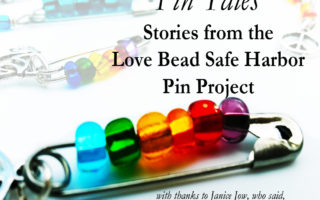
  • Pin Tales: The Waitress

    Pin Tales: The Waitress

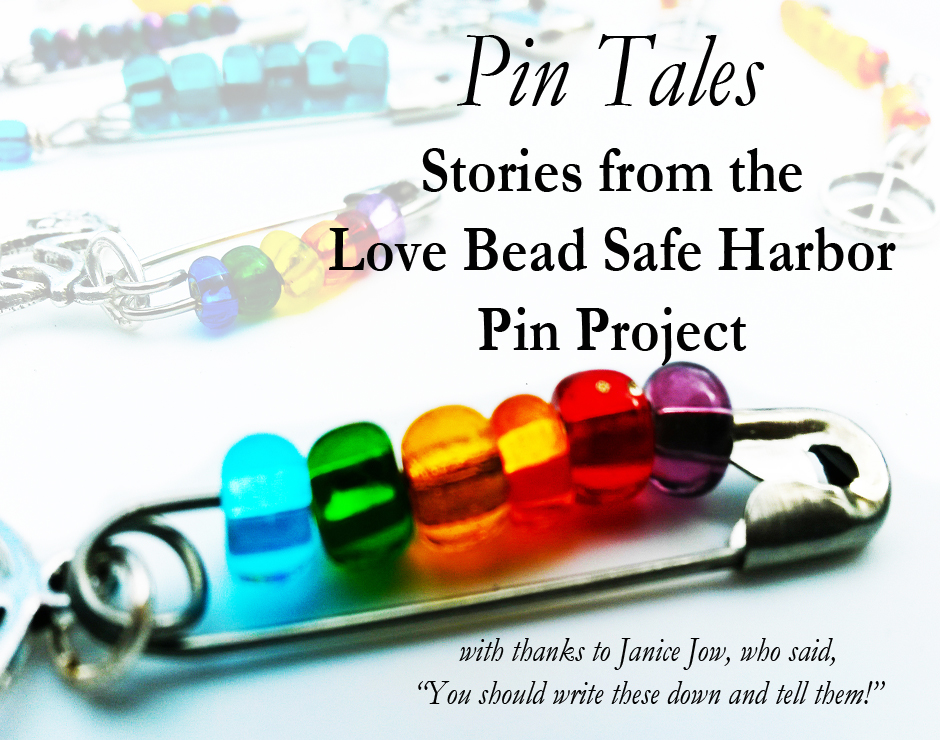
    This project is about human interaction — how we choose to treat other people.

    With thanks to Janice Jow, who suggested writing down and sharing the stories of The Love Bead Safe Harbor Pin Project.

    This is the story of The Waitress.

    My friend and I went out for brunch one Sunday. My friend is learning to drive  (which is badass when you never planned to learn and didn’t especially want to, but you just got a job you like and they want you to drive).  When we go out now, she drives at least part of the time, and we stop to eat.

    We went to a diner, ate, caught up on what was going on in our lives, and laughed.  I approached the register, making my way through the crowd.

    The waitress who had pulled cash register duty was young, maybe mid-20s, with big, serious eyes and dark hair pulled into a ponytail, which is close to being the Universal Waitress Hairdo (I used to be a waitress, years ago, and almost all of the younger waitresses wore their hair that way. It’s a practical thing). She glanced at the Love Bead Safe Harbor pin on my blouse. “I really like that,” she said quietly.

    She wasn’t familiar with Safe Harbor pins (most people I meet aren’t), but said she really liked the idea. I offered her a set of pins, holding out several types. I explained that one was Civil Rights and Social Justice, one was Women’s Rights, and the rainbow set was LGBTQI Rights. She bent closer and pointed to the rainbow set. “I’d like to have those, please.” Her voice was almost a whisper.

    I get it. You have to be careful when you work with the public. Some people feel it is their bound duty to give you their unsolicited opinions about how you live your life (instead of, say, keeping their opinions to themselves and going about their own lives. Whenever people do that, I want to ask for all the details about their lives so I can pass judgement on them. I should get to have fun, too).

    She took the pins, met my eyes, and said, “Thank you.”

    My friend and I left the restaurant. Not everyone is in a position to bravely trumpet their beliefs everywhere they go. If putting food on the table, or paying for school, or other necessities of life depend on not offending people, your march is harder than that of someone who won’t lose much by standing up. Which means that standing up is all the more important for anyone who can, because then you’re standing up for yourself, and for someone not so fortunate.

    She picked those pins, making her public commitment to the importance of people treating each other with true respect, in a time and place when it wasn’t easy for her to do that. Sometimes heroics are quiet, life-affirming acts taken by people for whom standing up at all is hard.

    Save

    Save

  • Field Guide To Love Bead Safe Harbor Pins: The Health Care Pin

    Field Guide To Love Bead Safe Harbor Pins: The Health Care Pin

    If you’re new to the Love Bead Safe Harbor Pin and you see one “in the wild,” on someone on the street, in a restaurant, at school, at work, or any of the places you might find cool people, you might wonder if there’s any significance to the color, or the charm hanging from the pin. The answer? Sometimes yes, sometimes no.

    The safety pin is what makes it a “safe harbor” pin. So no matter the color or decoration, it’s still a Safe Harbor Pin. The rest is about standing up for a special cause that is close to your heart. It doesn’t mean you don’t care about anything else, just that this particular cause is one you’re especially passionate about, or is especially relevant to your life, or in the lives of people you know.

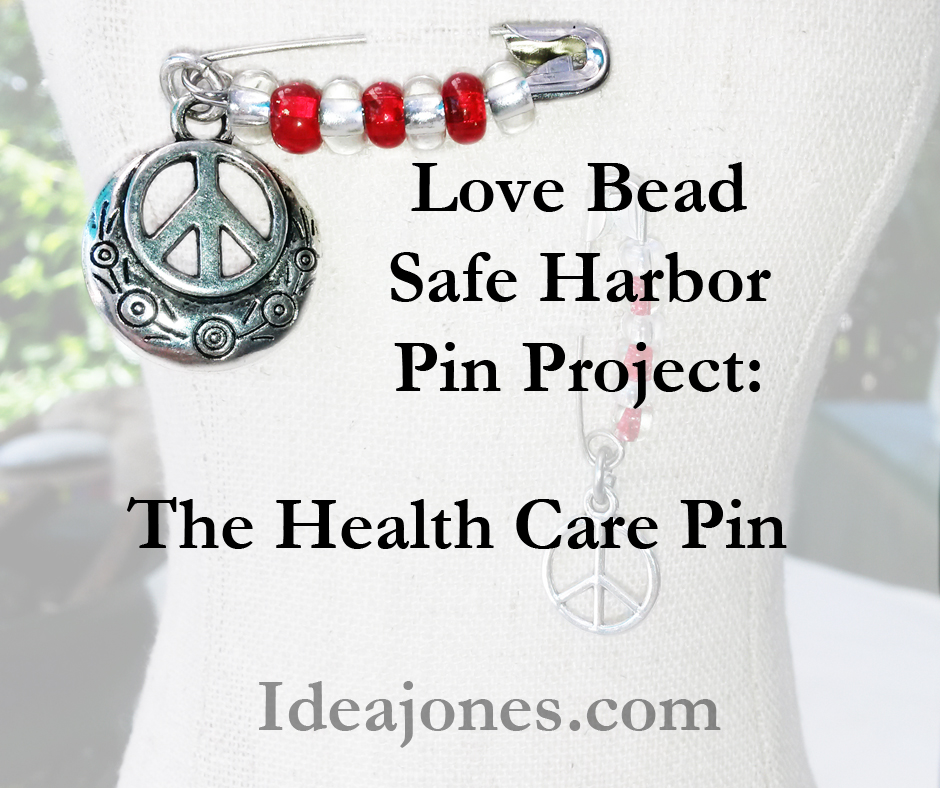
    The Health Care Pin:

    Whether your life is saved or not shouldn’t depend on your income.

    This was something suggested to me by a Pin Sponsor, one of the fantastic people who got online and asked to buy a set of pins and sponsor a set to be distributed free to someone else (maybe you?).  She wanted a pattern that signifies a commitment to seeing that people are able to find and afford the health care they need. She suggested the red and white pattern, which is also used by emergency health care providers and disaster relief organizations.

    Wearing this pin shows that access to affordable health care is an issue close to your heart (a phrase which takes on added meaning in this case). You believe that you, and that person over there, and people you don’t even know exist (which, if you think about it, is almost all people, since there are billions of human beings and you probably can’t name them all) deserve access to affordable, effective health care.

    Sure, there is a debate to be had about whether or not society should pay for treatment that doesn’t have a lot of scientific evidence to support its effectiveness. Or whether or not society pays for, say, somebody’s plastic surgery to change the shape of a nose that works fine, as a nose. Those are things we should debate and decide.

    But should your neighbor die of heart disease because he can’t afford to see a cardiologist? Should kids be crippled or killed by disease because their families can’t afford the vaccine that would prevent it? Is there a basic level of health care that should be accessible to everyone?

    Note that I don’t say “this is about universal health coverage.” It’s true, I do think that’s our best option, for a host of non-huggy-feely, practical reasons, but this isn’t about any one approach. It’s simply a starting place, “Yes, I believe there is some basic level of health care that should be available to all of us, so  now let’s figure out what that looks like and how we pay for it.”

    Here’s one reason why society (meaning all of us) benefits when there is general access to decent health care: no matter how wealthy a person may be, he isn’t self-sufficient. We depend on millions of other people to make, sell, repair, clean and cook things we need or want. Those people do a better job if they’re healthy. And if they don’t have to wait to be treated until whatever it is becomes an emergency, our own health care costs go down. And they aren’t hocking up germs on whatever it is they’re working with because they couldn’t see doctors, which means we’re healthier. We need lots of people at work, earning a living (and they have more available income to spend if they don’t have to go into bankruptcy due to health care costs), making things, buying things. Healthy people do a lot more of all of that stuff.

    Sometimes, when one of us is trying to make a decision and getting bogged down in details, Mark or I say, “The first question is: Do you want to do this at all? If you don’t, the details don’t matter.”  So this isn’t about what the program looks like, or the funding mechanism. It’s about that first question, “Should we do this at all?,” and the answer, “Yes!”

    Yes, you should be able to get your eyes checked, the cavity in your tooth filled, your flu shot, your blood pressure checked and treated if needed. So should I. So should that person over there, and that one (What’s his name? He looks kind of familiar…), and her over there (I think she works at the supermarket…). Yes, that baby with the inherited muscle problem should be able to get it treated so she can walk. Yes, that toddler who ate a watch when nobody was looking should be able to get it removed, by a doctor, in a safe facility.

    The peace sign on this pin? Peace of mind. Freedom from anxiety about how we’ll manage to see doctors, or dentists, or get whatever medical treatment we need. For you, for me, for everyone (yes, even that guy whose name we can’t remember. Him, too).