IdeaJones

Tag: california

  • Social Art, or The Love Bead Safe Harbor Pin Project Rides Again!

    Social Art, or The Love Bead Safe Harbor Pin Project Rides Again!

    Remember when I announced that we had finished The Love Bead Safe Harbor Pin Project?

    Turns out we weren’t done — we just didn’t know it yet.

    This project really began in late November of 2016. By the end of the election that year, we’d had over a year of arguments, name-calling and accusations All of that comes with an election, but this was particularly virulent. Many of the people we knew had stopped speaking to friends, colleagues, family, us…

    We heard stories from friends who had been threatened or who had friends or family members who had been attacked for being different, for not fitting in to someone else’s idea of how people should be.

    When I first heard of Safe Harbor pins, safety pins worn to signal your belief that all people should be treated with basic human decency and respect, I loved the symbolism of it. True, no symbol solves a problem on its own, but using the symbol requires a choice on your part. Do you agree with the idea it represents? Are you willing to make that belief part of your identity? That’s not a meaningless thing. Human lives are saturated with symbols that represent how we think the world works, or ought to work, indicate our commitment to ideas, tell the world who we are. Most things carry at least some symbolic meaning. I donned my Safe Harbor pin, knowing perhaps I’d get some push back from people who disagreed with me. Mark put on his pin and wore it wherever he went.

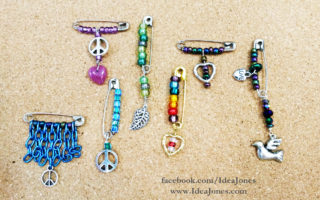
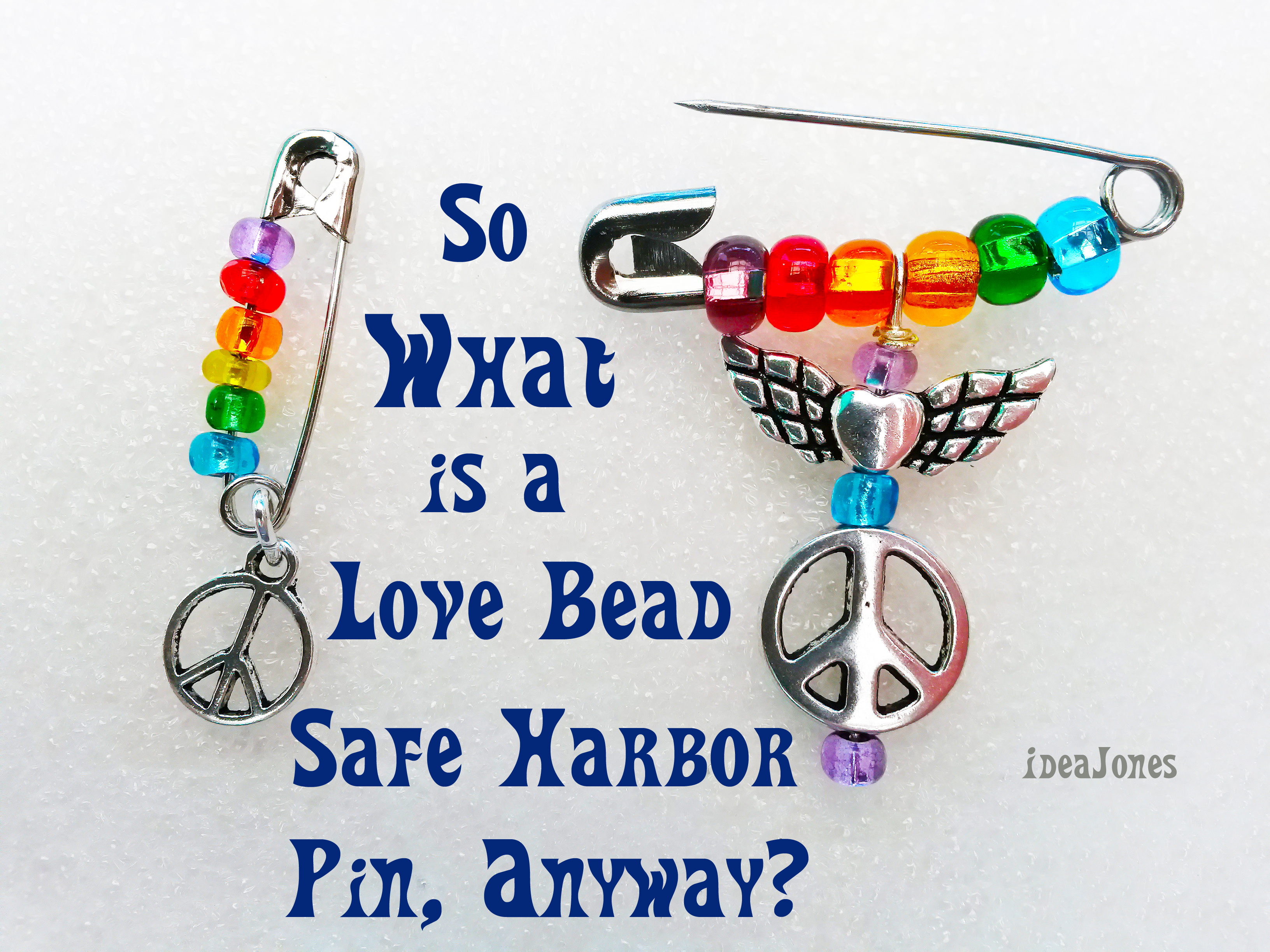
    Then white supremacists started wearing safety pins, co-opting the symbol and turning it. I wasn’t willing to relinquish it and have a symbol of decency and kindness come to stand for the opposite. So I started beading pins. I work with wire a lot in sculpting, so I figured out how to bead the pins so I could take them on and off without losing beads. I hung charms on them. I started giving them away.

    Honestly, I didn’t know what would happen. I’m an introvert, for one thing. Talking to strangers isn’t my strongest skill. I didn’t know how the idea would be received. They’re inexpensive, humble little things. The first time I did a large giveaway, I told Mark, who was parking the car, that I had no idea if it would take me hours to give them all away, or even if anyone would want them.

    Within fifteen minutes, I had none left. Hundreds of pins. Hundreds of people who consciously chose to adopt a symbol. I explained briefly what the pins stand for when I offered them. Each person made a conscious choice to affirm his or her belief that people, all people, should be treated with basic courtesy and respect. Even people they might not understand, agree with, or even like.

    We continued giving away pins. Even just giving them away casually in multiple cities, more and more pins found homes. Then we saw that the 50th anniversary of the Summer of Love in San Francisco was coming, and decided to be part of the celebration. There was a specific part of the celebration we wanted to honor. When scores of young people, most without jobs, housing or money, descended on the city of San Francisco in 1967, the city was overwhelmed. There was no infrastructure to take care of hundreds of homeless, jobless kids. Something like that, on that scale, just hadn’t happened before.

    So some of the residents stepped up. They set up soup kitchens. They distributed clothing. They helped kids find places to stay and health care. Confronted with a horde of hungry kids, those people chose to take care of them. They did urge them to return home to where they had some sort of support system, but in the meantime, they fed and clothed them.

    That was the legacy we wanted to honor.

    So we set about making over 1400 pins. We stood on street corners and walked through parks, we stood in front of a museum. Over and over, we offered strangers the following choices:

    • Will you interact with a stranger?
    • Will you listen to a brief description of an idea, Radical Respect, the idea that all human beings should be treated with basic courtesy and respect?
    • Will you accept a symbol of that idea?

    Accepting the symbol after the explanation means accepting the idea, and making it at least a small part of your identity. It was a public decision and affirmation.  We also tried to keep track of our results. The overwhelming majority of people we encountered chose to talk with me, listen to the idea, discuss it with me, and accept the pins.

    All in all, so far, over 750 people have made that choice. People from every economic level, from different cultures, countries and educational backgrounds have stood up in public and affirmed their commitment to supporting human decency for everyone.

    On days when the cacaphony of argument and accusation makes me want to become a hermit, I remember some of the people we met and talked with.

    We had planned to end the project after the Summer of Love anniversary. It consumed a lot of our lives for almost a year. But we had some materials left, so I offered a free workshop at a program for women and children in crisis. It seemed like a good way to wrap up the project. The workshop went so well, and I had so much fun making pins with some of the women there.

    On the way out, the art therapy coordinator introduced me to a member of the Board of Directors of the center. She accepted a set of pins, and asked if they could make pins to sell at an event to raise money. She and the art coordinator were so respectful, asking if what they wanted to do would fit into the goals of the project. I really appreciated their courtesy, and yes, while it’s true that we gave away pins, selling them to benefit a charity, especially one helping people who aren’t often treated with the respect they deserve, is in keeping with the project’s point of view. Anyone who buys a set of pins will get the pins mounted on a card describing Radical Respect, and will also  be making a choice to support people who could use help.

    So the project isn’t quite over. And I may make a few to sell as a separate-but-related project to raise money for other charities.

    Perhaps it’s not consuming my life as it did, but almost a year later, the Love Bead Safe Harbor Pin Project goes on.
  • The Love Bead Safe Harbor Pin Project

    The Love Bead Safe Harbor Pin Project

    The schedule for the 500 Safe Harbors pin event is coming together (more on that in a second). But just in case you’re new to the Safe Harbor movement…

    Safe Harbor is an idea that came to us from Great Britain (as did scones, which are wonderful, and tea, also great). People started wearing plain safety pins to signal that they were safe to approach, wouldn’t harm or be abusive toward you… that they were “safe harbors” in the social sea. I started wearing one after friends reported they or people they knew had been abused or threatened. They signal your commitment to treating people with respect and courtesy.

    Then reports started of white supremacists wearing plain safety pins. So I, and others, started decorating our pins, taking back the symbol. After quite a few conversations where I was asked to explain Safe Harbor, and ended up giving up the pin I was wearing, I began carrying a few in my purse wherever I went. If asked about my pin, I’d explain the idea of Safe Harbor and offer the person a pin. I put them on old business cards in little gift bags to tell the recipient “this is a gift, a bit of my time given to you.” Thus they became “love beads” as well, an idea that came out of the 60s, hand-beaded jewelry given to express friendship and good wishes.

    On a vacation, we met a young man who asked if I understood the significance of wearing a safety pin. I told him I did, and had made that pin, and offered him one of his own. Later, he showed me the hat he wears when he’s off work, with my pin front and center. He asked to hug me and said he was going to tell his friends about this. I determined to make more pins and give them away, spreading the idea of Safe Harbor.

    I made 100 pins and went out to give them away, no small task for an introvert. I was prepared for it to take hours, or even to come home with many of the pins. They were gone in 15 minutes.

    Now, I’m getting ready to try to distribute 500 pins in one weekend. You never know how people will respond, so I’m mentally prepared to come home with some of the pins. Talking to at least 500 strangers in one weekend sounds like trying to climb Mt. Everest with one foot in a cast (did I mention I’m an introvert?), but it’s happening.  Here’s why:

    At least 500 times, I’ll be spreading the idea of Safe Harbor. Tossing my pebble in the water and hoping some of the pebbles create ripples that spread. That people will consider, even if for a moment, that we have options in any interaction with others. We have the option of treating other people with respect and courtesy, even people we disagree with, or don’t like. If we don’t choose that option, it’s a choice to do whatever we do instead, because we could have chosen respect. People will have a choice of how to treat me, whether they accept the pin and hurry on, don’t accept the pin and hurry on, argue with me, talk to me, whatever. At least 500 times, I’ll be offering them an opportunity to stop for a moment and choose.

    When I give pins away, I do not solicit, nor do I accept, donations. People can choose to go online and sponsor a set of pins to be given away (and get a set for themselves), but in person, it’s a gift, from me, or from me and the person sponsoring that set of pins, given and accepted freely. I don’t ask where the recipient is from, what their politics are, who they sleep with, or what they believe. I only ask if they would like a free Safe Harbor pin. This is an apolitical movement.

    It’s simple, really. I’m advocating for what my mother would have called “simple decency and good manners.” She was a real fan of good manners.  As a work of art, it’s about choice, and consciousness. That we choose how we behave and react. Mom used to say that how you treat someone says a lot about who you are and who you want to be, far more than it says about the other person. This will be 500 little nudges, 500 opportunities for people to choose who they will be.

    I’m doing my largest event yet in San Francisco to mark the 50th anniversary of the Summer of Love. Specifically, I’m honoring the people who came together to help the kids who arrived in San Francisco with no money, nowhere to sleep,  no support system. Crowds of them descended on San Francisco in 1967, and the city wasn’t prepared for an influx of unemployed, broke kids. So people in San Francisco organized food, clothing, health care, help finding shelter, etc. That, to me, is the real beauty of the Summer of Love.

    Here’s the schedule so far. This event will be in San Francisco, CA on the weekend of June 2-4, 2017:

    Friday, June 2, 1-2 pm : Haight Ashbury Free Clinic,  558 Clayton Street. Celebrating their 50th anniversary this year, they help many of the poorest San Franciscans. I’ll be out on the street for one hour, giving away pins. Feel free to stop by, get a pin and say hello!

    Friday, June 2, 2:30-3:30 pm… meeting up with some tour groups on a Summer of Love tour. Wish I could say where, but the Parks Commission has asked that I not advertise. But if you see me, come on over!

    Saturday, June 3, 10-11 am… oooh, another park appearance, can’t say where! Silly, I know, but those are the rules, so if you’re interested, check your favorite SF park and you might find me.

    Saturday, June 3, 1-4 pm:  SCRAP, 801 Toland Avenue. The incredible recycler offering materials at low cost for artists and teachers. I’m teaching a class, open to the public, $20 including materials, on how to make Safe Harbor Love Bead pins. People who take the class will also get a set of pins from me, and if you’re at SCRAP while I’m there, hit me up for a set of pins. http://www.scrap-sf.org/workshops/

    Sunday — this one is still being confirmed, but I’ll announce it as soon as it is.

    If you know anyone in San Francisco, or who will be in the Bay Area that weekend, please let them know they can come to one of these events, get a set of Safe Harbor pins, and participate in a work of performance art!

    Save

    Save

  • Pumpkin Dances and Good Vibrations

    Pumpkin Dances and Good Vibrations

    ideajones-happy-jackI created this short video as a holiday greeting for our Facebook page. It’s set to the music of Mick Martin & The Blues Rockers.


    Fortunately, we have good working relationships with a few artists who allow us to use their music for non-commercial projects.


    Too often, what could be a good moment, or a good project, goes down in flames for lack of basic courtesy. Case in point…

    My friend Janice and I volunteered to hand out information for a charity at a concert. We wanted to go to the concert (The Monkees, supporting their “Good Times” cd and the band’s 50th anniversary). The charity, The Davy Jones Equine Memorial Foundation, supports a herd of horses left behind by one of the founding members of the band (Davy Jones).

    We wanted to approach people who came for the concert and tell them about the charity. From the venue’s perspective, this can go very wrong. We could have arrived and just started approaching people in line — people who might not have want to be bothered. We might have slowed down the line of people entering for the concert, talking to people who were interested, and making things harder on the people charged with seating the audience and getting the show started.

    Janice and I went the day before, explained what we were going to do, and asked who we should speak with. Because we approached the people at the venue when they weren’t too busy to talk to us, and asked politely (1) if we could and (2) how they’d like us to do it, they were receptive.

    Eventually, we spoke with the head of Operations for the venue and he had the staff set up a table and chairs for us inside, and allowed us to enter early to set up. We were told a few times by various people at the venue that they appreciated how we went about it — that we asked beforehand, and were mindful of not wanting to interrupt the jobs other people needed to do. They checked on us a few times to see if we needed anything. When the wind picked up, they even taped the back of our poster to our table so we wouldn’t have to chase it.

    Janice and I had a great time. Lots of people who are fans of Davy Jones learned about his charity, and we enjoyed the concert. We also enjoyed working with the staff at Vino Robles.

    Which is how Mark and I approached people about using their music for videos. We did it far enough ahead so that nobody was rushed, explained what we wanted to do briefly and clearly, and asked permission. It sounds simple, but I’ve seen people just charge ahead without asking more times than I can count — and it usually doesn’t end well.

    Mom used to say “Respect other people’s work and don’t get in the way of it.” Good manners are good sense. They don’t guarantee you’ll get a “yes,” but they take a lot of obstacles out of the way and make that “yes” more likely.

    Btw, I can’t say enough about Vino Robles, which is a lovely venue, and Paso Robles, a lovely small town on the California coast. If you’re making vacation plans, it’s worth checking their event calendar, picking a concert, and making a trip. We stayed at the Best Western Black Oaks, which was clean, comfortable and has a friendly, efficient staff.