Process is interesting to me — how someone makes a thing. I’m a sucker for factory tours (Jelly Belly in Fairfield, CA and the Budweiser plant nearby have fun tours), or watching someone create.
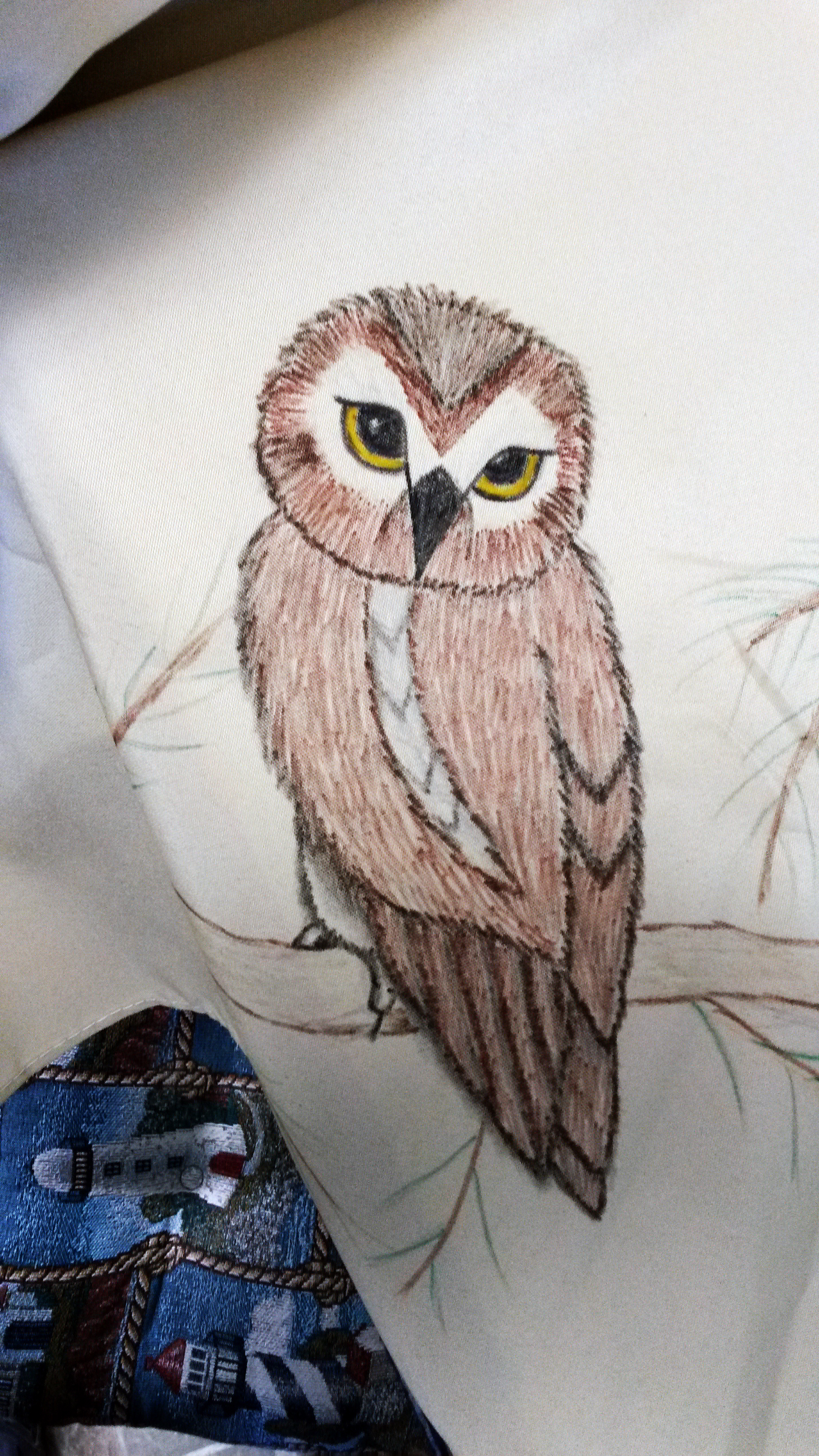
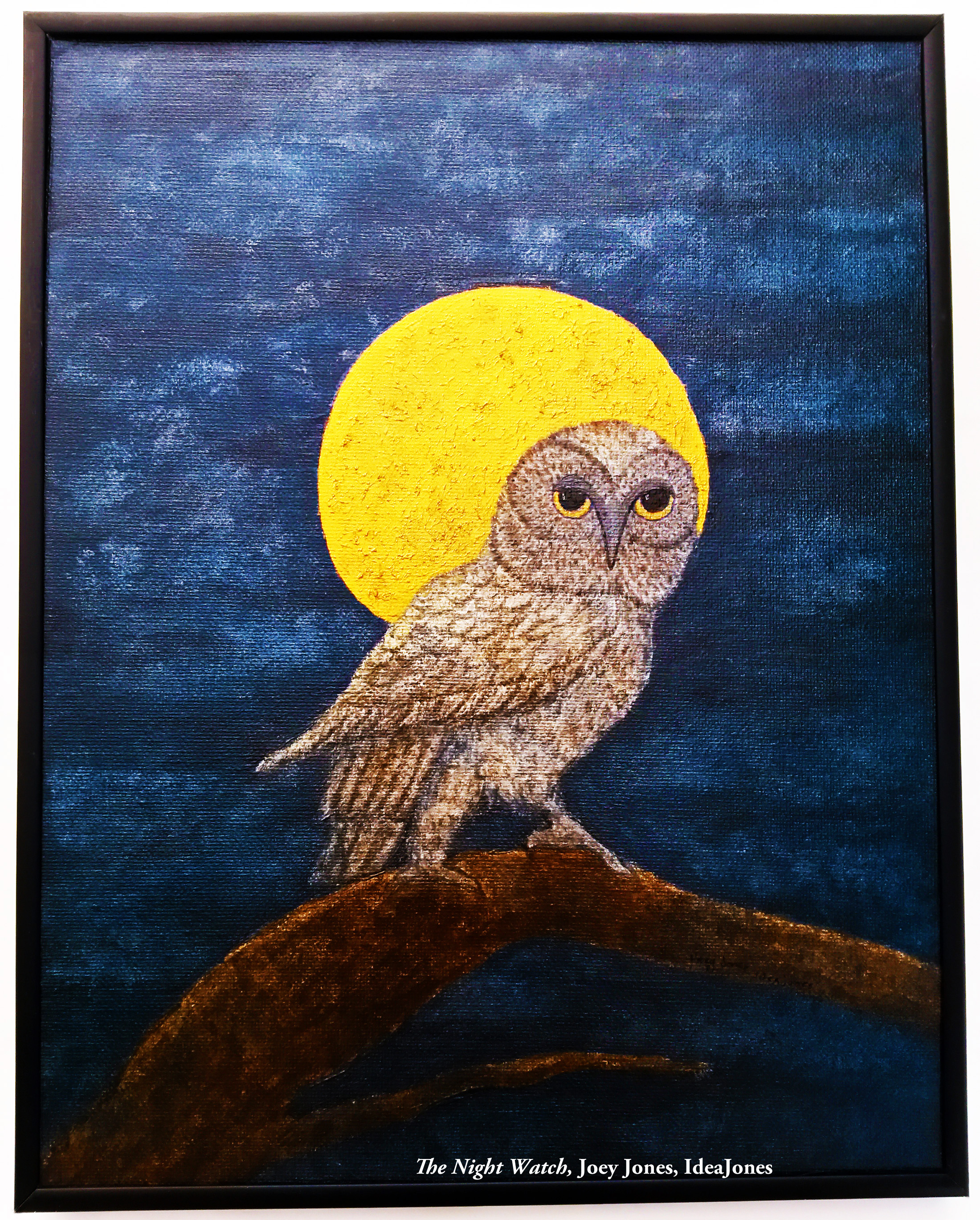
The latest animal painting, “The Night Watch,” is the first in a planned trio of paintings featuring owls. I’d painted an owl before, in a hurry, for a charity fundraiser, and on a 9-foot market umbrella at that (first time for that, too): Detail from the beginning of a 9-foot painting of owls and their prey.
This is an early sketch for the finished painting, which featured owls and their prey catching sight of each other. At the time, I hadn’t planned to paint another owl, but then an idea started rolling around in my brain, an owl dancing.
A painting and poem from our Redbubble.com shop.
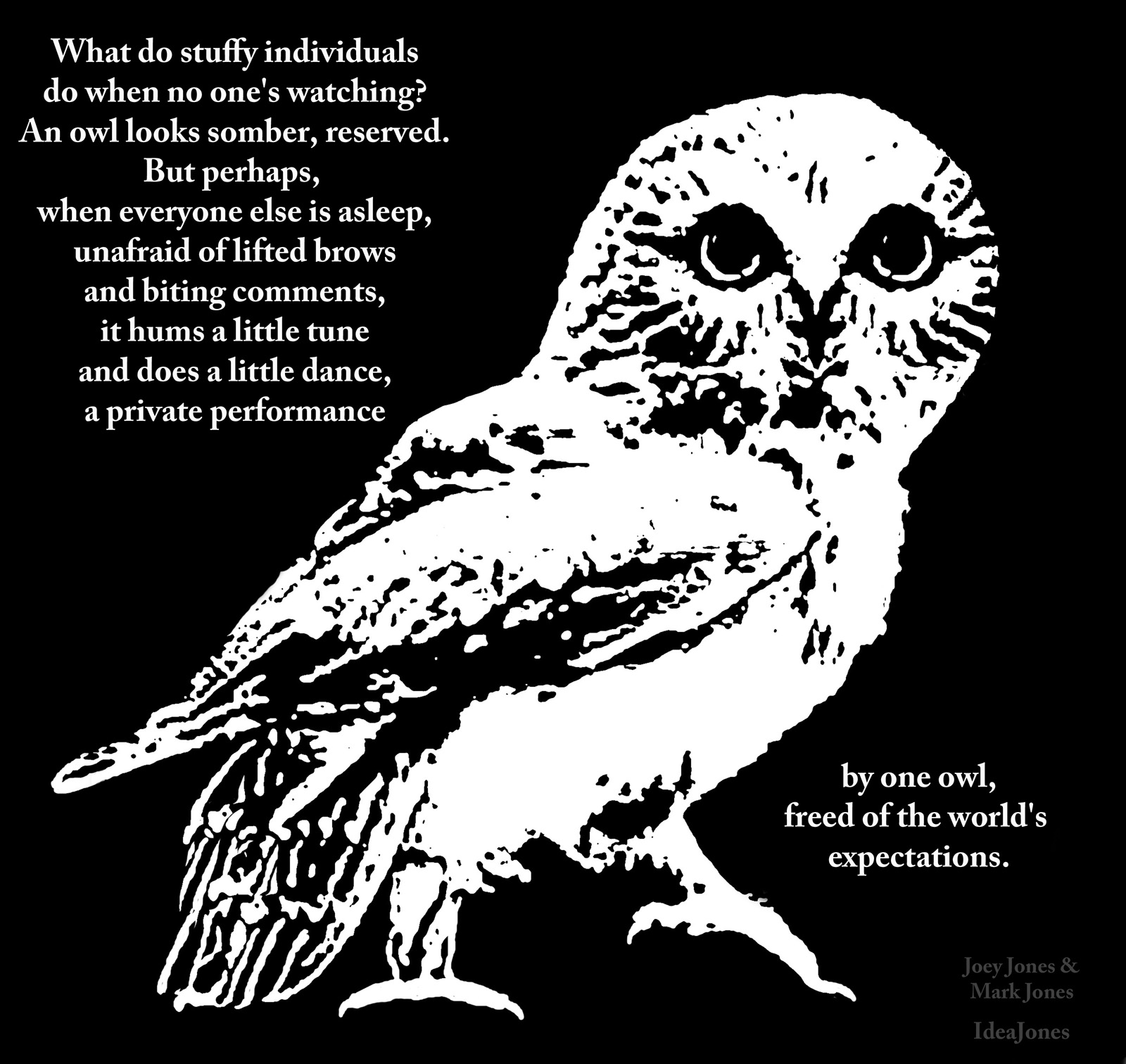
When i finished the painting, the poem came into my head while I was looking at it. I think most of us feel we have a secret self, and that self has the potential to do things very different from the things others expect.
So that led to an image of that same owl, about to take flight.
The moment just before takeoff. Ready to fly, but not yet in the air.
In the end, I liked the idea enough to create the full painting in color, that moment just before vaulting into the sky, one last look back before launching.
The first in a trio of planned paintings featuring owls, here an owl pauses before taking flight.
Each owl informed the next. Now The Night Watch is set to be in a show, and over the summer I’ll complete the series. It’ll be interesting to see where my owls are by the time I complete the last one.
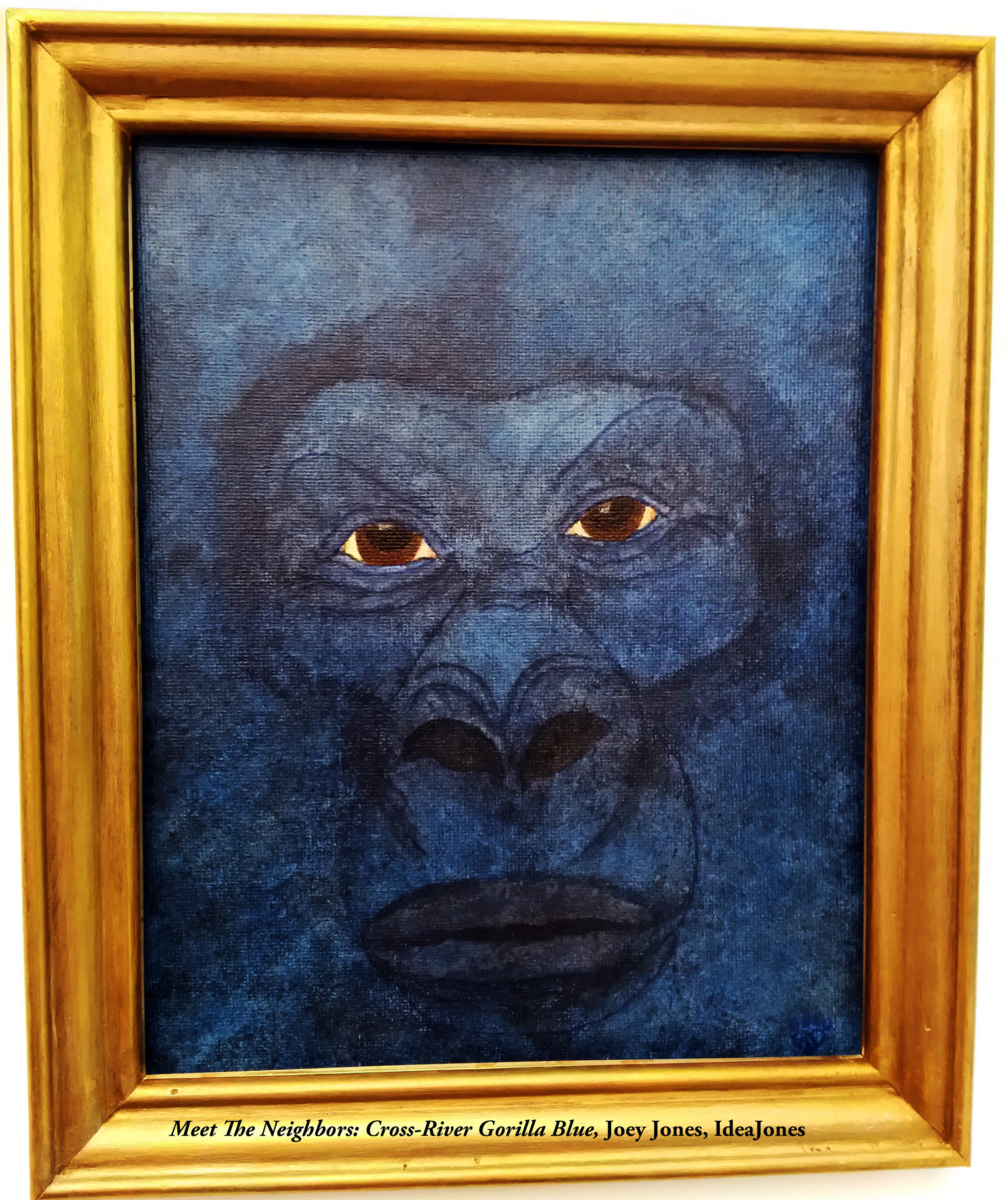
Two of our paintings, Cross River Gorilla Blue and The Night Watch, are on exhibit at The Art League of Lincoln in Lincoln, CA (580 Sixth Street, Lincoln, CA).
There’s a reception (free and open to the public) on Saturday, June 11, from 5-6:30 pm, and the show runs through July 9. If you get a chance, check it out — it’s a show of animal-themed art and promises to have some beautiful work. Beyond the reception, the gallery is open Wednesday through Saturday from 11 am to 3 pm, and admission is free.
It’s a high when a work gets accepted into a show, and when more than one is accepted, it’s an amazing feeling. We’ve shown two other works in this space (a digital animated video and a digital painting) and it’s a lovely little gallery, tucked into the historic district in Lincoln.
The first painting, Cross River Gorilla Blue, is part of the Meet The Neighbors series highlighting endangered species. The Cross-River Gorilla is highly endangered. All of the paintings in this series are confrontational. It’s a member of the species looking the viewer in the eye, making him acknowledge who and what is going to be lost, not a vague thing, “some sort of gorilla,” but this individual gorilla.
The Night Watch is the first in a trio of planned paintings featuring owls. I love the symbolism of the owl, guardian, guide, keeper of wisdom and secrets. I also love the look of owls, wide-eyed, solid, both soft (those special feathers, designed for quiet flying) and sharp (beak, talons). Symbolically, they’re a reminder that knowledge and wisdom have opposing sides, dark and light, soft and sharp. Sometimes you learn things you’d rather not know, and the knowing, even if good for you, can be painful. Some information is beautiful, some is not. The duality of knowing is embodied in the owl.
More information on the show is available at www.all4art.net.
The first in a trio of planned paintings featuring owls, here an owl pauses before taking flight.
As we gather information from those who know about promoting artists and arts groups, we’re sharing them. May your art thrive!
Here’s the final dispatch in this series (until we learn more)… the last part of Why Should Anyone Give A Rat’s? Advice Gleaned From The Gatekeepers:
3) Know who you’re talking to.
Before you submit a story idea or send a press kit, pay attention to what is on that station. Read that publication at least once and pay attention to what is in it, including the ads. Look at the website. How is it written? What does it talk about? That gives you clues to their target audience. How well does that mesh with the target audience for what you’re promoting?
If it’s not a natural match but there’s something special, that’s your hook. Your ballet recital might not be what your average reader of Biker Bar Monthly is looking for… unless your event is Ballet and Bikes and your dancers will be performing with, or around, motorcycles. Not that there aren’t motorcyclists who like the ballet — but as Mom used to tell me, “You shoot ducks where ducks like to gather.” Your chances are better in a setting that is more in line with the style of the event.
I’m told that if you pitch something that isn’t obviously for that publication, show or website without making the case for why it really is a good fit, that’s a big red flag.
Also, for local stations or publications, pay attention to what your local connection is. If you don’t have any, you don’t, but if the director, or a performer, or the writer, or the artist was born in that area, lived in that area, had parents who lived there, something that connects it to that area, feel free to mention it. Not belabor it, but mention it.
4) Remember what you’re up against.
Don’t let it stop you — just don’t forget it. In any midsized city, there are many, many events happening almost any week in the year. That’s your competition for time/space/attention. So do your homework. Which leads me to the last one for now:
5) Follow the *&#(#! instructions.
Contact whoever the way they want to be contacted. There’s not one magic format. Some like email, some like snail mail. Some have an online form to fill out. Whatever it is, show the basic respect of paying attention and following instructions.
Any show or publication gets many pitches for stories, for calendar items, for PSAs. The instructions aren’t meant to make your life difficult. They’re meant to help smooth the flow of information coming in. That’s how they are set up to handle incoming information. No point railing against it. Show that you value the chance to promote your art, your event, your performance.
Actually, that’s the biggest complaint I’ve heard. The #1 thorn in the side of gatekeepers — people who don’t bother to do the homework or follow the instructions. Do that and you’ve just increased your chances of a favorable reception.
There are no guarantees. You can do everything right and still not get it every time. But you can increase your chances. Good luck!
As we gather information from those who know about promoting artists and arts groups, we’re sharing them. May your art thrive!
Continuing with Lesson #2, Why Should Anyone Give A Rat’s? or What The Gatekeeper Wishes You Knew:
2) Think like your audience.
A producer put it best… “Put yourself in my listener’s shoes. Why should he care?” I’ve been told one of the biggest mistakes made by people looking to get an event, or their work, mentioned (or that golden holy grail, coverage, with an interview and everything) is that they assume everyone will automatically grasp why it’s fascinating.
Uh… no. First off, nothing is universally interesting to everyone. And chances are the person reading your press release or the person listening to that radio station knows less than you do about your event or the topic in general. Maybe nothing at all. She has no idea why she’d like to hear your lecture on 15th century art or listen to Seymour Garbick play French country tunes on his oboe.
If you already like Seymour Garbick, or his music, or French country tunes, then yes, all you need to hear is that there’s an event with that involved, that you can afford, at a date/time/location available to you, and yay, you make plans. But an any artist or arts group survive only on the support of people who already know about it? What about people who don’t know much about it but might be willing to give it a try?
When you’re in your car, what grabs you? What hooks your interest? Don’t assume that the public just needs to hear about your whatever to be fascinated. You should be able to explain in one minute why it’s interesting. You can expand on it, but there has to be a core. Is Seymour playing a song that hasn’t been played in 100 years? A song that’s played a lot, but Seymour happens to be the composer’s great-grandson? Or is Seymour a brilliant musician with a great reputation? Somewhere, there’s something about Seymour, or the music, or the oboe, or something that makes his performance different from the others happening that week.
Remember that unless you’re talking to the people at Seymour Garbick Oboe Performances Monthly, your first hurdle is a Gatekeeper who may not know anything about any of that, who is looking for things of interest to other people who may not. Remember that story about the concert by the elderly guitarist? If you hear that he’s playing a song that is almost never performed, or that he taught someone well-known, or that he’s an expert but there are few chances to hear him play live, you might be more likely to pay attention, and go. Certainly the Gatekeeper is more likely to see why it might merit coverage.
As we gather information from those who know about promoting artists and arts groups, we’re sharing them. May your art thrive!
Let’s call this one Why Should Anyone Give A Rat’s?
A conversation I had with someone at a gallery today brought back conversations I’ve had in the past with “gatekeepers,” the people who decide whether or not to cover something. These are editors, producers, reporters, critics — people who look at your press release, press kit, what-have-you and decide if there’s a story there. If they don’t see what will interest a reader, listener or viewer, your event won’t be mentioned.
I’ve been given some pointers on how to make a project, or event, more appealing to a gatekeeper. I’m sharing what I’ve been told in hopes some of it will prove useful (and so I remember it myself). The idea of this lesson breaks into a few parts, so we’ll start with: How are you saying it?
An idea can be more or less interesting depending on how you put it. I don’t mean “spin,” that manipulation that seeks to gild cowflops and call them gold nuggets. I mean looking at your event for what is new, unusual, or interesting about it. For example: I recently spoke with a man who organizes concerts and musical performances for a nonprofit. He was frustrated by their low success rate at getting noticed in the larger arts scene in the region.
So we talked about a recent event he’d worked on, a concert by an elderly guitarist. Sounds ripping, right? Well, I asked a few more questions and using the techniques I’d been taught, the concert with the elderly guitarist became a “rare performance by an influential musician, an expert in classical and flamenco guitar…” All of which was true. The man rarely performs any more, and was a teacher who influenced other up-and-coming musicians, including one who opened for him.
Not spin — what you say must be true and defensible. You should be able to make a strong case for what you’re saying if you need to. Look at your subject. What’s unusual about it?