IdeaJones

Category: Uncategorized

Etcetera:

  • Second Amendment Gun Control

    Motivational Monday The Value of Life IdeaJonesSo many people have weighed in on the recent shootings. I’ve had to go on a “news diet.” After a while, the details, the repetition of what happened, it all becomes overwhelming. And I’m basically a busker. I sing and dance on the boardwalk for spare change, metaphorically. Who am I to add to the babble?

    But we have to speak out. We have to have a babble, and more than a babble. We can’t afford complacency.

    Over 370 shootings in America last year that had four or more victims each. More than one a day. Most of the answers will doubtless be hard to come by, and someone won’t like whatever it is. But there are a few things we should do right off.

    Ban assault weapons. Understand that I grew up the child of a military vet who collected guns. I learned target shooting when I was so little I had to lean against something so the kickback wouldn’t land me on my butt. Half of my childhood was spent in NRA country. And I’ll tell you a truth — guns are fun. They’re often even pretty. You want a rifle to hunt or a handgun for target practice? Go for it!

    But. An assault weapon is not a hunting weapon. It has one purpose — to kill human beings, many of them, quickly and efficiently. And nobody who isn’t active military or police needs one. Nobody. The Founding Fathers could not have envisioned such weapons when the Second Amendment was written.

    And while we’re at it, the Second Amendment reads, “A well regulated Militia, being necessary to the security of a free State, the right of the people to keep and bear Arms shall not be infringed.” If you’re a strict Constitutionalist, you can’t escape the fact that it starts out with the words “A well regulated Militia…”  Not just “regulated” but “well regulated.” In other words, there was no thought of just anyone being able to just own anything. If you wanted to have a gun, you were going to be regulated.  We didn’t have a standing army as such, so the idea was that you would own a gun and be part of a state militia. Not a private one. Not one you concocted with your friends. Not an independent, private army. A “well regulated Militia.”

    If the Founding Fathers had seen assault weapons, would the Constitution read otherwise? Probably. But it doesn’t. It reads the way it does and the Bill of Rights includes rights, but also responsibilities. So let’s throw away that tired saw that the Second Amendment guarantees the right of anyone to own any old gun. It doesn’t, clearly.

    Which leads to the next thing we need to do. Whether you think Remington, Smith & Wesson are right up there with God, or you think guns are scary and make you a bit nauseous, you can get on board with one easy fix for our gun problem. Right now, the feds can put a person on a watch list or a no-fly list because he’s going to meetings where they talk about how to kill people, but they can’t stop him from legally buying a gun.

    Let’s review. Someone who is judged violently insane, who makes radical proclamations that people he doesn’t like should die, who’s looking up bomb making guides, that person can be kept from flying from Portland to Los Angeles… but he can buy as many guns as he wants and drive there.

    So how about that, for a starter? How about we get that national database going and require that anyone selling a gun, be it gun shop or gun show, refrain from selling to people on the terrorism watch list? Are there people on that list who will never hurt anyone? Without a doubt. Do those people need guns? Nobody outside of a police officer or military member needs guns. He might want a gun, and if there’s no reasonable reason why not, he should be able to buy it, but nobody needs a gun.

    Lastly, registration. Before you rip my head off demanding why you should have to register as a gun owner, explain to me why you shouldn’t? No mentioning the Second Amendment — it calls for you to be well regulated. So. You have to take a test, get a license and register your car (as well as provide proof of insurance) to drive a car legally. If you’re caught driving illegally, you will be fined (if your butt doesn’t land in jail). And a car has many non-fatal uses.

    A gun is designed to shoot stuff. It makes a poor shovel. It’s not much use as a screwdriver. It has one use, and that use is dangerous, especially in the wrong hands. So why shouldn’t you have to demonstrate that you know how to clean, load, shoot and store it safely? Why shouldn’t you have to register it? If nothing else, the money from the license fees could be put toward victim assistance.

    I could argue that “concealed carry” and “stand your ground” laws are making us less safe, not safer. Everyone would like to believe he’d be Clint Eastwood when it all goes pear-shaped but really, think about the people you know. Are there more Clint Eastwoods, or more Barney Fifes? I know people who have concealed carry permits who I wouldn’t want to have a sharp stick, let alone a gun, especially in stressful situations.  Put them in a shootout and wait for the casualty count to rise as stray bullets take people out. But that’s an argument for another day. Let’s start with the easy stuff that any rational, reasonable person can embrace. The low-hanging fruit.

    Because gun regulation is coming, neighbors. It just is. Too many mass shootings. We’ll reach a tipping point where even politicians who are sucking from the NRA like piglets will be put in the position of doing something. If you’ve ever seen what the government does when it panics, you can understand why it would be better if those of us on either side of the issue come up with some legislation we can live with and tell our states and DC what to do.

    So, in this year when “Hamilton” is all the rage and we’re experiencing a renewed interest in our Founding Fathers (and Mothers), let’s really honor our Constitution and Bill of Rights. Let’s put that basic regulation into place. Reasonable, rational gun legislation.

    Before another Sandy Hook. Before another Aurora. Before another Orlando or any of the other places where our people are gunned down.


    Save

  • An Open Letter To My Species

    Dear Human:

    We are the only species in history that gets to decide whether or not to evolve. For everyone else, environment forces the issue. Adapt or die. If you can’t deal with warmer temperatures, or colder, or migrate to a place that suits you better, or develop a taste for something you weren’t eating before, that’s it, you lose your place on the planet.

    Owing to our opposable thumbs, humans have been more successful at forcing the environment to adapt to us. It’s given us a deceptive feeling of invincibility.

    But every species has to pay its bill in the end, and if you can’t foot that bill, you either fade out or the challenge you’re facing eats you, burps and that’s it.

    One of the universe’s waiters who’s been standing around holding out a check is our tendency toward tribalism. It’s natural. You could argue that it’s the main thing that got us this far, after those thumbs and a willingness to eat almost anything. Knowing who is “yours” and who is other kept your ancestors safe enough to reproduce up until you. Tribalism has two main components:

    1. Identity – figuring out who is your tribe;
    2. Outsiders – figuring out what to do about anyone who isn’t.

    Identity used to be easy. Your tribe was the people who were born, lived and died where you did. You might not like all of them, nor they you, but some social structure enabled you to coexist most of the time with those people. You were all related by blood, then as the world grew and changed, you were all related by an idea – religion, nation, etc. Either way, for most of history, the members of your tribe looked generally like you. Your survival depended on knowing who your tribe was and what you could expect from them.

    Now, that’s a life’s quest. People move around. Is your tribe people who go to the same church, or people who like the same music, or just people who seem to like you and you like them? It’s harder to tell on sight who is “yours” and who is not.

    Outsiders – again, that used to be easier. There are three main responses to the Outsider:

    1. Kill it.
    2. Trade with it
    3. Ignore it.

    There are complications attached to all three, but while options 1 and 2 are well-known and discussed, option #3 doesn’t get a lot of coverage. We’ve always had that option. “Not like me” does not equal “and must die.” Those are two different thoughts.

    It’s not reasonable to push for a “Kumbaya-and-hand-holding” world. We’re not there yet. Too big of a leap from millennia of “Not like me so trade with it or kill it.” Even “Not like me so trade with it” is only middling embedded in our history. No, option #1 has been the preferred option too many times. From there to “Let’s all love one another!” is like asking a baby to walk to the moon. He’s barely mastered the basics, let alone conquering all the other challenges that would entail. Ask him to walk across the room a few times first. It’s hard enough to work with people you don’t like. Welcoming their presence is too big of a stretch for most of us.

    What we need to do, and it will be a conscious choice, is to acknowledge that there will always be The Other, the person who does not share some basic view on how the world works. The idea that there will always be many people not like you in really fundamental ways, that it’s a fact, and doesn’t require anything of you, much in the way the rotation of the Earth doesn’t require you to get out and push, needs to be spread until it’s part of our concept of the world.

    The next will be adopting the idea that if you can’t bring yourself to be open to those people, your response should be to just let them be is the next part. We need to uncouple “Not like me” from “so must die.” We need to tell our children, and ourselves, that we have options when it comes to dealing with people who are not like us and killing them isn’t the best one.

    If you happen to believe homosexuality, or being Muslim, or Christian, or a woman, or whatever it is you don’t like, is wrong, more power to you. We disagree, but you have a right to think that. And feel however you feel about it all. But unless they try to hold you down and make you join them, that’s as far as you get to go.

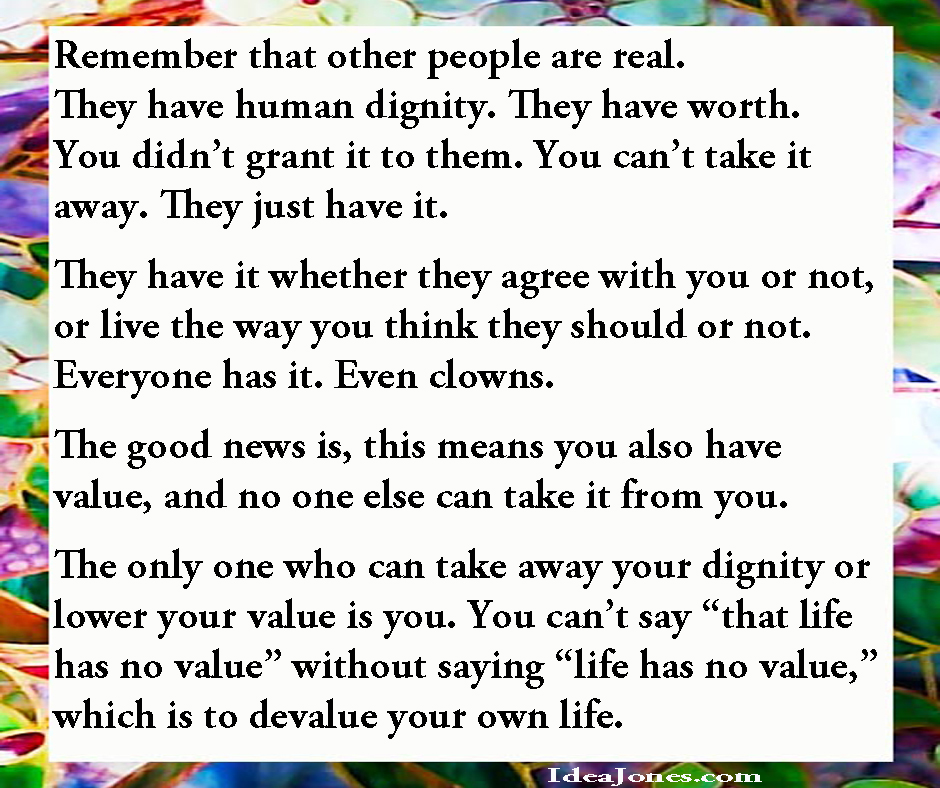
    Because they are human, and real, and have value, and that isn’t because you awarded it to them. They just have it. You don’t give it to them and you can’t take it away. If your whole ego depends on believing you run the universe on that scale, wow, are you in for some bad days. Your life now probably isn’t much fun, come to think of it – being responsible for the universe is a big, thankless task. Ask God.

    Option #1 is a lose-lose scenario. You kill, their tribe comes to kill you, so you kill some of them, so they… until there’s nobody left on one side, or both. Guess again if you think that mean your side is victorious. The land you depend on to live will be decimated. Many of your own, maybe you yourself, will die. It won’t change the other people. It may convince still others to side with them. You will lose all of the things they know that might have made your life better. Even if you are the ultimate victor, your wounded tribe will inherit ashes. It’s a zero-sum game.

    And if you think God is waiting to reward you for killing His creations, you need to ask who has been “interpreting” your sacred texts and what’s in it for them – because you are being played like a cheap flute by someone who is using you for his own power and ego gratification.

    We have a choice here. We can opt out of evolution, choose to remain not only tribal but violently tribal, and end up in the garbage heap of history, played by people who are using our fears and prejudices to control us for their own gain. Or we can nudge ourselves forward, determined to allow people who are not like us their human worth.

    We can try for Option #2 in the hope that this time, it’ll go okay, and make our fallback Option #3, which leaves us alive to pursue our own paths. And if you really don’t like the other tribe, feel free to feel that way. Not like them to your heart’s content. But don’t flash it in their faces, because that’s rude and if you’re really superior, you aren’t rude. And don’t kill them, because that’s stupid and how can one be both superior and stupid?

    Let’s just decide to grow up. As individuals and as a species. If we manage it, it will give us more time to do other things that are a lot more fun.

  • Tips For Creative Types — Entertainment Sites and Artist Pages

    As we gather information from those who know about promoting artists and arts groups, we're sharing them. May your art thrive!
    As we gather information from those who know about promoting artists and arts groups, we’re sharing them. May your art thrive!

    Entertainment Calendars
    And Artist Pages

    Do you play music, write, dance, act, draw, sculpt or otherwise create? Do you give readings, show your work or perform? Do you have an Artist page on the entertainment websites that serve where you are?

    If not, you really should. Take Eventful.com for example. It’s a searchable site with information on entertainment options, used by residents and visitors to find that “something to do” we all look for from time to time.

    I just figured this out recently. On Eventful, you can create an account that lets you list events, but what some people don’t realize is that you can also create an Artist page. This is a chance to get your work, and yourself, out there, and a chance for cross-promotion. You see, when someone lists an event in which you’re participating, if you’ve told them you’re on Eventful, when they create the listing they can tag you as one of the people participating. You can only tag people who are on Eventful. When that person tags you in the listing, the event appears on your Artist Page as well as on Eventful’s searchable database. Someone looking at your page will see the event (good for the event) and someone looking at the event will see you.

    People can event click to say that they’d like to see you or your work where they are. If you get enough interest, you’re in a good spot to tell a venue or organizer in that town that there’s a demand to see you.

    Go to Eventful.com. If you haven’t set up an account, do. Then click on “My Eventful.” At the bottom of the page on the right, you’ll see “Add Stuff.” One of the options is “Add Performer Profile.” Click on that and follow the directions.

    There are other entertainment websites that also allow Artist pages. If you’re not listing on the entertainment calendars and websites that cover where you or your work will be, it’s time to take care of that. People can’t want to see your work if they don’t know you exist! Here’s a link to my new Eventful page so you can see what it looks like: http://eventful.com/performers/joey-jones

  • Arts Life – Dispatch From The Trenches

    Arts Life – Dispatch From The Trenches

    Mistakes You Could Be Making 1 IdeaJones
    Mark and I once attended a panel discussion for writers on gaining attention for projects from the media. Editors, news producers, and people who were good at promoting their projects talked about how to approach the media when you want to get your project in front of the public.

    Then I agreed to help a few artists with their online promotion. I knew a bit about it, but sought guidance from people who were professionals on how to go about it.

    I’ve been gathering information on promoting yourself, or your arts group, on a limited budget. Today, I was speaking with representatives from a few local arts groups about what I’ve learned. Disclaimer — I’ve been good about doing these things for other people and not as regular about doing them for myself. I’m working on that. It’s a learning process, and I’m always learning. I’ve seen these things work. In this and future posts, I’ll share the lessons my teachers give me. Some of the information may be familiar, but there’s probably at least one tip that will help you better navigate the choppy waters of promotion. To start, a few basics:

    1) Take advantage of your opportunities.

    As I like to tell performers and artists, “People can’t want something until they know it exists.” They may have a vague idea they want something, but they can’t want to come to, say, your concert if they don’t know you, or the concert, exists.

    Increasingly people go online when looking for something to do. There are online events calendars like Eventful, and here in Sacramento, Sacramento365. Many local radio and tv stations, newspapers and magazines have their own online event calendars where their listeners, viewers and readers go to find entertainment choices. These are usually free to use. If you don’t have a budget large enough for advertising, or even if you do, you should take advantage of these services.

    Your local television station may have a morning show. Watch the show. See what they include that isn’t news, weather or traffic. Note how long the show is — longer shows often have guests in after the first half hour or hour is done. A two-hour show has time to fill every day, five days a week. More about this in another post.

    2) Understand what you want.

    For example, at our local public radio station, nonprofit groups can:

    1) Apply for PSAs (Public Service Announcements, very short on-air mentions of upcoming events),
    2) Post events to the Event Calendar (this one’s also available to for-profit groups/performers),
    3) Pitch events to a locally-produced show to be the focus of a segment on the air (more about this in another post).

    Applying for each of these is a separate process and submitted individually. If you only want to post to the calendar, you can do just that. If you want to be on the air, either with a PSA or on a show, you submit for each of these separately and it goes to a different person.

    “Why can’t they just look at the Event Calendar and give us a PSA or put us on the air?” (Another version: “Why can’t they just read our PSA and put our event on the calendar and…”).

    Because they don’t have time. Because it’s not that person’s job (that isn’t the only thing that person does all day — it’s one of many). That station or that paper makes this available to the community as a resource. Taking advantage of it is up to you.

    3) Don’t do it at the last minute.

    Stations may schedule PSAs a month in advance. Some shows line up guests 4 weeks or more ahead — and if they have a sudden cancellation they need to fill, they look at information about upcoming events they wished they could include but didn’t have time for.

    4) Follow the directions.

    Each event site has its own format. They don’t have meetings where they all decide one way to do it. Wherever you go, there will be directions. Follow them. To the letter. It shows respect for the opportunity, for one thing.

    It really isn’t hard. Have the following information handy before you start:

    * Name of the event
    * Date/time of the event
    * Location
    * Ticket price if any
    * Where you go to get tickets (website, physical box office, etc.)
    * Organization hosting the event
    * Name/email/phone of a contact person to call for the public to call for more information (if you just want them to go to a website, fine, what’s the link?).
    * Name/email/phone of a contact person for the station, paper, etc. to contact for more info (maybe not the same as for the general public).
    * A brief description of the event that tells why it’s interesting (and by brief I mean 2-3 sentences. Some sites have a limit on characters). More on that in an upcoming post.
    * Anything people might need to know (is the venue ADA accessible? Is there free parking — and if so, where? ).

    Go to the website (for tv and radio stations, you can search “television station” and your city to find some to get you started). Click on “Events” and look for a button for “Submit your event.” Follow directions. You can post your event to several sites in an hour if you have all of that ready to cut n’ paste on your computer, or on a sheet of paper you can look at to type it in.

    5) Limit yourself.

    Unless you have someone who is organized, enthusiastic, reliable and has buckets of free time, it’s not necessary to blanket the world — in fact, starting out this can be a mistake. You want to find out which online sites produce the best results for you, and this can vary. For example, if you play classical guitar, the local acid rock station might get you a few interested people as many people like more than one type of music, but if you have a public radio station, that’s probably going to be more productive.

    The strategy suggested to me is to start out with the basics (here that’s Eventful, Sacramento365, CapRadio.org, and the local papers). Make sure you enter your events on their calendars reliably. See how things look in three months. Add another and see if it makes a difference. If not, you can probably drop that one and try another.

    Don’t feel bad about not doing more — pay attention to what you’re doing so you know what’s working for you and what isn’t.

    I’ve been given more useful information, and will share it in future posts. But in the meantime, don’t be afraid to get your feet wet. Promotion is your friend. Like any good friend, if you treat it with respect, you’ll reap the benefits.

  • A Dream Of Forgiveness

    Dream of Forgiveness IdeaJones What is forgiveness? When and how does one forgive? Are there unforgivable actions?

    I had a dream, sort of a nightmare but also seductive. Someone who had hurt me, in myriad ways, about as badly as you can hurt someone, and I had him down on the ground and I was beating him.

    Horrifying in that I’m not usually an angry or violent person, and I wasn’t just hitting him. I was pounding him, obliterating him. This was all very graphic. In the heightened awareness that belongs to dreams and a few, rare waking moments, I could feel beyond feeling, hear every gasp, grunt, rasp of fabric on concrete, the different sounds my fists made depending on where they landed. I could smell everything (better left not detailed), even taste it.

    This person is gone and has been for some time, and I’d gone through a lot of work to forgive him. A recent revelation brought all that old stuff I’d thought not just buried but dealt with, processed and done back to life.

    You see, I’d hung my forgiveness on one thought, that as sick and awful as he could be, nothing he’d done to me was conscious. Not deliberate, by choice. He was out of control, I told myself. Sick. He’d hurt me, but he hadn’t meant to hurt me. That would have made it all so much worse, if he’d chosen to instead of just blindly thrashing around. If I’d been a chosen target, not just a victim of a sort of terrible accident.

    That one idea was what I hung all the forgiveness on. It made it possible for me to forgive him.

    Years pass, he’s gone, and someone asked me a question. I answered it and in that moment all the foundations of that forgiveness crumbled. The answer to that question made it clear, beyond argument or interpretation, that at least some of what he’d done had been done by intent. Victim chosen, actions planned. Target identified, aimed at and hit.

    The foundation I’d based forgiveness on had been jackhammered, suddenly removed, sending the forgiveness toppling. Talking to him, were that possible, would have been as fruitless as it always was, after all, while he hadn’t denied what he’d done, he also never expressed any regret or guilt for it. Just anger that I’d finally told anyone. What he’d done wasn’t the problem — my talking about it was, to his mind, the problem. Not what he’d done but that anyone knew.

    And talking to him wasn’t an option. He’s gone, after all.

    I sat up in bed, shaking, angry, frustrated, frightened of the force of my own reaction. And resentful. I’d been through this before, after all. Faced the demons, forgave him, moved on. And here I was with it all to do again.

    A friend asked if it was necessary for me to forgive him again. Couldn’t I just move on? Forgiveness, she rightly pointed out, doesn’t come when you call. It’s a process and can’t be rushed. One can’t magically forgive just for wanting to.

    She had a good point. The problem is, my mind tends to circle something like this until I find a way to forgive. Until then, it just won’t let it be. My mother used to say once she got something in mind she was like a dog with a bone, and I’m my mother’s daughter. Until I found some bit of forgiveness for this person, my mind would keep turning it over, rolling it around, looking for an answer.

    I did try putting it aside. Over and over. And found myself sleepless and shaking, alarmed at how delicious I’d found pulverizing another human being, even in a dream. How satisfying I had found his screams as they became cries, then whimpers. How much I hated feeling the seductiveness of rage.

    He was a tortured, complicated, injured, sick human being. Good at faking it in public, and even in his own mind. He edited life as he lived it. You could go through an experience side by side with him and not recognize it an hour later when listening to him tell someone else about it. He would tell me things weren’t happening as they happened or that something else was happening than what was clearly going on, and believed his own lies. And the events that had been at the back of all this were ones I’d always remembered clearly (not the sort of thing one forgets, after all). It was just that I hadn’t wanted to look at them closely. It was all bad enough on the surface, but taking a closer look, it became clear that those times, and others, had been calculated and planned. I’d just avoided admitting that, because if I admitted that he deliberately hurt me, how could I love him, and I did?

    I hung all my forgiveness on believing he never meant to hurt me, he hung his existence on false memories he created for himself about who he was and what had happened.

    I got past loving him, for the most part. It wasn’t possible to forgive him at all while I still loved him and hoped that he would realize what he’d done, repent, and love me back. It was so hard to let go of that hope that I hung on to it, and him, for years, loving him and yet never forgiving, holding it for the day all was made right. In time, I realized all would not be made right. Our relationship would never be what it should be because he didn’t have it to give. I walked away, and my only regret was that I didn’t do it sooner.

    And here I am, knowing I will have to forgive him. Not because he deserves it. He doesn’t. Not because he asked for it. He never did and now he can’t. So far as I know, he went to his grave whining about how he missed me and unable to understand why I told anyone what happened. Again, for him, the problem was never what he did, it was that I talked about it.

    I have to forgive him one last time because I’m tired of carrying around this load he put on me. And maybe that’s my path forward.

    Putting it down for no other reason than because I don’t want to carry it any more. I don’t want him to control any part of who I am or how I feel. Perhaps what I’m looking for is not the forgiveness that should follow repentance. Perhaps the flavor of forgiveness I’m seeking is that granted by someone who just isn’t interested in expending energy to maintain anger or resentment.

    Forgiveness isn’t forgetness, but it is freedom. He gave me burdens. I’m going to learn to put them down and give myself release.