We went to see “Newsies,” (a Broadway musical) in a movie theater (yay, Fathom Events, bringing such things to movie theaters across America), then “Despicable Me 3.” Guess which audience deserved a standing ovation?
The Newsies screening was lightly attended. We got there early as I’d been looking forward to it, got great seats and settled in to enjoy. One group settled behind us and began a symphony played on cellophane wrappers and purse zippers. Not just “zip,” or even “zip, zip,” but “zip-crinkle-zip-zip-crinkle-zip-zip-zip!” At the last minute, in walks a group of teenaged girls. Loud teenaged girls. I was a teenaged girl. I remember what it’s like, out with your friends, having fun. But these girls were talking (loudly) about theater. Auditions they had gone to/were going to. They talked (loudly) even during the special added moments, like members of the cast of Newsies singing new interpretations of songs. The sorts of things real theater people enjoy. Which we couldn’t hear. Because of them.
Real artists respect the craft. Music, acting, painting, whatever it is, it’s hard work if you do it right, and you respect other artists and respect an audience. They have their part to play, buying tickets, paying attention, being present for whatever it is. They paid to see/hear/experience something and a pro respects that and doesn’t get in the way of it. As a friend once told someone in my presence, “Nobody here paid to see you, so sit down.”
Then we went to see “Despicable Me 3.” An audience of parents and little kids. These kids, who weren’t together, by the way, behaved like champs. Sure, they talked a bit, quietly. If they kept talking, parents quietly told them to keep it down so people could hear. They reacted to the movie, laughing, etc. But they didn’t talk loudly, or run around, or otherwise ruin the experience for the people around them. They were great. When the movie ended, I told Mark I wished I could stand at the door to the theater and thank every parent there. “There’s some rock star parenting going on in this theater,” I said.
Now, I didn’t say it for effect. It was just a comment to Mark. “There are kids here behaving better than the adults in the other theater.” I saw a dad sitting ahead of us nudge his wife. Mark told me later the man’s wife was beaming. She should be. They are raising considerate kids who know how to be with other people, enjoying and participating, without selfishly getting in the way of what’s going on around them.
Thank you, rock star parents who are taking care of business in the most classy way possible. The rest of us who share this planet with your kids owe you our gratitude.
And to those girls, just know that nobody was impressed by your discussion of what songs you plan to sing for your auditions. You were just the jerks who disrupted the movie for the rest of us.
I missed the whole 1960s-hippies-coffeehouse-folk music thing. For me, the 1960s was learning to tie my shoes (some day I’ll tell you my penny loafer story, but let’s just say it wasn’t easy to learn shoe tying when one parent was right-handed and the other was left-handed), reading, playing with my dog and trying to “fly up” from Brownie to Girl Scout. Weird my parents might have been, but they weren’t going to let their five-year-old hang out with the hippies at the coffee house. I saw that stuff on tv and in movies.
But guess what? If, like me, you missed out on the 60s or you were there and you’re nostalgic, or you just like seeing music in small venues where you can actually hear and nobody’s blocking your view by standing on a chair, you’re in luck, if you can get to Berkeley, CA. Next time you’re in the San Francisco Bay Area, make time to go to a show at The Back Room.
It’s got that funky, comfortable feeling, brick walls, sofas (they also have some tables and chairs in the back). It’s “intimate,” both in the usual way that word is used to describe a venue (small) and in a real, accessible, welcoming way. My friend Janice and I saw James Lee Stanley there (and James Lee Stanley is a whole separate post, or will be), and it was all kinds of fun. The overall feeling is of seeing a performer at a house party. In the case of James, he chatted with the audience, asked for (and got) requests… it felt more like watching a friend perform in his living room than, say, an arena show. You feel like an insider.
This is a venue that, based on our visit, deserves to thrive. It’s fairly new, so I’m hoping people get the word and try it, so it continues. If you live in the area, you’re in luck. If not, but you want to visit San Francisco in the future, make sure you bookmark their website, which is here: backroommusic.com
Back when I was a Girl Scout, I volunteered to pull the wagon full of cookie boxes if the other girl would ring doorbells and ask people to buy cookies. I like people, but I’m an introvert, and shy. Talk to lots of strangers? I’d rather step in front of a bus.
There’s this feeling, and I’ve certainly had it, that we should wait to do things until we “feel like it.” It’s not yet the time, goes that thinking, until the motivation is stronger than any reluctance we might feel.
A good friend once listened patiently as I listed all the reasons I could think of not to start a project, including how unready and nervous I felt. When I ran out of excuses, she interrupted me before I could run through the list again and said, “You’re scared? So, do it scared.”
That seemed too simple. Surely the answer was more complicated. “If it’s important,” she told me, “then it’s important enough to do it. If it’s not important enough to do it, the fear doesn’t matter. How important is this to you?”
I proceeded and the project went, if not perfectly, very well. During the project, I was nervous, elated, scared, excited, all at once. After, I was very happy I’d done it. There are no guarantees — it might have gone down in flames — but I was proud of myself for tackling something I felt strongly about.
It’s hard to explain to an extrovert, and more people are extroverts than introverts, how big a deal it is for an introvert, and a shy person, to talk to almost 600 people, even though 91% of them were receptive, everything from mildly pleased to very enthusiastic. There is not one person I met through this project who I am not glad I met. I got to meet almost 500 intelligent, openminded, caring people (and my assistant got to meet 20-30 others). If you are one of the people we gave Love Bead Safe Harbor Pins to, know that there are no words to say how happy I am that we met, or grateful I am that you listened to me, considered what I said, and decided to make your public commitment to the dignity of all human beings, even those you might not understand or approve of.
But it never did get easier, approaching strangers. Every time, I had to nerve myself to speak to people. Each encounter, I did it scared. I’m so glad I didn’t wait until I felt like it.
If there’s something you want to do, or create, and it’s important to you, don’t wait until you “feel like it.” If it’s really important to you, get moving, even if just the initial planning stage that will eventually bring your idea to fruition. Pat was right, all those years ago. If you need to do it, do it scared.
I was tired and dejected after our stop in the Haight Ashbury district. It wasn’t that people had rejected the Safe Harbor Pin — most of them had no idea they were being offered anything. They rejected me, personally. Sure, every person gets rejected, but being quickly sized up and dismissed by a hundred people in fifteen minutes is hard to take.
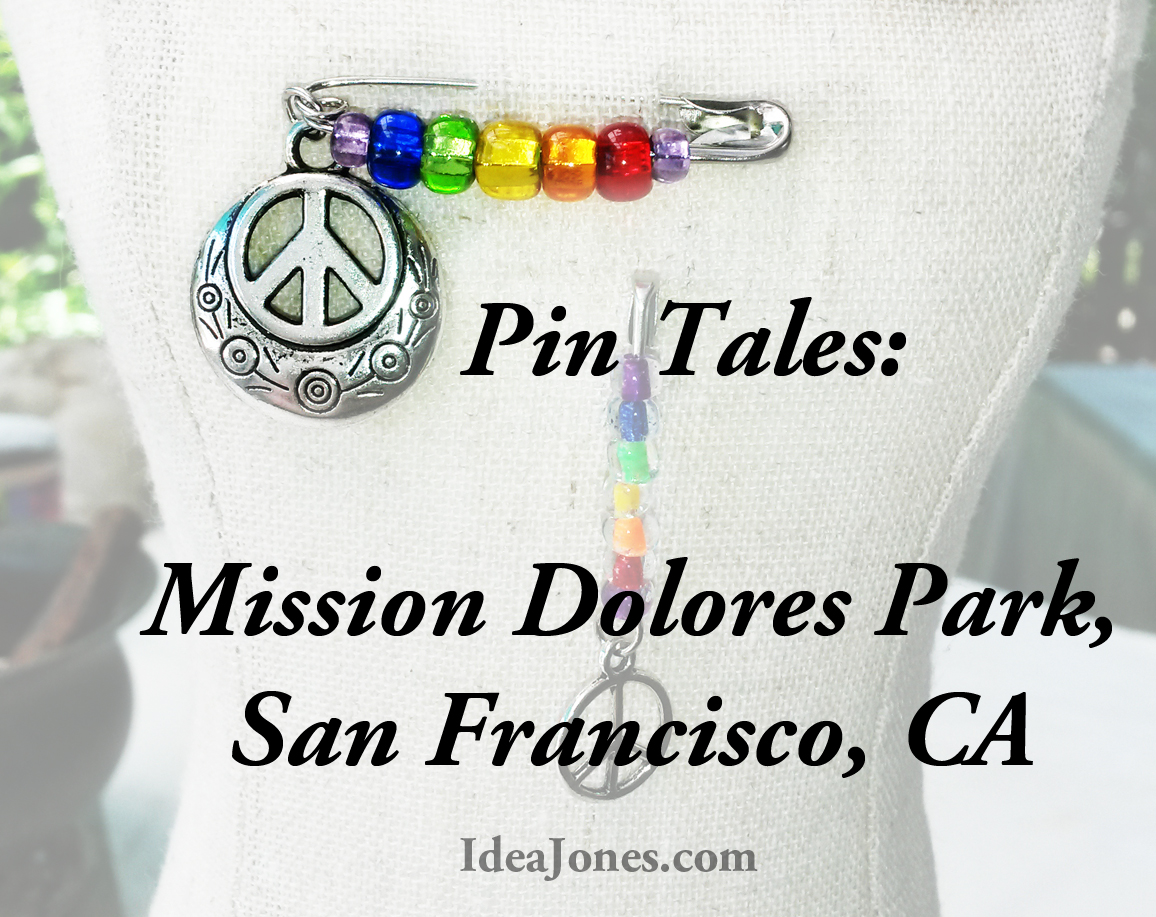
It didn’t dawn on me at the time that among people who actually gave me 30 seconds, the acceptance rate was about 85%. And those people were enthusiastic. No, in the moments after our visit to “the Haight,” I was just tired, feeling stung, and ready to go to our room. Mark reminded me that the Haight was an unusual circumstance and I should try again. We went to Mission Dolores Park, a beautiful city park that runs down a steep hill. At the top corners are concrete platforms from which you can get a spectacular view of the park and the city of San Francisco, joined by concrete walkways that meander through the center of the park to another area at the bottom of the hill with a playground and picnic area. The park was full of people in ones, twos, and groups, enjoying the sunshine and cool breeze.
Mark was right. I believed in this project and determined not to give up. I got my crutches (I’m on crutches for a walk of any real length), grabbed the bag (the wind made offering them on a tray impractical), and set off at the top of the park.
Right away, I ran into a group of tourists and their guide, on bicycles. I waited until the guide had finished his presentation and approached the group. “Would you like a free Love Bead Safe Harbor Pin? Surprised, they asked how much the pins were. I repeated that they’re free. They asked questions about Safe Harbor and the pins, selected their pins, thanked me, and pedaled away. I set off down the walkway, offering pins.
Understand, that for an introvert, this isn’t easy. Heck, making eye contact with a lot of people isn’t easy. Talking to them? Much harder. I like people, but where extroverts are energized by being around other people, introverts expend energy to be around people and recharge their batteries by being alone. So talking to lots of people can be fun, but it’s also tiring. Plus, I’m shy. So approaching hundreds of strangers isn’t the easiest thing for me to do. To stand on a corner trying to talk to strangers is hard for most people. To be curtly dismissed or passed by people pretending not to see you is exhausting.
But I’m also stubborn. Having decided this was important and I was determined to see it through, I smiled into every face I met. Some people averted their eyes, others smiled back but sped up their pace. If the person made eye contact, I offered him or her a pin. A few — very few — said “no, thanks” without breaking stride before I even finished the first sentence. That’s fine. They have the right we all have to decide who we associate with, even briefly. I don’t take that personally, although it’s tiring.
Most of the people I tried to engage with made eye contact. Almost all seemed wary at first, which I understand. By the end of the brief explanation, however, all but one reacted positively. They looked at the pins, asked questions (“Who made these?” “What organization are you working with?” “Why did you decide to do this?”). They listened to the outline of the meaning of various color patterns, and chose. I only had two people choose based on color alone, and no one who took one before listening to the explanation (in other words, just because it’s free).
A couple of people offered me money, even though they understood by that point that the pins were offered free. “I want to make a donation!” “I want to help!” I thanked them and urged them to donate that money to a charity or cause they supported. Both liked the idea — I hope they followed up on it.
I spoke with people as young as six (with parental permission) and as old as their late 60s (I don’t ask for personal information, but some people volunteer it). They were, based on clothing, accessories and volunteered information, from a wide range of cultures and economic and educational levels. Here’s a key point — in both cases, my own and the person I’m speaking with, we are probably talking to someone we would not have spoken to otherwise. We didn’t know each other. Often, we had nothing obvious in common. Everything that happened took place because we opened our walls just a chink for a couple of minutes. Here are some of the stories:
The Skaters: I approached a group of about fifteen people who appeared to be between 17 and 23 years old, a mix of races and clothing styles, some with skateboards, some smoking pot openly (thank goodness for allergy medication — I’m very allergic to marijuana). When I first approached, they seemed a bit wary, but by the end of the first sentence, one asked, “What’s a Safe Harbor Pin?” I explained Safe Harbor and the idea of “radical respect,” that we can respect someone’s humanity even if we disagree with him or don’t approve of him, and the meaning of the pin. A young man near me said, “Fuck, yeah! I want one of those!” Several of the people in the group looked sharply in my direction, probably with an expectation that the old lady wasn’t going to appreciate that “F bomb.” I laughed, and they laughed. He accepted the bag of pins, chose one, and at my request, passed it around. We chatted about respect, who we get it from and give it to.
Another young man skated up to the group. He noticed the packet in the first young man’s hands and asked about it. Before I could say anything, the first man said, “It’s a Safe Harbor Pin.” He went on to explain the ideas of Safe Harbor and Radical Respect, and read the explanation on the back of his pin package to the newcomer. One of the girls said, “So are you for respect, or what?!?” The second man said, “Bitch, yeah! I’m all over that!” Then he glanced at me. I looked solemnly at the first man and said, “True, he’s calling you a bitch, but with great respect.” We had a chuckle and continued passing the bag around.
As I said goodbye, I asked if everyone had a pin who wanted one. A young woman in the back (so uphill from me) said quietly that she hadn’t gotten a pin, so I went up the hill. We chatted about the project as she selected her pin set. She wished me good luck with the project and I went on to the next group.
At another place in the park, near the playground, I approached a young woman with two children, a boy and a girl, about six and eight. I offered her a set of pins, and the kids swarmed up to look in the bag, all bright eyes, energy and curiosity. Mom translated my explanations and she and the kids picked out pin sets. Mom cautioned them that the pins are sharp, but if they could take it seriously, they could have pins. We chatted for a moment, and as I wished them a good weekend and turned to leave, the little boy jumped up and shouted, “You have a good weekend! And a good summer break!”
A man and woman sitting at a picnic bench with a young girl heard my “spiel,” and accepted pins. As they looked through the bag, the man picked up a rainbow set. Before I could explain the LGBTQI significance, he laughed and said, “You have the flag (the rainbow flag, seen around San Francisco)!” He then selected a different set, saying, “It’s obvious that I’m gay. I don’t need to fly the flag on my shirt.”
Which is a good point. To me, being, say, homosexual is one facet of a personality, but by no means the only, or even most important, thing. It’s information, like height or eye color, but we are all so much more than any one thing.
A group of nicely-dressed teen girls listened to me, smiled broadly, and selected pins. Like everyone else I encountered at that site, they seemed to select pins based on the meaning more than the color. One looked up from the pins and said, “This is a good idea.”
I think people respond to this on an almost subconscious level (more about that in another post). One woman at another site said she was happy to have a name to give the ideas (safe harbor and radical respect), because that makes it easier to talk about it. When we give something a name, it’s easier to bring it up and talk about it than if you have to form the concept as you’re talking.
By the time my husband picked me up at the bottom of the hill, I was sore but happy. I met young mothers, kids, older people, young adults… and most of them were interested in the idea of Safe Harbor and standing up, in a quiet way, for the idea of respect. Those people turned my day around, and I was ready to have some lunch and prepare for the next day.
The schedule for the 500 Safe Harbors pin event is coming together (more on that in a second). But just in case you’re new to the Safe Harbor movement…
Safe Harbor is an idea that came to us from Great Britain (as did scones, which are wonderful, and tea, also great). People started wearing plain safety pins to signal that they were safe to approach, wouldn’t harm or be abusive toward you… that they were “safe harbors” in the social sea. I started wearing one after friends reported they or people they knew had been abused or threatened. They signal your commitment to treating people with respect and courtesy.
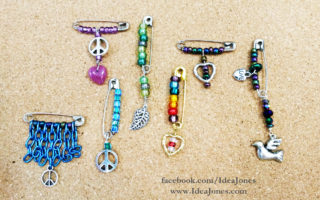
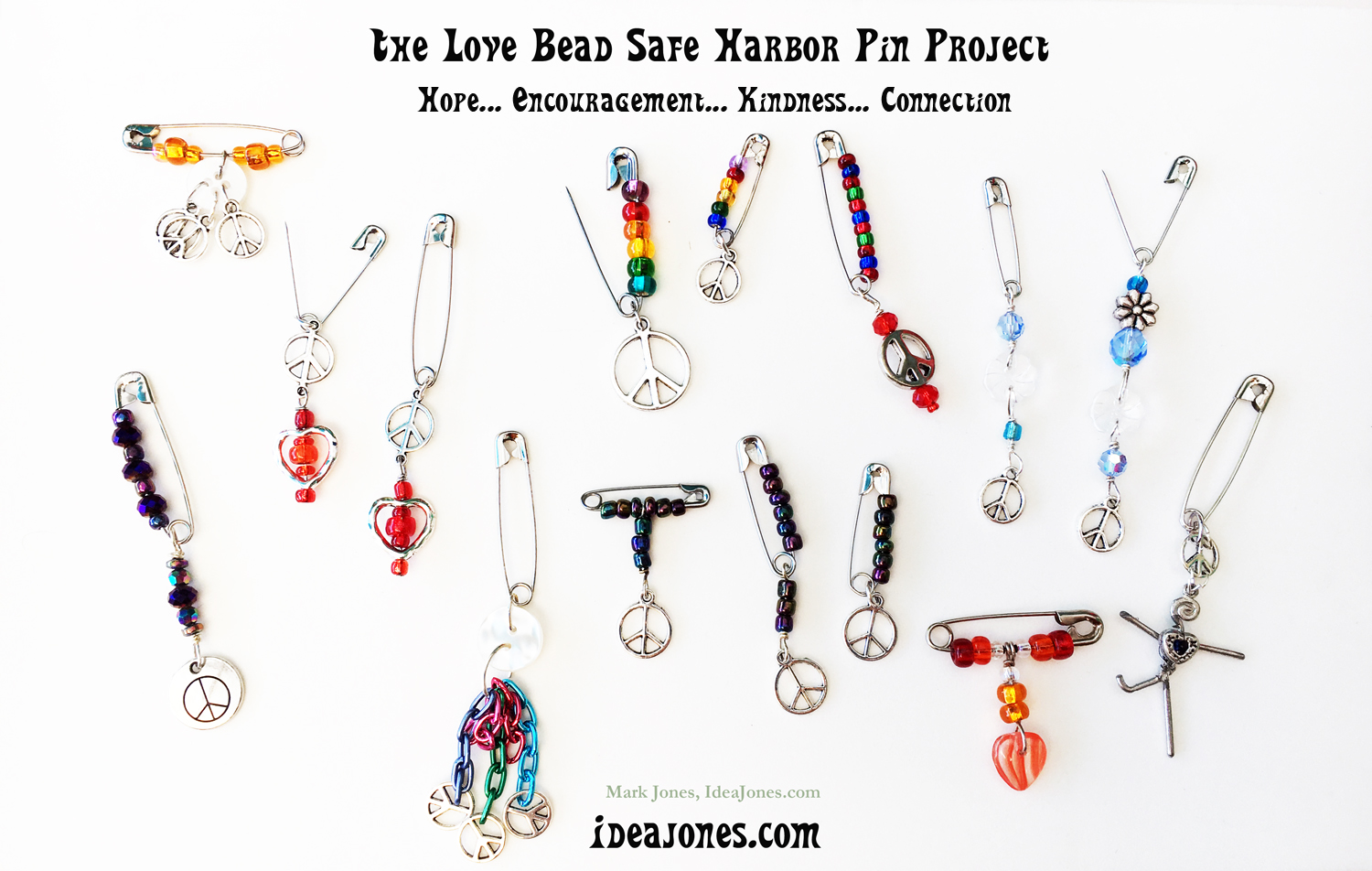
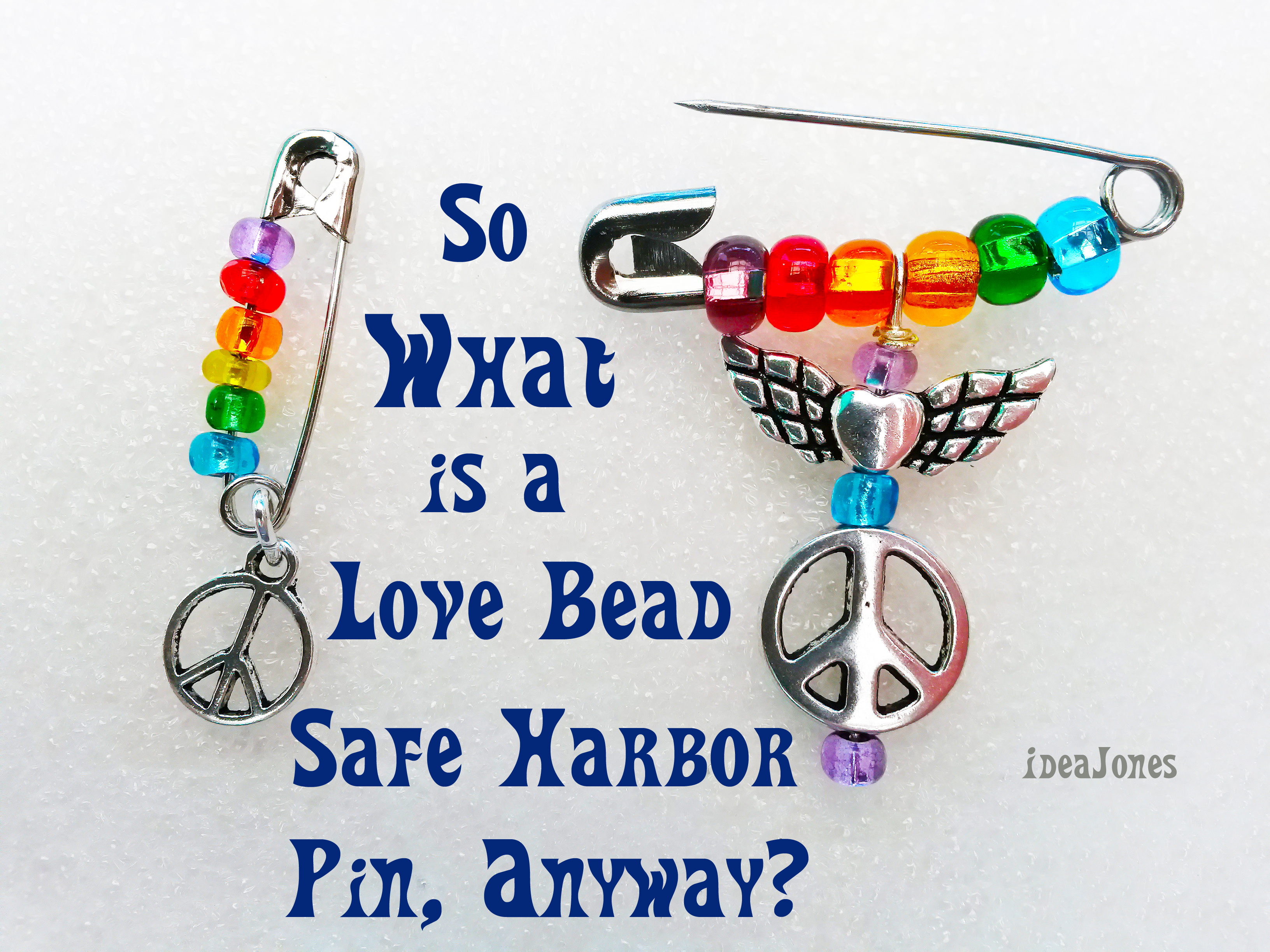
Then reports started of white supremacists wearing plain safety pins. So I, and others, started decorating our pins, taking back the symbol. After quite a few conversations where I was asked to explain Safe Harbor, and ended up giving up the pin I was wearing, I began carrying a few in my purse wherever I went. If asked about my pin, I’d explain the idea of Safe Harbor and offer the person a pin. I put them on old business cards in little gift bags to tell the recipient “this is a gift, a bit of my time given to you.” Thus they became “love beads” as well, an idea that came out of the 60s, hand-beaded jewelry given to express friendship and good wishes.
On a vacation, we met a young man who asked if I understood the significance of wearing a safety pin. I told him I did, and had made that pin, and offered him one of his own. Later, he showed me the hat he wears when he’s off work, with my pin front and center. He asked to hug me and said he was going to tell his friends about this. I determined to make more pins and give them away, spreading the idea of Safe Harbor.
I made 100 pins and went out to give them away, no small task for an introvert. I was prepared for it to take hours, or even to come home with many of the pins. They were gone in 15 minutes.
Now, I’m getting ready to try to distribute 500 pins in one weekend. You never know how people will respond, so I’m mentally prepared to come home with some of the pins. Talking to at least 500 strangers in one weekend sounds like trying to climb Mt. Everest with one foot in a cast (did I mention I’m an introvert?), but it’s happening. Here’s why:
At least 500 times, I’ll be spreading the idea of Safe Harbor. Tossing my pebble in the water and hoping some of the pebbles create ripples that spread. That people will consider, even if for a moment, that we have options in any interaction with others. We have the option of treating other people with respect and courtesy, even people we disagree with, or don’t like. If we don’t choose that option, it’s a choice to do whatever we do instead, because we could have chosen respect. People will have a choice of how to treat me, whether they accept the pin and hurry on, don’t accept the pin and hurry on, argue with me, talk to me, whatever. At least 500 times, I’ll be offering them an opportunity to stop for a moment and choose.
When I give pins away, I do not solicit, nor do I accept, donations. People can choose to go online and sponsor a set of pins to be given away (and get a set for themselves), but in person, it’s a gift, from me, or from me and the person sponsoring that set of pins, given and accepted freely. I don’t ask where the recipient is from, what their politics are, who they sleep with, or what they believe. I only ask if they would like a free Safe Harbor pin. This is an apolitical movement.
It’s simple, really. I’m advocating for what my mother would have called “simple decency and good manners.” She was a real fan of good manners. As a work of art, it’s about choice, and consciousness. That we choose how we behave and react. Mom used to say that how you treat someone says a lot about who you are and who you want to be, far more than it says about the other person. This will be 500 little nudges, 500 opportunities for people to choose who they will be.
I’m doing my largest event yet in San Francisco to mark the 50th anniversary of the Summer of Love. Specifically, I’m honoring the people who came together to help the kids who arrived in San Francisco with no money, nowhere to sleep, no support system. Crowds of them descended on San Francisco in 1967, and the city wasn’t prepared for an influx of unemployed, broke kids. So people in San Francisco organized food, clothing, health care, help finding shelter, etc. That, to me, is the real beauty of the Summer of Love.
Here’s the schedule so far. This event will be in San Francisco, CA on the weekend of June 2-4, 2017:
Friday, June 2, 1-2 pm : Haight Ashbury Free Clinic, 558 Clayton Street. Celebrating their 50th anniversary this year, they help many of the poorest San Franciscans. I’ll be out on the street for one hour, giving away pins. Feel free to stop by, get a pin and say hello!
Friday, June 2, 2:30-3:30 pm… meeting up with some tour groups on a Summer of Love tour. Wish I could say where, but the Parks Commission has asked that I not advertise. But if you see me, come on over!
Saturday, June 3, 10-11 am… oooh, another park appearance, can’t say where! Silly, I know, but those are the rules, so if you’re interested, check your favorite SF park and you might find me.
Saturday, June 3, 1-4 pm: SCRAP, 801 Toland Avenue. The incredible recycler offering materials at low cost for artists and teachers. I’m teaching a class, open to the public, $20 including materials, on how to make Safe Harbor Love Bead pins. People who take the class will also get a set of pins from me, and if you’re at SCRAP while I’m there, hit me up for a set of pins. http://www.scrap-sf.org/workshops/
Sunday — this one is still being confirmed, but I’ll announce it as soon as it is.
If you know anyone in San Francisco, or who will be in the Bay Area that weekend, please let them know they can come to one of these events, get a set of Safe Harbor pins, and participate in a work of performance art!