Imperium Neptuni Regis: The Ancient Order of the Deep
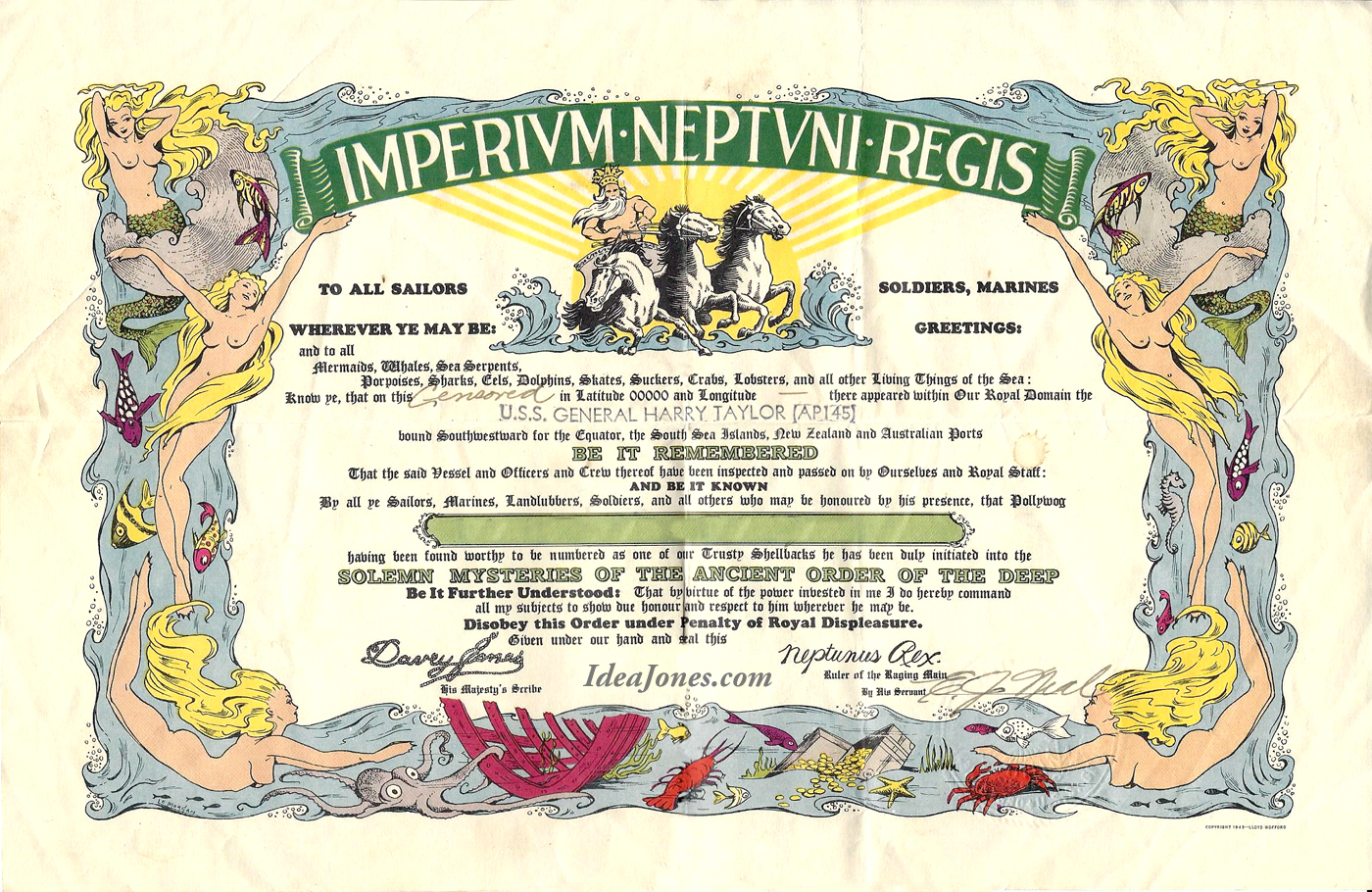
Another certificate from WWII, again from the USS General Harry Taylor (for more about that ship, see the post on The Domain of the Golden Dragon). Here, the certificate a sailor got when he became a “shellback,” a sailor who had crossed the equator. Before that, he would have been a “tadpole.”
The tradition, in addition to boosting morale, may have also indicated to other sailors that this one could handle long sea voyages. That’s something you need to know during times of war, when voyages can end up being far longer and more dangerous than expected. There can be an initiation ceremony to go with the certificate, although not always. Conditions didn’t always permit it. Some of the ceremonies described sound like the more benign college fraternity hazing rituals, with tests of strength or endurance, and a fair amount of rough-housing.
Note the women on the certificate. This being WWII, women served primarily in medical services, administration or training. They weren’t part of the ship’s regular crew. These young guys could go a long time without seeing many women, or any. So no wonder the certificate features lots of naked women. The mermaids in the upper corners you would expect to find in a certificate featuring Neptune, but unlike the Golden Dragon certificate, there are also human women swimming around naked (how are they breathing?), including two who are about to get in trouble with an octopus and a crab.
I could chalk up the representation of naked women to the era, but let’s face it, what else does a young, straight, healthy guy dream of? Well yes, food… the only thing that would make this a more complete fantasy would be if the women were naked and holding trays of steaks and baked potatoes.
The sailor who earned this (whose name has been removed for the post) was a big fan of steak and potatoes. He had his problems with women.
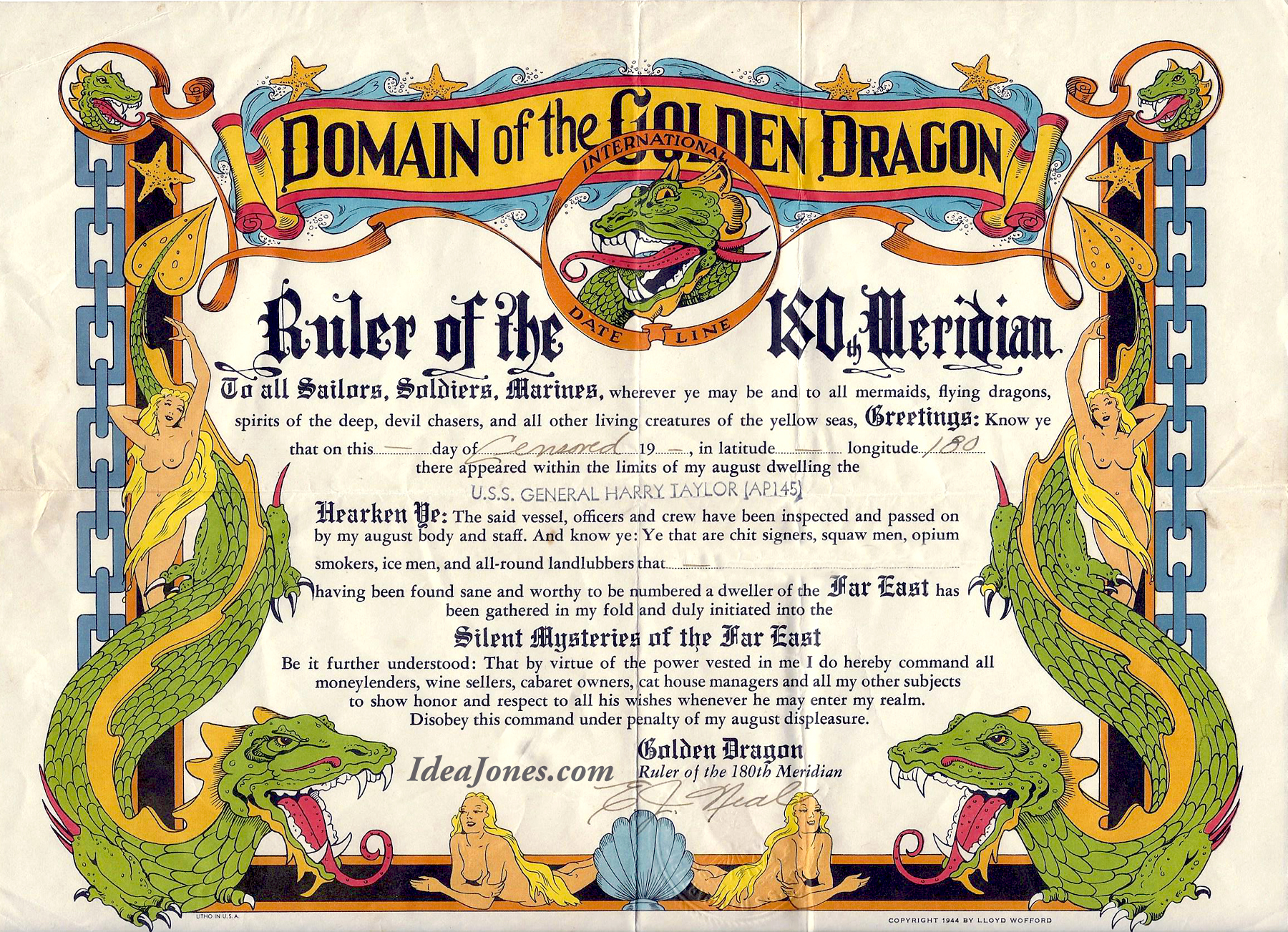
This is a certificate awarded during WWII (the recipient’s name has been removed for this picture). Certificates were awarded to Navy sailors who crossed the International Date Line aboard ship. The recipient of this certificate earned both this one and the Imperium Neptuni Regis (more about that in another post).
With so much activity during WWII, there probably wasn’t much of an award ceremony. There are some interesting things to note here, though…
The date is listed as “Censored,” and only the longitude is filled in. This is common for WWII paperwork. Security was a serious consideration (still is), and if the enemy knew where ships had been and were, they could guess where they were headed.
The ship given is the U.S.S. Harry Taylor. The Harry Taylor was a General G.O. Squier Class Transport, or troop carrier that was used in WWII from 1944 to 1946. Thousands of soldiers slept in its bunks and walked its decks en route to battle or coming home. After that, it transported all sorts of people, including refugees. It made over 30 trips ferrying refugees to their new homes, then was used to track missiles. Now? It’s part of an artificial reef helping to protect marine life.
The sailor who earned this certificate? He survived WWII, although many of his friends did not. He got married, had kids, tried to work though the problems he carried with him, some of them due to his wartime experiences. Is there more to that story? Of course. But for now, he rests, under the protection of the Golden Dragon.
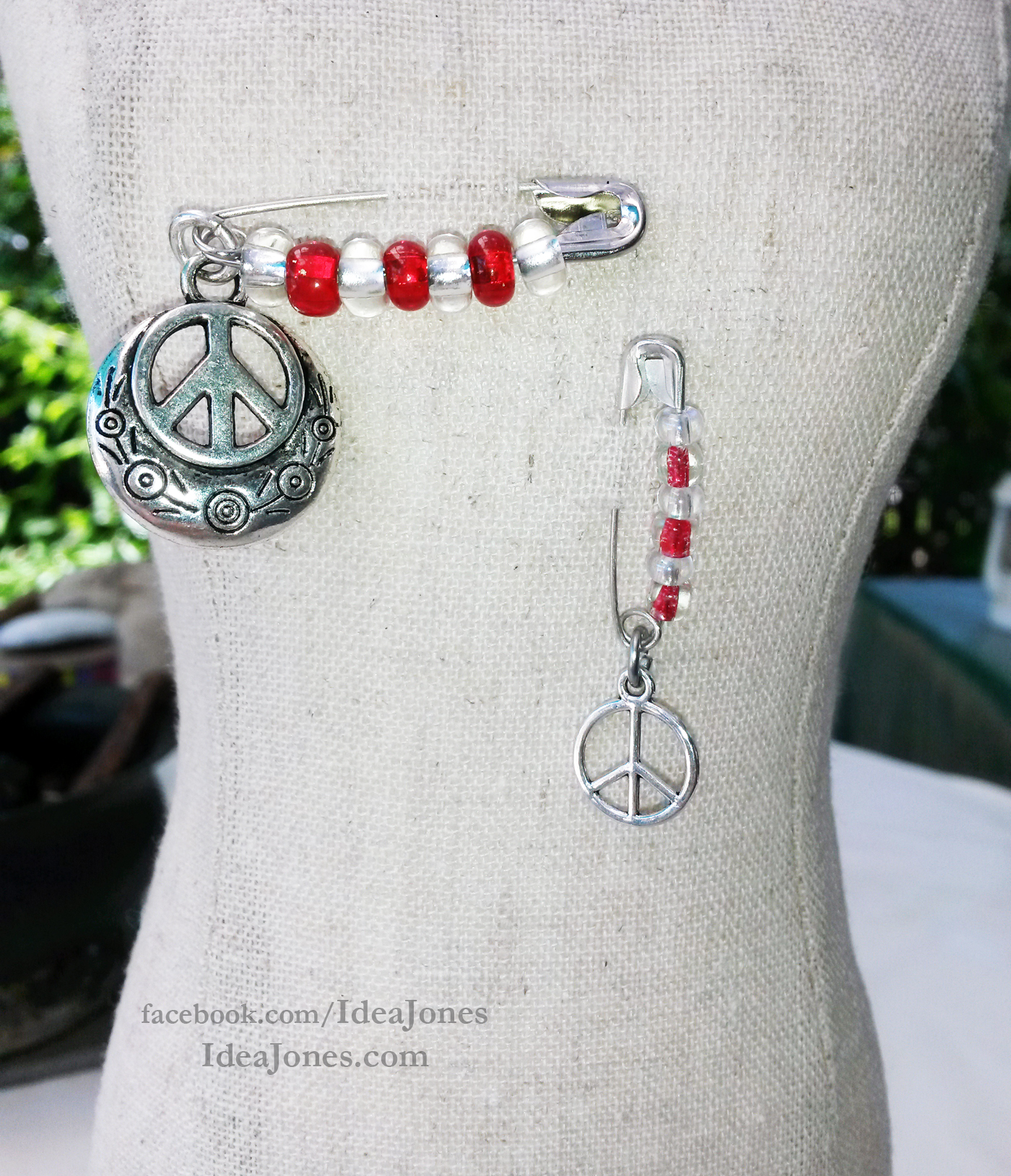
“Guv’nor,” our donation to the PAWS fundraiser, Petitecture, inspired by the auction winner’s beloved dog.
Waiting for the address to mail this to the person who won it at auction at the Pets Are Wonderful Support fundraiser in San Francisco. It was inspired by her dog, Guv’nor (who is, from the photo, adorable). PAWS is a great organization, helping people who are chronically ill keep their beloved pets. From their website:
“PAWS believes that the healing impact of the human-animal bond is one of the best supports available for medically vulnerable individuals, and mounting evidence indicates that this bond can yield valuable health outcomes. For many people, having a companion animal is part of living a happy and fulfilling life. For some individuals, especially those who are chronically ill, frail, and isolated by disease or age, having a companion animal can be central to their health and well-being. Animal companionship becomes even more important when our human contacts diminish because of aging or illness.”
I don’t make a lot of jewelry now (if you don’t count the 1,000+-and-counting Love Bead Safe Harbor Pins we have given away this year). Writing takes up most of my time, and artwork that I create for Redbubble.com and other online businesses. But we’ve been supporting PAWS for years now, and the mission is one we really believe in. Once, I stopped in to drop off jewelry for an event. Ahead of me was an elderly couple with their dog. As I waited, I heard them explain that they were checking in because their dog needed to see the vet. As they checked in, they told the receptionist how important the dog was to both of them. “He gives us a reason to get up in the morning,” the wife said. They expressed how grateful they were for PAWS, who helped with food and vet care they couldn’t afford.
I was so glad to be a small part of what they do. PAWS is now partnered with another organization, Shanti Project, still helping those who are ill keep the pets who give them comfort and support, and keeping those pets out of shelters.
This project is about human interaction and conscious choices.
You’ve found a project you’re passionate about. You think you’d be good at it. You’re excited! You tell your friends and family and… pfffft, the air goes out of the balloon. Nobody’s interested. What now?
This has happened to me more than once over the years, so I feel you. The natural feeling, when you’re excited about something, is that the people around you will see how great it is and get excited about it, too. Or at least be excited for you. You’re hoping for encouragement, for someone else to be excited for you, happy that you’re happy. If you run headfirst into a wall of indifference, it can bring your momentum to a halt. There you stand, looking around, baffled and hurt — why doesn’t anybody seem to give a fig? Don’t they care about you?
I used to let that stop me. If the people around me weren’t interested, then ( so I thought) either (1) whatever I was excited about wasn’t important, or not “worthy,” or (2) I wasn’t important or worthy. That is not true, and here’s why.
People who like you like you. They may or may not like your work, or be interested in the same things you are. They may enjoy your company and think you’re great and still not get your work. I have a couple of really good friends who, so far as I can tell, don’t get what I do. Everything isn’t for everyone, just as every person isn’t for everyone. I don’t much care for cauliflower, or the paintings of Jackson Pollock. This doesn’t mean that cauliflower is bad, or that Jackson Pollock’s paintings aren’t “worthy.” It means that neither does much for me.
Yet I might have liked Jackson Pollock, and I can like someone who is passionate about the paintings of Jackson Pollock (a passion for cauliflower might be harder to take. I really don’t like the smell). The people who like you have found something they enjoy, or admire, or both, in you. But they might look at your painting, or whatever your project is, and be mystified, or disinterested. It doesn’t move them — you do.
The flip side of this is that you shouldn’t let their reactions determine how you view your project. Get it out there and let your work find its tribe. Chances are there will be someone who will look at it and know just what you were trying to do, and be excited about it. Just as you have your tribe, so will your work.
Case in point… I put together an art show for a local radio station. Eight artists were involved (including me). It was, by design, a range of styles, disciplines and media. Everything from painting and sculpting to jewelry and clothing. The reception was a crush, a great crowd, many of them very enthusiastic. But there was one man, nicely-dressed, who looked over the gallery and asked, “Why jewelry? Why clothes? I understand why you’d include sculpture and painting, but,” and here he actually sniffed in disdain, “why would you include crafts?” And he said “crafts” with great condescension.
The inclusion of jewelry and clothing was deliberate, I explained. Personal ornamentation is one of the oldest forms of art, possibly the oldest. Most major museums have collections of jewelry and clothing. He wasn’t convinced, but said that it did offer “the uneducated” something they could “understand,” which was “probably clever” on my part. (*sigh*). So he clearly didn’t get it. That didn’t make my choices wrong. Most of the people at the show didn’t even question the “why” of that, and enjoyed the show.
My latest project, the Love Bead Safe Harbor Pin Project?Most people who know me could not possibly care less about it. They like me, but they aren’t interested in my work or this project. But over 500 people so far are. They get it. They understand that those little pins are a symbol of an important idea. They think the pins are fun. They get that the pins start conversations. They like the idea of deciding, consciously, to try to treat other people, even people they might not understand or approve of, with respect. They are my project’s “tribe.”
The “Access To Health Care” Pin
The acceptance rate for the pins is about 91%. Nine out of ten people offered pins accepted them. Their reactions range from mildly pleased to very enthusiastic. I get to have interesting, challenging, enjoyable conversations with so many people about respect, who we give it to and why, what it means… all because of a pair of little, beaded safety pins in a packet. Another artist said she thought this was “the most important work of social art” she had heard of in years, and I’m still dumbfounded by that. People hug me. They tell me their stories. Parents talk to their kids about respect. It has been amazing — and had I not put it out there, I’d have missed it.
Yes, you might put your work out there and it might prove hard to find its tribe. But for sure you won’t find that tribe if you don’t try. People can’t want what they can’t conceive of, and they can’t conceive of your project before you put it out there. If the people in your life don’t get it, accept that and keep moving.
The people who like you, but don’t get your work? Appreciate the role they play in your life, even if it’s just to enjoy your company. You need them. It’s great to have people like your work… but it’s just as great to have people like you as a person. On days when the work just won’t cooperate, you’ll be glad to have someone who, independent of your work, looks forward to talking to you, to seeing you.
And when you do find people who get your work, listen to them! Let the opinions of people who have experienced what you’re trying to do weigh more than those who haven’t. When I would get discouraged, my husband Mark kept saying, “Listen to the people who have experienced what you’re doing and told you that it meant something to them. They know what you’re doing.” They are my project’s tribe, and I wouldn’t have found them if I hadn’t taken a chance that they might be out there.
This project is about human interaction — how we choose to treat other people.
With thanks to Janice Jow, who suggested writing down and sharing the stories of The Love Bead Safe Harbor Pin Project.
This is the story of The Waitress.
My friend and I went out for brunch one Sunday. My friend is learning to drive (which is badass when you never planned to learn and didn’t especially want to, but you just got a job you like and they want you to drive). When we go out now, she drives at least part of the time, and we stop to eat.
We went to a diner, ate, caught up on what was going on in our lives, and laughed. I approached the register, making my way through the crowd.
The waitress who had pulled cash register duty was young, maybe mid-20s, with big, serious eyes and dark hair pulled into a ponytail, which is close to being the Universal Waitress Hairdo (I used to be a waitress, years ago, and almost all of the younger waitresses wore their hair that way. It’s a practical thing). She glanced at the Love Bead Safe Harbor pin on my blouse. “I really like that,” she said quietly.
She wasn’t familiar with Safe Harbor pins (most people I meet aren’t), but said she really liked the idea. I offered her a set of pins, holding out several types. I explained that one was Civil Rights and Social Justice, one was Women’s Rights, and the rainbow set was LGBTQI Rights. She bent closer and pointed to the rainbow set. “I’d like to have those, please.” Her voice was almost a whisper.
I get it. You have to be careful when you work with the public. Some people feel it is their bound duty to give you their unsolicited opinions about how you live your life (instead of, say, keeping their opinions to themselves and going about their own lives. Whenever people do that, I want to ask for all the details about their lives so I can pass judgement on them. I should get to have fun, too).
She took the pins, met my eyes, and said, “Thank you.”
My friend and I left the restaurant. Not everyone is in a position to bravely trumpet their beliefs everywhere they go. If putting food on the table, or paying for school, or other necessities of life depend on not offending people, your march is harder than that of someone who won’t lose much by standing up. Which means that standing up is all the more important for anyone who can, because then you’re standing up for yourself, and for someone not so fortunate.
She picked those pins, making her public commitment to the importance of people treating each other with true respect, in a time and place when it wasn’t easy for her to do that. Sometimes heroics are quiet, life-affirming acts taken by people for whom standing up at all is hard.