IdeaJones

Author: Joey@IdeaJones

  • We thank you, they thank you…

    (Quick note — if you haven’t gone to Rebubble.com and signed up for their emails, you really should. For example, they have a sitewide 20% sale going today. Getting great stuff from talented artists is wonderful, but getting a deal on it? Awesome!).

    If you've made a purchase from us, you've helped a refugee start a new life in America!
    If you’ve made a purchase from us, you’ve helped a refugee start a new life in America!

    If you’ve bought anything from our Redbubble store, or from our Etsy store, in the past three months, you just did something very cool.

    Four times a year, we take 25% of everything we’ve sold and buy something for a charity. Right now, we’re supporting Opening Doors, a charity that helps refugees resettling in California. These people arrive in the U.S. with next to nothing. They’re often fleeing violence and the threat of death, so they don’t get to bring much. The charity finds them housing and helps them get started with language classes, help navigating getting the kids into school, how to get around using public transportation, etc.

    So what did you do? You helped buy bus passes so that people who don’t have the money even to ride the bus can get to the doctor, or get the kids enrolled in school, or buy groceries. Often refugees arrive from places that don’t have much in the way of public transportation, and they don’t know the city. Volunteers show them how to use public transit to get where they need to go, taking them to appointments. It makes a new and intimidating place just a bit more familiar.

    Opening Doors also collects items for “welcome kits,” including pots and pans, dishes, etc. When it’s time to turn part of our sales into donations, we contact the charity and ask what they need most. This time, Opening Doors asked for bus passes, so that’s what we donated.

    We. Not just Mark and me… if you bought anything from us in the last three months, you’re part of “we.” You bought bus passes and donated them to a charity. You are part of the day someone gets a bus pass, leaving $7 in his or her budget for food, or school supplies for the kids, or medicine.

    So thank you. We thank you, and they thank you. Enjoy being a patron of the arts (buying something from a small arts business like ours makes you a patron of the arts), and a humanitarian. As a friend of ours says, “You are awesome! Own it! Own it!”

  • Pop Music, Pop Art

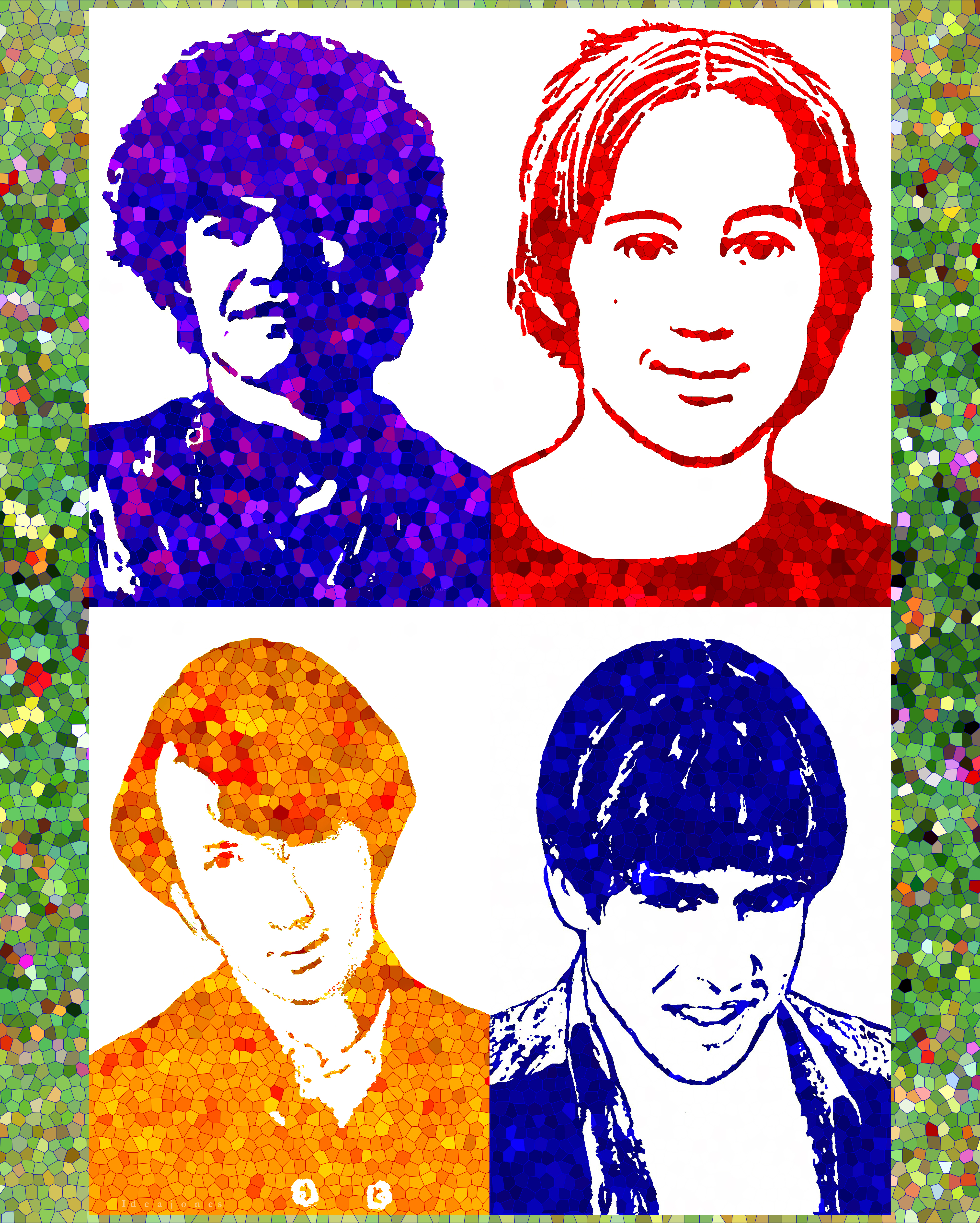
    stained-glass-monkees-2-ideajonesThis being the 50th anniversary of the launch of both The Monkees and Star Trek on tv, I’ve been enjoying the shows again and revisiting the music that surrounded me as a kid. It was like life had a soundtrack. There were radios on (and thankfully, not the booming bass we get subjected to now. It was just music, not an assault on the people around you) in the car, in the house. We had portable transistor radios that gave us tinny versions of the popular songs, portable record players (a big deal with the record player in the living room was a substantial piece of furniture)…  stores weren’t always full of Muzak warbling The Living Strings play Jimmy Hendricks Very Softly, but there was music almost everywhere you went.

    Listening to The Beach Boys, Chad & Jeremy, The Hollies, The Grass Roots, The Monkees, etc. takes me back to a very happy time in my life. I can smell the redwood trees and hear the ocean. For a moment, I’m riding my horse through a forest vibrating with life, singing along with the radio, young, strong and joyful.

    While I do get the need for people to express whatever they’re feeling, good or bad, love or anger, I realize now that whatever you listen to most often will be what brings back memories later. Had I listened to a lot of angry music back then, those would be the memories that would come back to me now. As it is, I just have to put on a certain song to be transported out of whatever is bothering me to a better moment, and I’m grateful for that.

    I was creating fan art for a while, using the projects as practice to improve my skills, posting them to amuse friends. I’m not doing it much any more, but I did create this to celebrate the wonderful, infectious pop music of the 60s. This is how that bouncy, fun music makes me feel. I think it’s fitting that this print is available on, among other things, a miniskirt.

  • Working Dark

    Working Dark

    Working with old photos is an art in itself.
    Working with old photos is an art in itself.

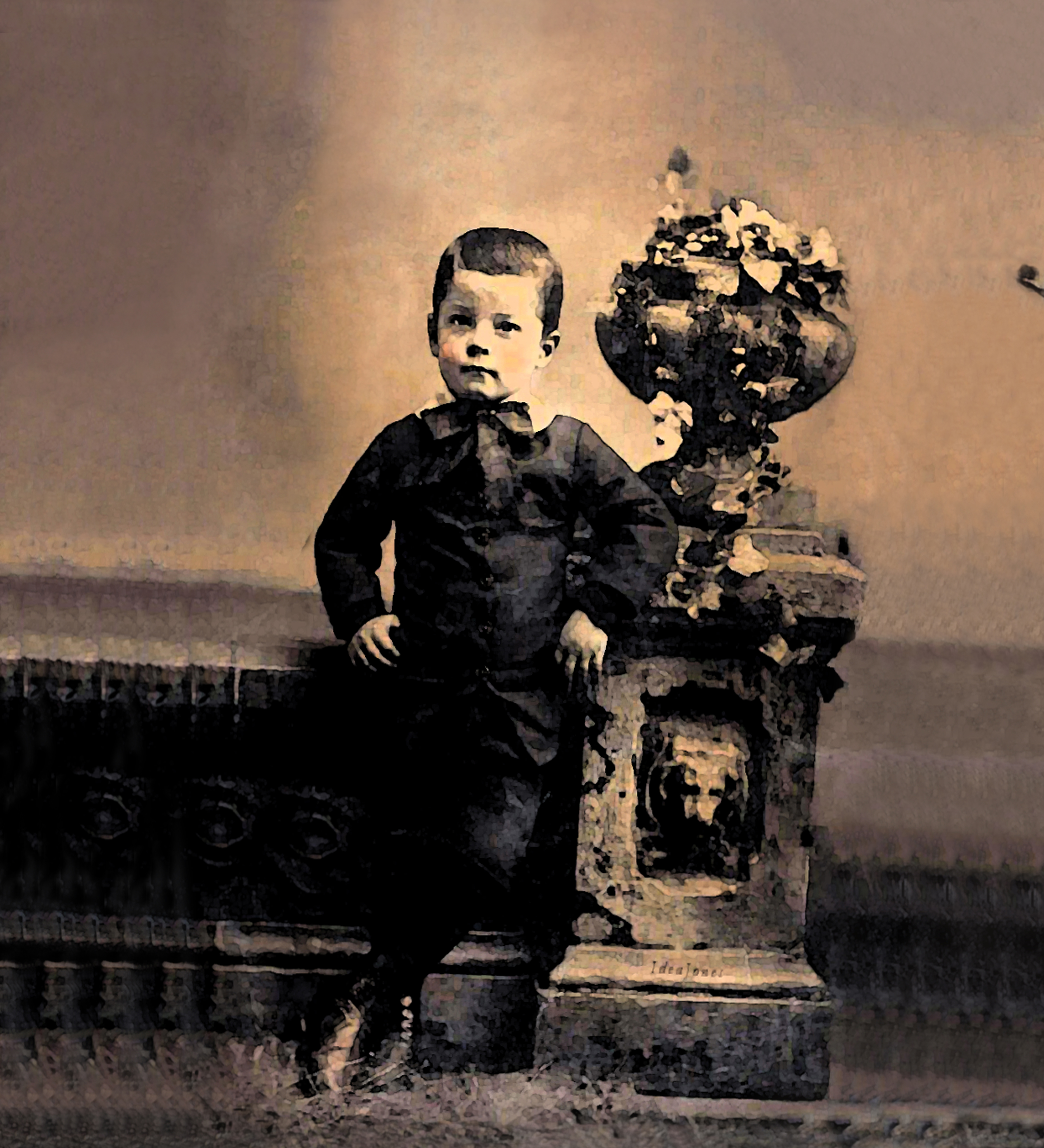
    I don’t usually create dark, moody artwork. Perhaps there are elements of “Simran: Altar of Memory” which are bittersweet, even sad (it’s about dementia, after all), but it’s not spooky. Recently, however, I decided to work with old tintypes and photos my grandmother gave me, and one in particular just seemed to pick up on the fact that it’ll be Halloween soon.

    This started with a scan of that old tintype. I work with old photos from time to time, healing scratches, brightening faded images. Working with this photo, I tried to heal some of the damage of time while only brightening it enough to reveal details. Once I did, I discovered details I wanted to emphasize, like the skull in the lower left. This might not have been a skull at the time the photo was taken, but when the image emerged in working with it, that became the theme of the picture, so I repeated it.

    That led to other repetitions. Ordinarily, I would smooth out the background, eliminating visual “stutter.” In this case, I cause the stutter. Patterns repeat in the background, in the setting, giving the photo a cluttered, neurotic feeling.

    When it felt like I’d reached that point, I turned it into a digital watercolor and continued painting, sometimes pixel by pixel. As I worked, I gave him a backstory. A brave boy, the son of parents who hunt the things that go bump in the night, he is comfortable in the graveyard, knowing his parents have banished evil and confident that one day, he will take his place beside them.

    His image is available in our IdeaJones Redbubble shop.

  • Healing the Old (Photo)

    Healing the Old (Photo)

    Mark visited a camera store the other day (we’re shopping around for a camera). While talking to the store’s owner about what we’re looking for, he mentioned that one of the things I do is work with old photos, including “healing,” improving faded, scratched images, and creating artwork based on that digital image. The man told Mark that working with old photos is a difficult skill to learn.

    It is. I’m still learning. And the first thing I learned is not to approach it as photography.

    Digital image manipulation has changed everything, and in a way, it’s brought us back to where we started.

    Before cameras, pictures and portraits had to be sketched or painted. Photography brought the ability to “capture” an image. To change it, you could change lighting, how the image is framed, how long it’s exposed, but for much of photography’s history, seeing was believing. Making composite images wasn’t easy and most didn’t look real. Before color photography took off, the most common way to add color was to physically paint on the photo. Retouching meant actual touching.

    But with digital photography, a picture ceases to be a photograph when it enters the computer.  Take a digital photo and increase the magnification until you can see the individual pixels. You’re seeing what the computer is telling you it sees. To the

    What seems to be one thing is a lot of other things, when it's a digital image.
    What seems to be one thing is a lot of other things, when it’s a digital image.

    computer, it’s not a photo — it’s data to be interpreted. Learning how the computer sees what you give it will help you figure out how to do what you want to do.

    To work with photographs digitally, you approach them… as paintings. Look at those pixels. When you back out and look at the whole image, that part may appear to be one color, but when you zoom in, it isn’t. Even “black and white” images contain dots of color in every digital photo I’ve worked with. If you need to heal a scratch, or change something, you have to put away what color you think it is. Look at the colors the computer sees. That’s what you’re working with.

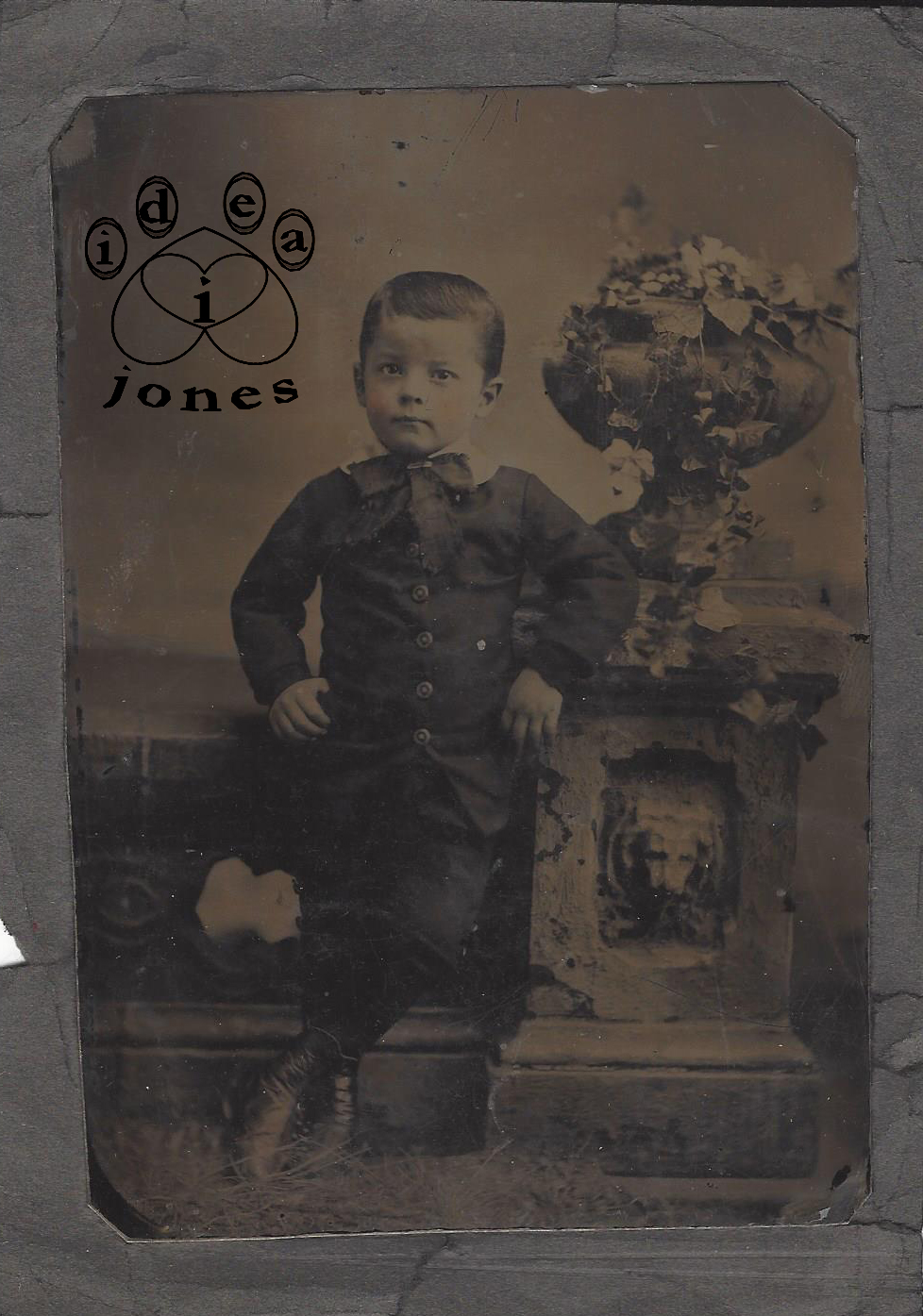
    This isn't in bad shape for a picture from the 1890s, but there's a lot of work to do.
    This isn’t in bad shape for a picture from the 1890s, but there’s a lot of work to do.

    This is a family photo taken around the turn of the last century. It’s one of the few not labeled, so I don’t have a name. I decided to turn it into a digital art project for our Redbubble shop. This wasn’t a straight-ahead healing of an old photo. I wanted to emphasize certain things and omit others to produce an effect. Still, the process started with healing a scratched, faded photo over 100 years old.

    It appears to be lighter and darker tones of one color (sepia), but if you look at that magnified sample from the original, you can see greens, yellows, even a rose tint.  When you’re healing scratches, brightening or manipulating the image, that’s what you’re working with.

    It seems obvious, but the first thing I learned about working with digital images is you have to work with what you have, not what you think you have.

    Save

  • How To Shovel Shit

    I considered a few different titles for this post, then it came to me, a picture of my worst summer job.

    Mom was a landscaper and avid gardener. For a time, she and my dad would buy old houses, rehabilitate them and sell them (it wasn’t called “flipping” yet. And flipping sounds so effortless. This was hard work for all three of us).

    Then Dad announced he had accepted a promotion and we were moving to Reno, NV. Reno has things to recommend it (the most beautiful sunsets I’ve seen), but it’s hardly a gardener’s paradise. My parents had a house built, about 45 minutes from downtown Reno (at the time — now I understand it’s more like 30). It wasn’t near anything, surrounded by semi-desert, scrubby manzanita bushes, tumbleweeds, sand and hard-packed dirt, miles of it. There was a lake of sorts, mostly quicksand. The nearest town was Stead, an abandoned military base.

    Mom couldn’t live without plants around her. She’d had no desire to move to Nevada. We were living in Scotts Valley near Santa Cruz, CA, an area so verdant that people said if you dropped a seed you’d better pick it up unless you wanted it to grow right there. Green everywhere, trees you often couldn’t see the tops of, wildflowers. Gardener’s heaven.

    But now we lived in a little patch of ranch-style houses with long dirt roads. There weren’t enough houses to make it worth anyone’s while to pave the streets at that time. The main road to highway 395 was paved, but everything else was dirt so hard it could have been concrete. There weren’t many homes when we lived there, and the ones that were there usually had tiny lawns watered frugally from wells (each house depended on its own well) and perhaps a few hardy flowers.

    Desperate for a garden, Mom undertook negotiations with the desert. She rented a big cultivator to break up the ground and began amending the soil, only it was more like reconstruction. We broke up clods with hoes and rakes and tilled in a long list of additions to add everything our soil didn’t have, which was everything.

    Then Mom found out the sewage treatment plant in Reno would let you have a truckload of composted sewage for little or nothing. We had a big pickup, used to pull a horse trailer, haul hay for our little herd of horses… now it became a sewage truck. Mom and Dad returned with a large load of black stuff that smelled, well… if you’ve ever run across a Porta-potty left in the hot sun for days, like that on steroids. It remains the worst smell I’ve ever run across (which is *not* a challenge, universe, just an observation).  Mom told me with a bright smile that I would “get” to help her put it in the garden and she’d even pay me (I had regular chores but didn’t get paid for those. I did get paid for “extra” work I did).  My going rate was 50 cents an hour, but when I turned down the job, this went to 75 cents an hour, her final offer.

    That summer, I filled wheelbarrows full of dark, stinky sludge, trundled it over to the area where the garden would be, scraped the sludge out and spread it with a rake, working it into the soil. Now, that probably isn’t allowed. It would be seen as a health hazard. But then, it was seen as a sensible way to dispose of waste material, by everyone but the ten-year-old girl with a bandanna tied over her nose and mouth, out in the sun trying to pull up enough dirt to mix with sewage to tamp down the smell.

    I’ve had other jobs I hated over the years, but none to compare with that one. Mom even kicked in a bonus for doing a good job. It wasn’t enough.

    But here’s what I learned:

    *if you leave shit lying around, it doesn’t get any better. It just becomes uglier, smellier shit.

    * Shit can’t be prettied up to smell like something else. If you put, say, peppermint extract on your bandanna, you will smell shit with a hint of mint. And the longer you leave it, the more aggressively shitlike it will smell.

    * It can be composted and used to fertilize something better, but turning it into something better will be hard, smelly work without an ounce of fun to be had. There’s no song you can sing, no game you can play with yourself, that will make dealing with shit enjoyable. But if you have shit, you have to deal with it.

    * If you don’t have to deal with it all at once, you have choices. You can elect to exhaust yourself and plow through to the end, excited about the day you no longer have to deal with this shit, or you can do a bit at a time and reward yourself for dealing with the shit, knowing it’ll take longer but be less tiring.

    This has served me well over the years. While it’s true I don’t have to rake poop (if you don’t count picking up after the dogs) now, life just contains a certain amount of shit. It’s part of the natural process. Ranting against it doesn’t change that. Grab your shovel.

    Shit you deal with becomes fertilizer. Shit you don’t deal with becomes lower-grade, more disgusting shit.

    A friend once told me that people can’t bear feeling helpless. Causes anxiety and any number of problems. But if you find something you can do about the situation, however small, it eases your tension. So when you’re standing out in the yard in your beat-up sneakers, the ones you are going to throw away as soon as you can, holding your rake, watching that truck pull up, don’t look at the truck. Don’t think about how much it holds. Move one wheelbarrow full of shit and decide if you want to move another right away when you’re done with that one. But move that one wheelbarrow full of shit.

    Because every life contains a certain amount of shit, and it isn’t going to be fertilizer unless you use it.