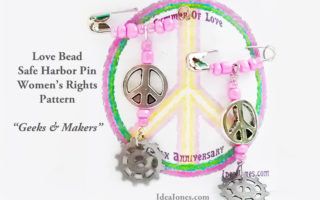
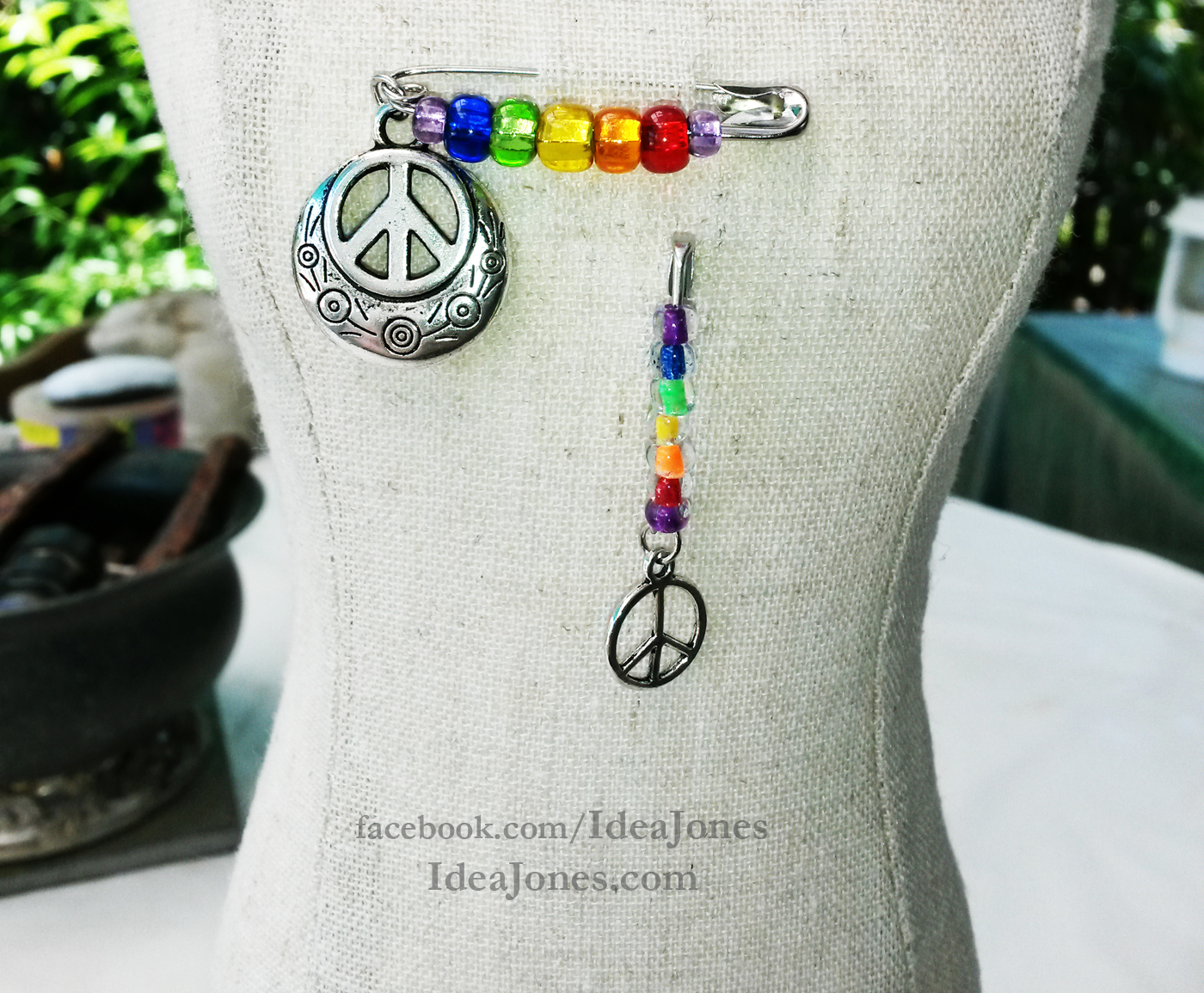
Love Bead Safe Harbor Pin set honoring “girl geeks” and “maker mamas!”
The big push is done (the large-scale pin giveaways) after three cities, but LBSHPP is far from over. Here’s what’s in the works (so far):
A free workshop at a charity in Sacramento. Date and time TBA, but probably in July;
Pins for Progress, a fundraiser. We’ll be offering sets of pins in our Etsy shop (which is under construction right now). You can buy a set of pins *and* make a donation to charity! Each pin set will be $10, with 25% being split between Opening Doors, a charity helping refugees resettle in their new homes, and Mustard Seed School, helping kids from homeless families. One note — we can ship up to 8 sets in one envelope for one shipping price ($5 in the USA, message for the shipping rates outside the US) and more in a box (message for shipping rate). Date TBA, but within the next few weeks;
A video showing how to make your own set of pins. Date TBA, probably by the end of the summer;
We’ll continue to carry a few sets with us, so if you meet us, ask for a set of pins!
In the first phase of the project, we gave away over 1,000 pins (wow… it became larger than I ever expected), but the project was largely self-funded, so we had to look at how we could continue. This way, we can keep helping others and spreading the word!
If you’re new to the Love Bead Safe Harbor Pin and you see one “in the wild,” on someone on the street, in a restaurant, at school, at work, or any of the places you might find cool people, you might wonder if there’s any significance to the color, or the charm hanging from the pin. The answer? Sometimes yes, sometimes no.
The safety pin is what makes it a “safe harbor” pin. So no matter the color or decoration, it’s still a Safe Harbor Pin. The rest is about standing up for a special cause that is close to your heart. It doesn’t mean you don’t care about anything else, just that this particular cause is one you’re especially passionate about, or is especially relevant to your life, or in the lives of people you know.
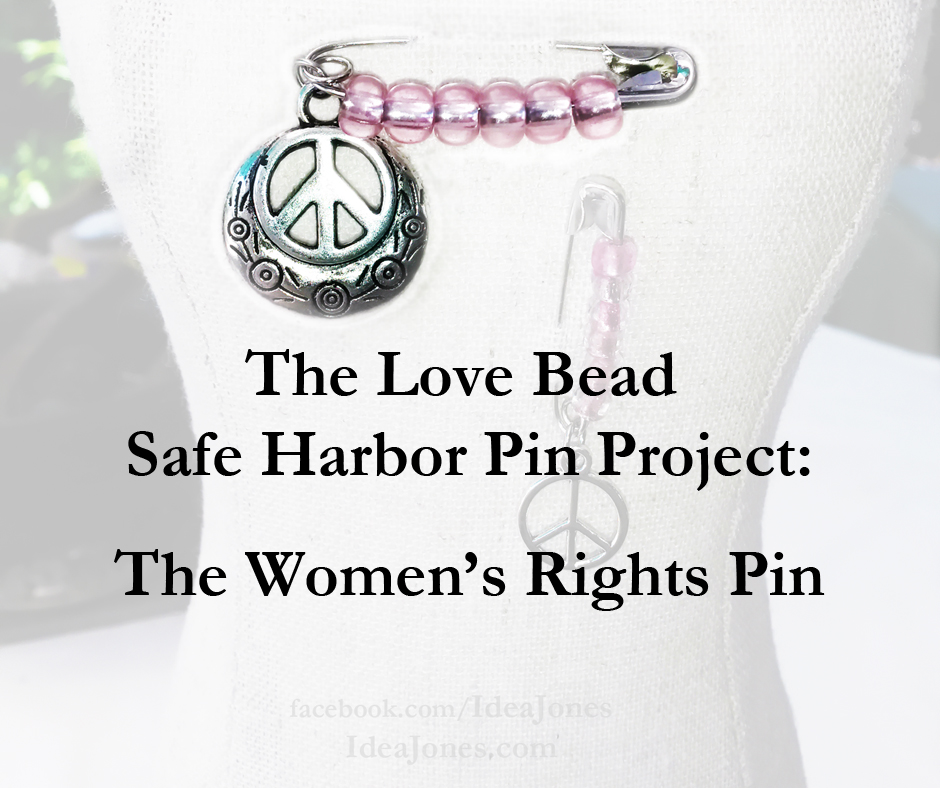
The Women’s Rights Pin:
I’ve really never understood why some people think being a feminist is a bad thing. I keep hearing women say, “Oh, I’m not a feminist!,” as though to assure other people they aren’t dangerous, or contagious. One day, I engaged a young woman in conversation, just asking what it was about feminism she didn’t like. This was only a couple of years ago, mind you. She said something like, “Well, I like men!”
I nodded. “So do I, the nice ones, anyway.” I asked her if she thought people should be paid for doing the same work, about as well. “Sure!” But, I protested, men have to support families. Women don’t. “What?,” she protested. “There are a lot of women who have kids and aren’t married, you know.” Yes, I admitted, I suppose that’s true. But what about child care? Women should be home taking care of their kids, right? “Most women can’t,” she said. “They have to work.” And some might want to work, I added. “Right.” But it doesn’t matter much what child care you use or how expensive it is. She looked at me like I was nuts. I had to laugh. “You’re a feminist,” I told her.
She really didn’t know. You might think everyone knows this stuff by now, but a lot of people don’t. They don’t know that at its base, feminism is about women being treated not like men, but on an equal basis with men. That how you are treated and what your options are shouldn’t be determined by your gender, whether you are male or female, in your personal or your professional life. The only two jobs I can think of that are gender-specific are sperm donor and surrogate mother.
There are, however, problems that are either unique to one gender or the other, or far more common for one gender or the other. You are far, far more likely to be raped if you’re female, for example. Breast cancer can hit either sex but is more common in women. Ovarian cancer? Women, obviously. So while feminism is really for any reasonable person, there are a few “women’s issues.” Women still lag behind men in pay for the same jobs, and you can debate how much the disparity is, but that’s not the important issue. It’s that women are paid less, not how much less.
Health care? An issue for everyone, but there are certain things that strike women more. Lack of access to contraceptives. Prenatal care. Lack of access to screenings like pap smears and mammograms that can catch disease when it’s early and treatable. By the way… Planned Parenthood? Its most common services, by far, are health checks for women who either can’t afford or don’t have access to other sources of health care. So defunding Planned Parenthood sentences a lot of women with low incomes to illness and death.
Rape? Do I even need to spell this one out, with the slap-on-the-wrist trial of a college athlete who dragged an unconscious woman behind a dumpster and raped her fresh in our minds? Yep, “She was asking for it because she (went there at all/wore what she was wearing/danced/you name it)” is still alive and well. Women are being held accountable for men’s choices. If I said, “I bashed him on the head, but it’s his fault because he walked past me dressed (fill in the blank) and he had a head,” I’d be sent to jail so fast my own head would spin. But rape kits expire untested and judges give offensively mild sentences and the justification is always that the victim was responsible for the choices of her attacker.
Child care? Women still get tasked with the bulk of the responsibility for child care, but this is an issue everybody can rally around . For most women, not working isn’t an option. The family needs their income. So access to affordable, quality child care is an issue that hits women, men, children, employers, everyone. Remember, we will live in the world those kids run. We need them sane, healthy, educated and safe. Employers need those women on the job, not taking off work because they can’t find child care. Any man worth the name wants his kids safe and healthy. Even if you don’t have kids, you can get behind this one.
Childhood education and nutrition? Another “everybody in/everybody wins” issue. We will grow old in the world that these kids will grow up to run. And once they reach young adulthood, our economy will count on them being employable, and employed. Which means we all need those kids educated, healthy and ready to work. Think you don’t need to worry about this because you have no kids, or you have money so your kids are okay? What planet will you be living on where you don’t need other people to do things? When I’m older, I want to be surrounded by people who are educated, healthy, employed and don’t have any reason to clobber me and steal my purse.
There’s probably at least one issue on that list that you can get behind, which would make you… take a deep breath… a feminist.
That’s why we have a “Women’s Rights” pin. So women and men who really do like women (not just want them) can say that they believe a woman’s life is as valuable as a man’s, and women shouldn’t suffer or be penalized for being female. Sounds pretty “Well, duh, of course!,” but it’s still a problem.
Back when I was a Girl Scout, I volunteered to pull the wagon full of cookie boxes if the other girl would ring doorbells and ask people to buy cookies. I like people, but I’m an introvert, and shy. Talk to lots of strangers? I’d rather step in front of a bus.
There’s this feeling, and I’ve certainly had it, that we should wait to do things until we “feel like it.” It’s not yet the time, goes that thinking, until the motivation is stronger than any reluctance we might feel.
A good friend once listened patiently as I listed all the reasons I could think of not to start a project, including how unready and nervous I felt. When I ran out of excuses, she interrupted me before I could run through the list again and said, “You’re scared? So, do it scared.”
That seemed too simple. Surely the answer was more complicated. “If it’s important,” she told me, “then it’s important enough to do it. If it’s not important enough to do it, the fear doesn’t matter. How important is this to you?”
I proceeded and the project went, if not perfectly, very well. During the project, I was nervous, elated, scared, excited, all at once. After, I was very happy I’d done it. There are no guarantees — it might have gone down in flames — but I was proud of myself for tackling something I felt strongly about.
It’s hard to explain to an extrovert, and more people are extroverts than introverts, how big a deal it is for an introvert, and a shy person, to talk to almost 600 people, even though 91% of them were receptive, everything from mildly pleased to very enthusiastic. There is not one person I met through this project who I am not glad I met. I got to meet almost 500 intelligent, openminded, caring people (and my assistant got to meet 20-30 others). If you are one of the people we gave Love Bead Safe Harbor Pins to, know that there are no words to say how happy I am that we met, or grateful I am that you listened to me, considered what I said, and decided to make your public commitment to the dignity of all human beings, even those you might not understand or approve of.
But it never did get easier, approaching strangers. Every time, I had to nerve myself to speak to people. Each encounter, I did it scared. I’m so glad I didn’t wait until I felt like it.
If there’s something you want to do, or create, and it’s important to you, don’t wait until you “feel like it.” If it’s really important to you, get moving, even if just the initial planning stage that will eventually bring your idea to fruition. Pat was right, all those years ago. If you need to do it, do it scared.
The basic idea behind the Love Bead Safe Harbor Pin Project
In November of 2016, I found myself increasingly distressed by the tone of civic life, not just in America, but around the world. There was a new level of just plain, low-down meanness. Name calling, threats… it seemed as though humanity, as a species, was bent on finding out what’s lower than living in the gutter.
I heard from people who were being threatened, or attacked, for some perceived difference. Some way they were perceived as being strange, or not fitting in. It’s not like the abusers were taking time to get to know people and then finding them objectionable. No, this was surface stuff. A way of dressing, the sound of a voice, skin color. Based on just that, the attackers decided they knew who those people were and what that meant.
About that time, I found out about the “Safe Harbor” pin, a plain safety pin worn to signal that you are safe to approach, that you won’t abuse or attack someone else. The idea came from Great Britain. I began wearing a safety pin. It wasn’t something I thought through deeply. It just felt right.
Soon after, reports started surfacing of people who self-identified as “white supremacists” wearing plain safety pins, and a few people objected to the idea of the “safe harbor” pin. The first were, perhaps, trying to co-opt the safe harbor symbol and turn it. The second objected because, they said, wearing a safe harbor pin was (and I’m paraphrasing here), a way for white people to feel good about themselves without doing anything about the problems facing society.
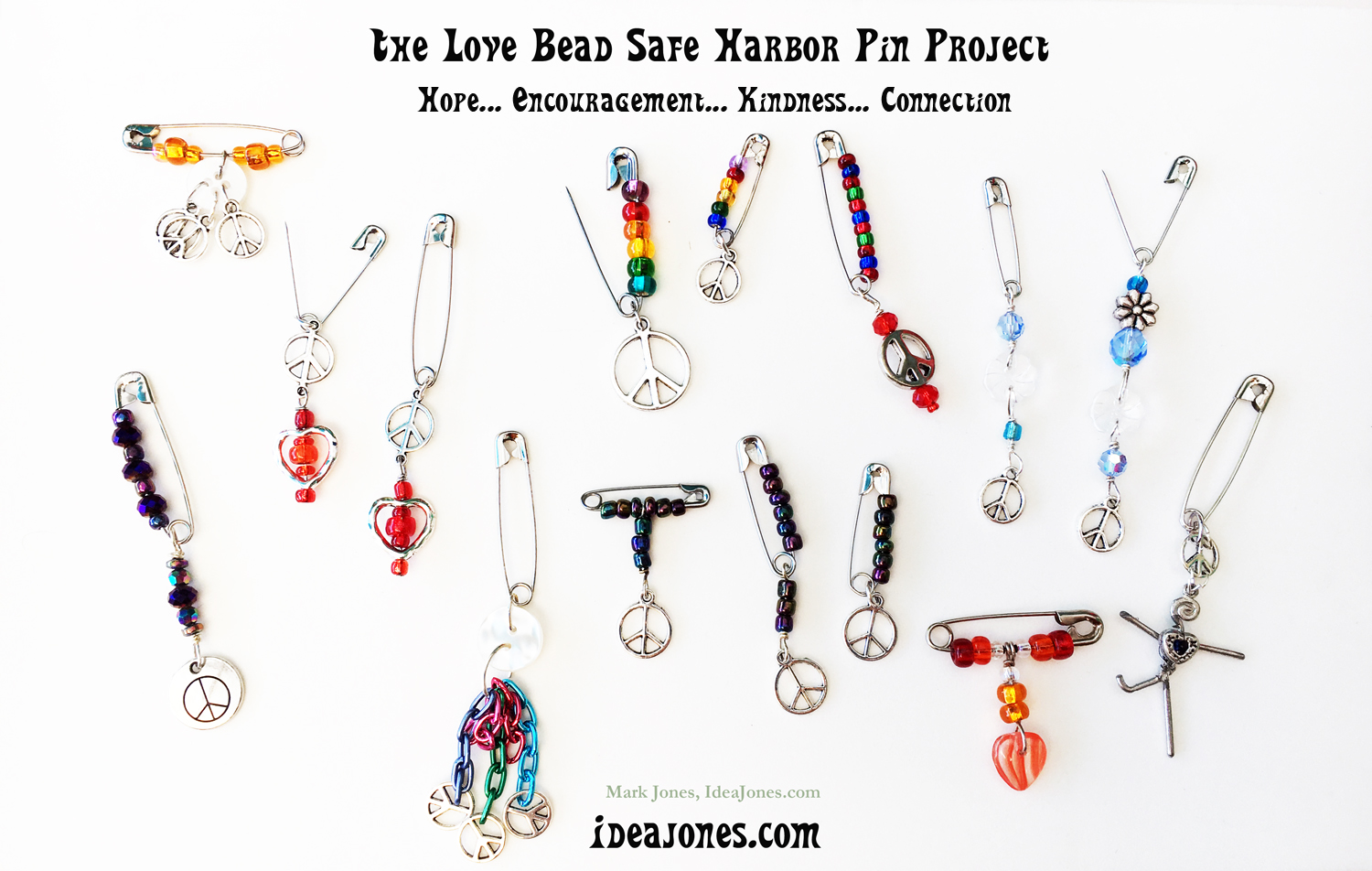
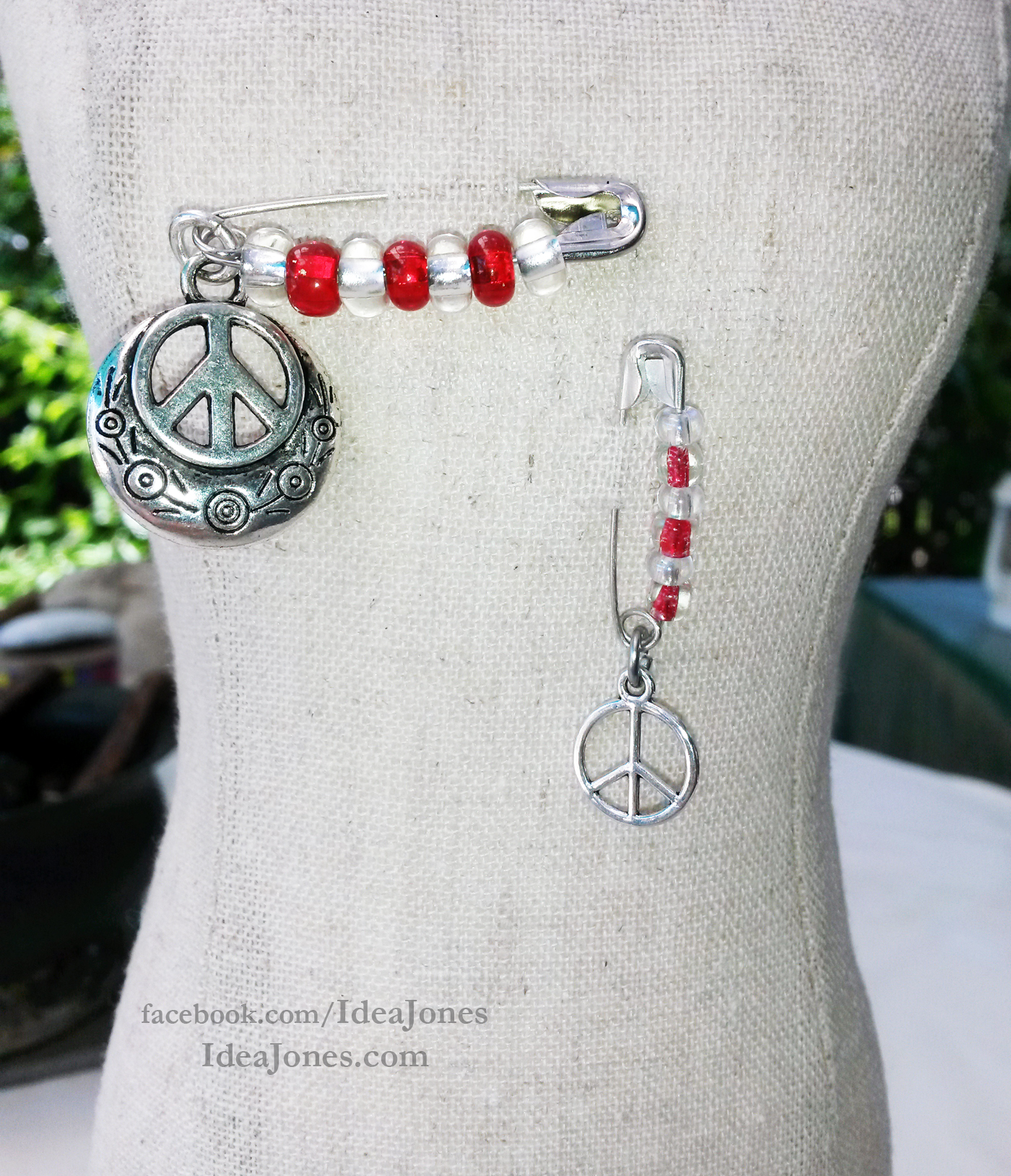
To resist the co-opting of the symbol, I started decorating my pin, making it more flashy, not the sort of thing your average white supremacist would be comfortable with. I started beading my pins, either adopting color patterns already associated with certain causes (like the rainbow pin for LGBTQI rights), or assigning a meaning to a pattern (like the red and white pin showing a commitment to health care for all).
Before going on, let’s address the second issue, that the pin is “just” a symbol. No symbol, on its own, solves a problem, yet human beings seem to need them. We’re always creating symbols. It’s a shorthand for an idea, and using that symbol is a way to remind yourself that you are committed to it, and to tell others that you think it’s important. I have been told by people wearing Love Bead Safe Harbor Pins that when they have them on, it alters their interactions with other people. They’re more cognizant of the choices they make. That, I believe, is a good thing.
As I wore my pin, other people admired it and asked where they could get one. I started making extras, carrying them around and giving them to people who admired my pin. As I did, I explained briefly the significance of the pin and started using the term “radical respect” to explain the idea that we have the choice to treat other people, even people we disagree with, or don’t understand, or disapprove of, with respect. That we can respect our common humanity.
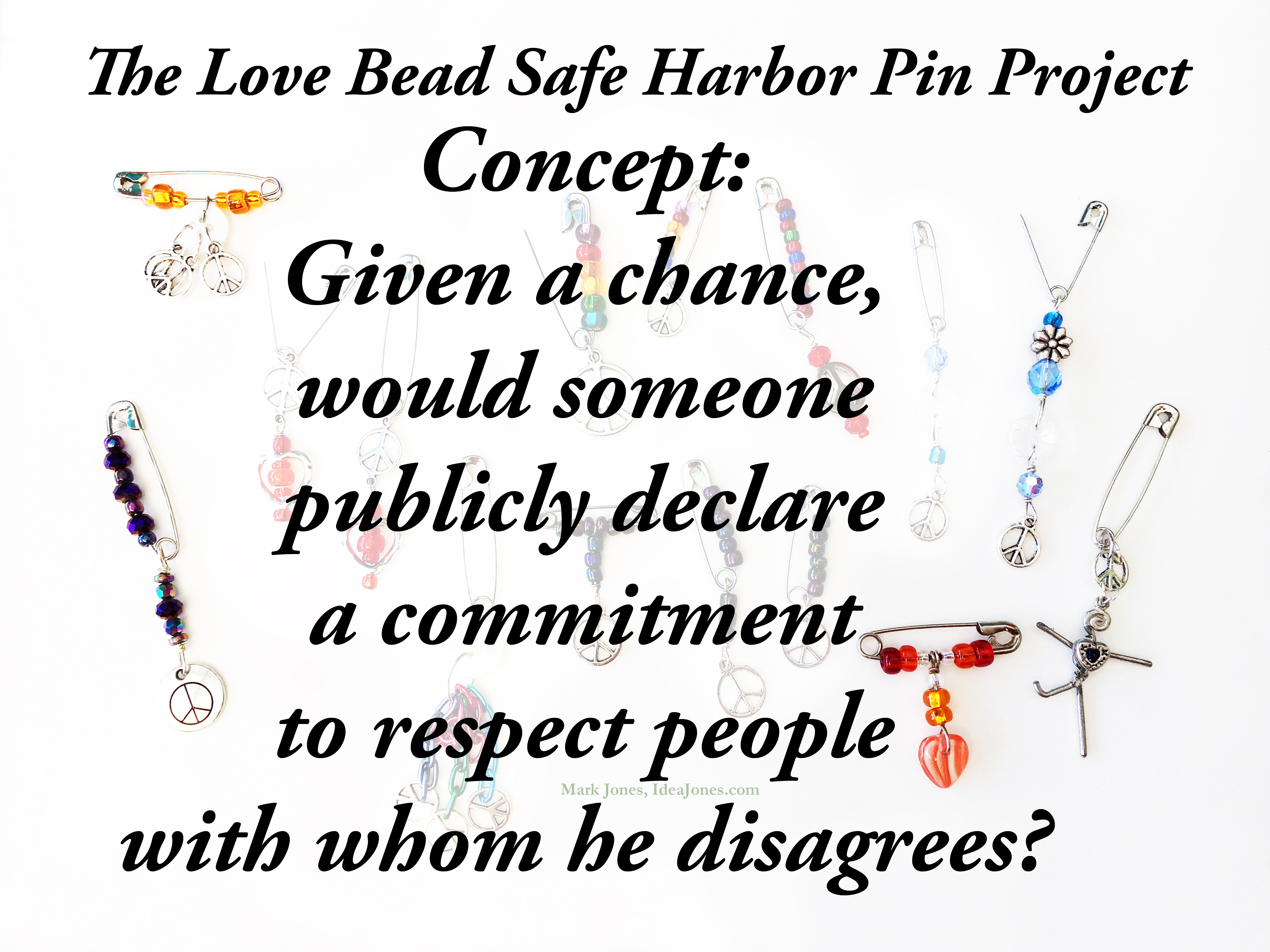
The more I talked to people, the clearer the idea became. Given a chance, would people choose to publicly avow a belief that all people should be treated with respect?
Looking at the conversations I was having, I realized that the pin was a means to talking about these ideas and making them conscious choices. If I simply approached someone and asked him to publicly declare his commitment to treating people with respect, most people would probably decline, if they even let me finish the thought. But I saw that offering that little keepsake, that beaded pin, gave people the opportunity to make a conscious choice. At a pin giveaway, here are the choices:
Make eye contact or don’t. If someone avoids eye contact, I let him walk by;
Talk to me or don’t. If I start to offer a pin and the person indicates he doesn’t want to talk, I let him pass;
Listen to me or don’t. A few people will cut me off mid-sentence and leave, or dispute the basic idea (the “yeah, but” reaction);
Accept a pin, or don’t. At this point, the pin has a meaning attached to it already (“Wearing it or keeping it where you can see it represents your belief that all people, even people you may disagree with, not understand, or disapprove of, should be treated with respect.”). To accept the set at this point is to accept the philosophy. Because you are offered the pin, and the philosophy, in a public place, acceptance is a public statement;
Choose a basic Safe Harbor Pin, or choose one with a secondary meaning (support for women’s rights, for example, or support for access to health care);
Wear the pin, or don’t. What you do with the pin is another point of choice. Those who strongly agree are most likely to wear the pin (sometimes putting it on at that moment);
Share the second pin on the card, or don’t. I’ve seen people do it right away, or state to whom they intend to give the second pin.
Via that little pin, people are given a way to make a conscious choice, affirm that choice, and even advocate for their belief.
While a couple of people contacted me online and volunteered to contribute to the cost of the materials for the pins, when I give away pins in person, I do not solicit donations, nor do I accept them. It’s important to me that it is free to the recipient. It is presented as a gift. If someone offers me money in person, I urge him to contribute that money to a cause or charity he supports.
In total, we gave away 510 sets of pins in three cities (or 1,020 pins).
Over and over, I’ve talked with people who get very energized and enthusiastic, far more than the offer of a free beaded safety pin can account for. Having talked to hundreds of people and watched them react, it seems to be the idea they get excited about, that we can consciously choose how to treat people, and that those choices say something about the people we decide to be. In a couple of minutes, they are presented with that information (by being presented with the chance to consciously choose), and a symbol of the decision they made.
I’ve had people say they like “having a name for it.” As one woman explained, “having a name for the idea makes it easier to talk about.” Another said that having the symbol helped her talk about the ideas behind it as she could show the pin and explain what it is as a way to start.
My mother used to say that people will rise to your expectations, or fall to them. Certainly that’s been my experience in this project. Given a simple keepsake as a symbol, many people will confirm for themselves and the people around them that they aspire to ask more of themselves.
Which is a very hopeful thing.
I’m grateful to have been present when they made that choice. To everyone who chose to take a set of pins, thank you for letting me be part of that moment. May you be blessed and may you enjoy the pride you justifiably feel. It seemed like a brief moment and a small thing, but it was big.
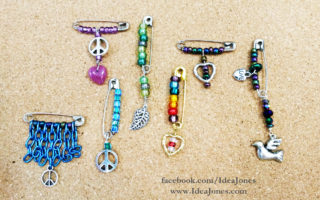
Secondary meaning came via the color pattern. Shown here: women’s rights, environmantalism, LGBTQI rights and Civil Rights & Social Justice.The “Access To Health Care” PinThe “LGBTQI Rights” PinThe “Women’s Rights” Pin
This was one of those that was both not as good as I expected, and much, much better.
Because The De Young Museum is running a “summer of love” – themed exhibition, I thought this would be a great place to offer Love Bead Safe Harbor Pins. People would be there to see an art exhibit with a similar theme. The packaging had a peace sign on it, after all,and we brought the project to San Francisco in connection with the 50th anniversary of the Summer of Love, so it sounded like a perfect match.
I even contacted the De Young, or tried to. I sent a couple of emails that were never even acknowledged. Having gotten permission from the police department, the arts commission and the parks commission, I was on solid ground to give pins away in Golden Gate Park. I couldn’t advertise it (or the appearances in Mission Dolores Park), but I could do it.
Grabbing my crutches and bag of pins, I took my place on the sidewalk. Attendance was very light, so often I simply stood, looking around . Among the people who did pass by, many did exactly that — pass by. If someone doesn’t make eye contact, I let him walk by.He’s self-selecting to not be included by not agreeing to that initial contact. If someone pretends he doesn’t see me, I let him. Also, if someone does make eye contact but won’t listen, I let him pass. It doesn’t seem to fit the idea of promoting respect by not respecting that person’s right to refuse contact.
A few people were so uncomfortable with my attempt to make minimal contact that they cringed. So I stared into my pin bag, shuffling the contents (this reduces their tension, as though the eye contact was accidental so it’s okay to ignore it). A number of people I encountered at the De Young fit this category. If you were watching me, you would have seen me staring into a bag about a fifth of the time I was there.
Of the people who did tacitly agree to make contact, most of those took pins. A couple listened politely to my explanation then refused to take a pin, but of those, one told me she agrees with the whole idea but doesn’t wear any jewelry. Another said she agrees with everything I said but didn’t want a pin. I thanked them each for their time.
A group of people gathered near me. I overheard them speaking in French and debated approaching them as I had one year of French in junior high, from a teacher who wasn’t much interested in teaching French. I can say “hello” and ask where to find “the room of the bath,” but that’s about it. My French, such as it is, is a collection of disconnected phrases, “la salle de bain,” “encroyable,” “oui et non,” “la plume de ma tante est sur le bureau de mon oncle,” that sort of thing. Only one other sentence sticks in my mind, “Je suis enerve,” which I think means (approximately), “I am tired.” Also, I have a few of the lyrics of the song “La Vie En Rose” stuck in my head.
So my command of French is more of a weak suggestion. Then it occurred to me that the guide had to be bilingual to navigate the city. When he seemed to be done, I approached and asked if I could offer his group Love Bead Safe Harbor Pins.
This began a back-and-forth between me, the guide, and the group. I explained the project and offered the pins, stressing that they are free. “Free?” Yes, I explained, free, gratis, no charge…
He explained to the group. I was just able to follow enough of what he said to know his interpretation was quite close to mine. The members of the group murmured amongst themselves. One person said, “C’est merveilleux!” I laughed, and had to explain that I was laughing as this is one of the few French phrases I understand completely (“It’s marvelous!”).
Someone asked, “What group do you represent?” I explained that I’m an independent artist. We continued to converse through the guide. Someone wanted to know how I came to do this project. Another person asked what my inspiration was. Was this my usual artistic style and medium? Could we discuss the meanings of the various colors and patterns?
After we finished and everyone who wanted pins had selected a set, a lovely woman approached and hesitantly pantomimed a wish to hug me, which I agreed to. Solemnly, she kissed me on one cheek, then the other, her hands on my shoulders. She said something to a member of the group, who translated, “She says this is very important.” Another asked to have her picture taken with me and I consented. As I wished them a good day and turned to go, a woman said something to her companion, who laughed a bit awkwardly. I looked a question at them and her companion said, “She said… it’s not polite… she said she never expected to see an American doing something like this.”
I had to laugh — so they did. We wished each other well and I moved on to talk to a couple nearby.
Later, I saw two of the members of the group and felt bad — I didn’t recognize them away from the group! It’s hard when you meet a lot of people in a short time. They looked familiar but I couldn’t be sure, so I offered them pins… and found out they already had them. I tried to explain, but I’m not sure they understood.
I spoke with an interesting woman who was a young girl in San Francisco during the Summer of Love. We talked about the atmosphere then, and the project, and her experiences at the time. I also gave pins to (among others) a couple celebrating their 50th wedding anniversary (they married in San Francisco during the Summer of Love), a young couple from Korea who were, I think, on a date, some parents with small children who talked about trying to raise kids who are kind people while giving them the kind of wariness of strangers they need to survive (not easy, I’m sure, and partially why I don’t approach anyone who seems to be younger than 15 who doesn’t seem to be with an adult)…
One person I approached was a woman seated on a bench who had been watching me for some time. As I approached, she said, “I’ve heard it. I’ll take a pin, but I don’t think talking is going to do anything.” We chatted a bit about the idea that talking is central to doing anything much… we need the cooperation of other people. At last, she admitted she was feeling particularly downhearted that day, which I understand. Current events can seem overwhelming, no matter what your beliefs may be, and a part of what seems so disheartening is a perception that people can’t talk to each other any more, especially if they disagree.
Here’s the thing — we all disagree about something with every person we know. It may be a small thing. Should the toilet paper hang over the roll, or under?” It might be a big thing. But we disagree with every person about something. Sometimes I disagree with myself — I’m not sure what the answer is. So if I don’t talk to people I don’t agree with, I won’t even be able to talk to myself!
My husband met a different tour group and they accepted pins, as did the driver. A couple from England took a set for themselves and a set for their granddaughters. Another couple asked for a set each so they could give the second pins to their daughters.
One couple enthusiastically selected pins, and the man held out some five dollar bills. “It’s free,” I repeated.
“But I want to help,” he said. “I want to do something!”
“I really appreciate that,” I said, “but I don’t ask for or accept donations when I’m giving away pins. Take that money and donate it to a charity or cause you believe in.”
The woman with him said, “We could give it to the museum! We’re just about to go in!”
“That would be a great choice,” I told them. “Thank you!”
They went off toward the museum, money at the ready. I hope they followed through on it. I get that reaction a few times a day when distributing pins, and I tell everyone the same thing.
Which reminds me — I’ll be creating some very special pins soon, and those will be offered for sale, with part of the money going to charities helping people in need (like Opening Doors and Mustard Seed School). I’ll post when those are available.
And if we meet, ask for a set of pins. I’ll always try to keep a few on me.